VGM Entry 02: Early arcade music
(Thanks to Tish at FFShrine for the banner)
Few early games had music mainly because they were better off without it. The music of Rally-X was certainly an enhancement to the gameplay, but if it really showcases the best technology of the day then it’s easy to understand why most programmers didn’t bother. New technology came fast though, and Rally-X was hopelessly outdated in a matter of months. Carnival (Sega, 1980) is often credited as the first game to employ any of the new and improved sound chips for continuous music, but this claim amounts to little. All of the arcade developers took advantage of the advancements as quickly as they were able.
That’s why you get games like New Rally-X (Namco, February 1981), released less than a year after the original. Video game music immediately emerged in fully developed form the moment it became an option; it didn’t really take any market research to recognize that this would enhance the product.
From 1981 on, arcade music sounded pretty decent. Certainly a lot of games suffered from bad compositions, but many did try, and the work here becomes a simple matter of listening to everything and picking out the best. Arcade games had a unique advantage in this regard. Being self-contained systems, every new game had the opportunity to employ the newest technology on the market. This was seldom the case with computer games, and never the case on home consoles. A pretty massive disparity in sound quality would continue to distinguish arcade music from all of the competition up through the end of the 1980s, when the arcade began to die out as a viable source of revenue for game producers.
The indisputable king of arcade music was Taito. They backed up their claim to being the first, with Space Invaders in 1978, by maintaining a higher standard of quality than most of the competition. Jungle King (1982) is one of my favorite early examples. Here the music isn’t just a nice added feature; it’s the game’s entire selling point. The player feels compelled to keep moving, driven by a sense of urgency and adventure that would be completely absent otherwise. The sound effects make an effort to acknowledge the music’s dominance, seldom clashing and, with the hero’s footsteps on the rock-dodging stage, even roughly synching up to add another layer of depth to the music.
Jungle King has kind of a funny history. The form you are seeing here never made it far out the door before the estate of Edgar Rice Burroughs won a lawsuit for copyright infringement on Tarzan. Having already tossed out a beta version called Jungle Boy, Taito recouped their losses by replacing the Tarzan character with a creepy explorer in a pith helmet and safari outfit and retitled the game Jungle Hunt. Never really satisfied with this conversion, they went back to the drawing board again after the release, replacing the explorer with a pirate. Pirate Pete became the forth and final installment of the game, featuring new graphics and a new soundtrack but the same old mechanics.
Konami may have been Taito’s driving force, persistently one-upping them. Gyruss (Konami, 1983) is a real audio masterpiece. Rally-X and Space Invaders both had tonal sound effects, and in the latter ‘sound effects’ and ‘music’ were one and the same entity. Gyruss might be seen as a sort of climax to this trend of music-sound effects-gameplay synthesis.
J. S. Bach’s Toccata and Fugue in D minor, BWV 565, might seem like an odd choice at first glance, but it had recently been converted into a rock and roll hit by the U.K. band Sky, so it certainly had some pop culture appeal. The significance here though is how well the game is paced to the music, or vice versa. Enemies appear almost on cue, and every sound effect is perfectly attuned to the background music. Really, to call it ‘background music’ at all does it a disservice. Gyruss has a very distinct song, but though the music and sound effects can be easily separated, in practice they are essentially indistinguishable.
What’s most impressive to me is that I really doubt the synthesis is programmed. It would become common enough in the future to sync up music to game events fluidly (consider the added music layer in Super Mario World when you mount Yoshi) and vice versa (the Guitar Hero series and many other games like it are based around the concept), but that’s all written into the code. In Gyruss the cues are apparent, not encoded reality. It tricks our senses, like a fine painting, and indeed it should be regarded as an interactive audiovisual work of art.
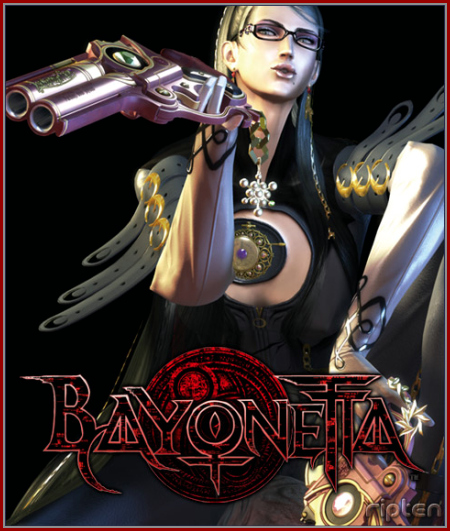
Hideki Kamiya is a name well-regarded by hardcore gamers everywhere. He was the man responsible for giving gamers the iconic action game series, Devil May Cry. The series lasted through four games and released to three different console systems (PS2, PS3, Xbox 360/Windows PC) and was seen by many gamers as one action series on par with Tomonobu Itagaki’s equally iconic franchise, Ninja Gaiden. In 2007, Platinum Games made an announcement about a game being directed by one of its founders (who happens to be Hideki Kamiya himself) that would make it’s way exclusively to the Xbox 360, but which in months ahead would get a PS3 port by way of the game’s publisher, SEGA. This game would turn out to be Bayonetta and looks to be the spiritual successor of Kamiya’s previous franchise, Devil May Cry.
The game received much buzz and fanfare from many gaming sites and bloggers. This was a game that would be a continuation of what Hideki Kamiya was doing with Devil May Cry over at the now-defunct Clover Studios at Capcom. With no news of another installment to the DMC series in the offing it was now up to Bayonetta to satisfy action game junkies the world over. Using the provocative titular character as a selling point for the game, Platinum Games’ was able to keep the title in the public’s consciousness but not so much that oversaturation would set in to create a backlash against a game that wasn’t even out yet when the middle part of 2009 rolled around.
After a couple of release date delays it is now January 2010 and the game has finally been released to both current generation console system in the Xbox 360 and the PS3. The game has turned out just as advertised and promised by Kamiya and his Platinum Games team. It is an action-packed title eerily reminiscent of Devil May Cry both in its presentation and it’s extremely fast gameplay. With Bayonetta developed independently of the much larger and previous employer of Kamiya and his team, the game uses the well-used over-the-top storyline and characters from DMC and adds a very oversexualized sheen to everything from Bayonetta herself to some of the many bosses and cutscenes in the game.
The game’s storyline takes place in a recognizable, albeit alternate Earth, where two clans of witches (the Umbra Witches and the Lumen Sages — Dark and Light respectively) have kept the world’s divine balance in check through the centuries. Using the prologue (and tutorial chapter) to explain some of the particulars as to what caused the destruction of both clans, the player learns some of the mystery behind the character of Bayonetta. She herself is one of the last remaining Umbran Witches who also happens to have forgotten her past as one. All she knows is that she acts as a sort of indepedent contractor for the daemonic side of the equation and hunts and kills the many angels sent by Heaven after her. The rest of the game is Bayonetta’s quest to learn more about her lost memories and to solve the puzzle of why Heaven is after her. Along the way much violence and mayhem ensues with her in the center and all of it heavily tinged with some of the mose provocative cutscenes, camera angles and dialogue outside of Japanese eroge‘s and dating sim games.
The gameplay is easy to pick up with the Y-button and the B-button on the Xbox 360 controller providing both punch and kick attacks respectively. The A-button is where the jump command is mapped to with the X-button relegated to action commands when not in combat and firing a simple pistol when in one. Players who are usually just button-mashers should be able to pull off tons of combos just randomly pressing all four buttons every which way but loose. True action game experts have access to pretty much all the combos in the game right from the beginning and will have a time of their life mastering and chaining all of them to try and get the best combo score in the several Verses which make up the sections in each Chapter (Stage) of the game. It’s pulling off these combos which fills Bayonetta’s magic meter and when full she can pull off the myriad of special finishing moves called Torture Attacks. These attacks are some of the more bizarre and inventive gameplay actions Platinum Games have brought to the action game genre. One Torture Attack has Bayonetta drop an Iron Maiden device behind her target which she then kicks repeatedly until they fly back into the device before it slams shut to kill them.
The one aspect of the combat mechanics in Bayonetta that helps both newbie and hardcore gamers alike is the addition of the “Witch Time Dodge” that could pulled off with the simple pull of the right trigger on the Xbox 360 controller. When a player pulls the right trigger (to dodge an attack)and successfully dodges an enemy who is about to land a blow the gameplay will purposely slowdown and the screen enter a purple-hazed time-delayed moment. It is in this moment which lasts between 5-10 seconds depending on the level of enemy being dodge that a player stays in regular speed while everything else on the screen stands still. This will allow a player to pull off a godly amount of attacks and combos not to mention avoid getting hit. Mastering the “Witch Time Dodge” is a necessity in the later stages of the game as enemies get stronger, faster and smarter in combat. Hopefully once a newbie player gets that deep in the game they’ve learned the nuances of the game and, at the very least, has gone beyond just button-mashing.
Each Verse in the 17 Chapters which make up the full game brings in an assortment of huge screen-filling Angelic Boss fights which raises the hectic and chaotic fights a player experiences. Some boss fights could end as quickly as under a minute depending on where the game’s difficulty level is set at to almost ten or more minutes. These mid-chapter bosses are not cheapies but could be as difficult to defeat as the big bosses which brings each chapter to a close. One thing which separates Bayonetta‘s fights, both regular and boss types, from other action games of its type is that they never feel cheap. They’re hard enough to do without being so mind-numbingly difficult (a la Ninja Gaiden) and with enough practice even a casual player could defeat in no time. They’re also not too easy that it takes away any sort of challenge and strategy from the gameplay. With patience and attention to detail about how the bosses behave the player can pull off Bayonetta’s Climax Moves which has her spooling out her hair to create a demonic portal for massive Infernal Demons (made up from her hair) which will finish off the bosses in question.
On the graphics and audio side of things Bayonetta ranks as one of the best games released on the Xbox 360. The game runs a consistent 60fps right from the get-go. There’s rarely a slow down in the game’s engine during gameplay even when the action gets extremely busy with the screen full of enemies all doing their own unique actions in addition to the player’s. When there is a slowdown it’s slight enough that it doesn’t cause the player’s commands to fail in pulling off attacks and combos. It actually seem to look like part of the game itself. Like adding a dramatic twist to the boss fight (where it usually occurs) right when the player is about to kill them off. There are some screen-tearing during certain parts of the game where the player navigates Bayonetta through the many varied Chapter environments, but like some of the rare slowdown in gameplay this graphical glitch doesn’t happen too often and when it does occur gameplay is not affected and didn’t pull me out of the gameplay moment.
The game’s art direction and design was well done with enough of an over-the-top 30’s Neoclassical look to the game’s locations to give Bayonetta a recognizable, but unique visual-style. The design of the Angelic host which make up the enemies in the game brings together the classical Renaissance-style of angels and heavenly figures and architecture, but with a slightly demented and disturbing twist to them. One mid-level boss is a flying two-headed dragon whose serpentine necks are attached to a body the size of a small mountain in the shape of a cherub’s face. Platinum Games design team should be commended in their work with Bayonetta. On their design alone I would recommend this game to others just for the sheer audacity of their chosen visual and design styles. But it’s Bayonetta’s look which will bring the most discussion amongst gamers.
Bayonetta I can only describe as combination of sexy British librarian, long-legged model dominatrix and sex personified. Bayonetta also pretty much spends a goodly amount of the game literally naked. I say this because her body-hugging leather outfit is actually created from the locks of her long hair which when she pulls off combo finishing moves (which is often) and Climax Attacks spool off of her body. While none of the special bits are ever shown a lot of skin do show up to be viewed. This design choice adds that touch of sexiness to the the ludicrous and imaginative designs throughout the game. Some may call this as Platinum Games using sex as a selling point for the game and they’ve been heard saying as such, but since that was the intent then people shouldn’t be shocked when they see it.
The voice over work in the game was actually pretty good. The lines of dialogue spoken were done so with panache and flowed well from the actors of the cast. Bayonetta’s voice actor gives the character a seductive and sexy British accent which just adds to an already oversexualized character. Innuendos and double-entendres flow from Bayonetta’s lips with the rest of the cast of characters on the receiving end. The dialogue was really nothing to write home about but when heard through Bayonetta they’re some of the most laugh out loud stuff to come out of games in a long while and will also elicit more than a few “WTF?!” moments. Again it all adds to the chosen decision by Hideki Kamiya and the Platinum Games team to create an over-the-top game which continues what they began with Dante in Devil May Cry.
Lastly, the music used I could only describe as a mixture of J-technopop, techno-jazz riffs and, in one instance, an amped up, bubblegum-pop jazz rendition of the classic song by Frank Sinatra, “Fly Me to the Moon.” Listening to this song as it plays throughout certain areas of the game does get old after awhile, but it still has a certain catchiness to it that I caught myself humming the tune myself while playing the game.
In the end, Bayonetta is one of those games which will appeal to both casual and hardcore gamers. The replay value from trying to unlock new items, costumes and difficulty levels (the hardest difficulty setting aptly named Non-Stop Infinite Climax) makes the game worth more than just one playthrough. The ease with which a player can pick up the game and become very adept in its combat mechanics makes it less of a niche game that only the elite of the elite action gamers could delve deeply into. This game is definitely not like Itagaki’s Ninja Gaiden or even Kamiya’s own Devil May Cry where the gameplay could get so difficulty and frustrating that it loses its appeal to most gamers who fail to see the fun in such a game. While the game itself is not perfect by any means there’s little the small flaws in the game can do to detract from the fun one will have playing it from beginning to end then playing it again to see what they can discover.
As an aside this review is from playing the Xbox 360 version which is superior in every way to the PS3 version whose development was actually given by Platinum Games to one of SEGA’s internal teams. The quality made by that decision of Platinum Games to outsource the port development definitely shows as the PS3 version’s graphics looks washed out, barely keeping a 30fps throughout the game (forget even getting 60fps) and too many long loading times some of which just ruins the game even for the most ardent PS3 supporter and fanboy. Really, the only place to play this game should be on the Xbox 360 and for those who own both systems I recommend they buy the Xbox 360 version.



 Through the Shattered Lens