VGM Entry 60: Splatterhouse
(Thanks to Tish at FFShrine for the banner)
Today is October 1st, and Shattered Lens readers probably have a good idea of what that means.
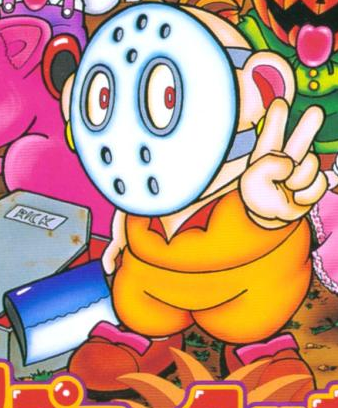
Namco’s Splatterhouse series first emerged in the arcades in 1988. As the advertisement poster used in this music video suggests, it was one of the first video games that really possessed the graphical capacity for some good old fashion gore. You play as Rick Taylor, a run of the mill college student who takes refuge from a thunderstorm in an old rickety mansion and inevitably finds himself demonically possessed, hacking and slashing his way through all sorts of hellspawn and ultimately butchering his girlfriend before defeating the mansion’s demon fetus-spawning womb and escaping. Quality stuff.
The game is accompanied by quite an impressive soundtrack.
When not taken to weird, incoherent noises such as on “Poltergeist”, the game has a knack for some rather pretty tunes that are only disturbing when placed in context. (The theme for Jennifer is one such instance; let’s not forget that the scene results in you chopping her head off.) I am not sure whether Yoshinori Kawamoto or Katsuro Tajima composed Splatterhouse. The former name crops up slightly more often on vgm websites, but trusting the majority consensus has lead me astray plenty of times before. Unfortunately, Namco have featured so seldom in my gaming music compilation that I am not really in a position to take an educated guess.
Splatterhouse is probably not thought of by most gamers as an arcade series. The original 1988 Splatterhouse only found obscure ports–to the PC Engine/TurboGrafx-16 in 1990 and the Fujitsu FM Towns in 1992. Its sequels made a bigger splash, becoming staples of the Sega Genesis/Mega Drive. Splatterhouse 2 and Splatterhouse 3 were released only seven months apart, in August 1992 and March 1993 respectively.
Both sequels were composed by Milky Eiko, and despite their wide acclaim, Milky’s rather outlandish pseudonym does not seem to have surfaced since. I could not find any other Eiko associated with Namco, and he must be regarded as both one of the last and one of the most famous game composers to be buried in complete anonymity, before composition credits became standard.
On an odd final note, there was actually another series game, Splatterhouse: Wanpaku Graffiti, released in 1989. It was an SD game, that is, super deformed, which generally refers in video games to over the top, excessively cute anime portrayals of familiar characters from earlier games. Released exclusively on the Famicom, Wanpaku Graffiti offered good clean serial murder for the whole family.
VGM Entry 59: Street Fighter II and SNES domination
(Thanks to Tish at FFShrine for the banner)
An enormous disparity had emerged between the Super Nintendo and competing platforms by the early to mid-90s. The Sega Genesis/Mega Drive, released two years sooner, still didn’t have much to offer, and the arcade was fading fast. The former simply couldn’t compete with the SNES’s ability to simulate real instrumentation, and the latter, I suspect, was no longer funded the way it used to be. This lends itself to a number of comparisons, but in consideration of the fact that my available time for writing these articles is rapidly coming to an end, let’s just jump straight to the point.
The Street Fighter II series is a massive and confusing string of titles through which Capcom managed to milk a great deal of money releasing minor updates and new characters over a short period of time. The original Street Fighter II came out for the arcade in 1991. This was followed (in the arcade) by Street Fighter II: Champion Edition (April 1992), Street Fighter II: Hyper Fighting (December 1992), Super Street Fighter II: The New Challengers (October 1993), and Super Street Fighter II Turbo (March 1994).
If that were all, it would be fairly easy to sort out, but each of these games was given a different title based on region and platform. Street Fighter II Turbo for the SNES, for instance, was a port of Street Fighter II: Hyper Fighting, not Super Street Fighter II Turbo. Street Fighter II: Special Champion Edition for the Sega Genesis/Mega Drive was not a port of Street Fighter II: Champion Edition, but rather of Hyper Fighting. The additions made in the original Champion Edition were carried over into most future versions of the game and ports, such that the original Sega Master System Street Fighter II (released in Brazil, where there was inexplicably still an SMS market, in 1997) was actually Street Fighter II: Champion Edition.
I would love to sort all this in a nice coherent list, but it would take me all day, and as I said, my time for writing these articles is starting to run short. So let’s just look at the version currently playing: Super Street Fighter II: The New Challengers. This one was released for the Super Nintendo in 1994 as simply Super Street Fighter II. Skip ahead to 5:12 and you’ll hear a delicious little oriental arrangement reminiscent of Miki Higashino’s Yie Ar Kung-Fu. (Again, time restricts me from actually finding the name of the song.)
Wikipedia credits Isao Abe and Syun Nishigaki with composing the Super Street Fighter II soundtrack. This is a little confusing as well, since Isao Abe and Yoko Shimomura get credited for the original Street Fighter II and a lot of the music is the same, but whoever wrote it, you’ve now heard the arcade version of the song, and I think we can all agree that at least in the 80s sound quality (not necessarily composition and arrangement) was substantially better in the arcade than on any home system.
The same song appears in the SNES Super Street Fighter II song compilation at 4:29, and I don’t think I need to point out how it’s better. Here’s a game released for a 1990 system, and the quality of sound is decisively better than Capcom’s 1993 arcade release. Forget about state of the art technology in the arcade; I think at this point companies were cutting costs, and high-end sound systems had to go.
Here’s another case in point. Shining Force (Sega, 1992) was a tactical RPG released for the Sega Genesis/Mega Drive. Composed by Masahiko Yoshimura, it is one of the most highly regarded soundtracks on the system. Aside from a ton of spin-off titles, Shining Force as a series only saw three installments, and each of these featured a different composer. Motoaki Takenouchi, for all his talents, didn’t do such a hot job with Shining Force II (Sega, 1993), and the third was released on the Saturn, so we’ll just focus on the original.
Masahiko Yoshimura did a really outstanding job here with the limited resources available to him, especially when the gameplay situation called for intensity. The tracks beginning at 1:47 and 2:34 especially impress me in this regard. Yoshimura’s militant snare carries the day, and there’s also something interesting going on in company with the bass. The deep piano tones on this second track play tricks on my ears, projecting a piano vibration onto the bass when I listen to the song as a whole which clearly isn’t there when I focus on the bass specifically. Both at the start of the 1:47 track and mid-way into the next, around 3:19, he musically employs a tone that sounds more like a jumping sound effect in order to simulate an instrument sample that probably wasn’t available on the system, and it works. You can catch some more of this in the track that kicks off at 7:23.
Packed with catchy songs creatively arranged to artificially simulate a higher degree of orchestration than the system allowed, Shining Force was a great success.
But what it took a lot of creativity to pull off on the Genesis the SNES made easy. Jun Ishikawa and Hirokazu Ando (both of Kirby series fame) composed Arcana (HAL Laboratory, 1992) the same year Shining Force came out, and the improvement in sound quality was staggering. RPGs to a large extent defined the SNES. I have no statistics to back this up, but I have to imagine more popular games outside of Japan fell into the RPG/adventure/tactics spectrum on the SNES than on any other system, to such an extent that NOA even incorporated an “Epic Center” column into Nintendo Power for two years (March 1995-November 1996).
An end date of late 1996 roughly coincides with the North American launch of the Nintendo 64, when Nintendo Power subscribers began to feel the effects of the cartridge gaming fallout. RPGs were big games, calling for big capacity, and the Playstation rapidly became developers’ new system of choice.
But this was 1992, and even little known, quickly forgotten titles like Arcana were blowing Sega and arcade gaming out of the water.
VGM Entry 57: Snatcher (part 2)
(Thanks to Tish at FFShrine for the banner)
Needless to say, when a game is released in six formats over a span of eight years the list of credits gets pretty wild. If we take Wikipedia’s unsourced credit synopsis for every Snatcher release mingled into one, it would appear that Akira Yamaoka, Keizou Nakamura, Masanori Adachi, Kazuhito Imai, and Masanori Ouchi are responsible for the score. But let’s not do that.
Konami’s ost releases generally only credit the Kukeiha Club as a collective, so that’s of no real help. Thanks to Snatcher‘s devout fan base though, a video of the end credits is available on youtube for every version of this game. They struck me as a bit suspect in so far as every version except the PC-Engine was in English, when only the Sega CD version was officially translated. But I do get the feeling–I’m sure plenty of people could easily confirm or deny–that a lot of games in Japan for whatever reason have English credits.
In any case, the PC-8801 ending credits are perhaps the most thorough I’ve ever seen in a game, and whether their English (Engrish really) is a fan translation or the authentic original, I do think it would be nice to provide a transcript. This is the track by track credits as listed in the two-part youtube video posted by AFX6502, condensed to save some space. Most tracks were listed with two names: one in quotations and one in parenthesis.
Compositions by M. Ikariko:
“Prologue Demo” (Bio Hazard Snatcher)
“Title Telop” (Evil Ripple)
“Pursuer Part1” (Creeping Silence)
“Pursuer Part3” (Pleasure of Tension)
“Pursuer Part4” (Endless Pursue)
“Katrine Part1” (Innocent Girl)
“Katrine Part2” (Theme of Katrine)
“Bath Room” (Virulent Smile)
“Joy Division” (Decadance Beat)
“Blow Up Tricycle”
“Mortuary Part1” (Morg)
“Restoration”
“Search Light” (Spreading Diehard)
“Credits”
“Game Over” (Lement for The Death)
Compositions by M. Shirakawa:
“Team Logo” (Slave to Metal)
“Jaime” (Theme of Jaime)
“Outer Heaven2” (Theme of Izabel)
“Title Part1” (Theme of JUNKER)
“Title Part2” (Theme of Randam)
“Title Part3” (Faded Memories)
“Title Part5” (Peace of Mind)
“Action” (Danger Dance…and Justice for all)
“Epirogue” (Beyond Sorrows)
Compositions by S. Fukami:
“Theme of Opening” (Twilight of Neo Kobe City)
“Outer Heaven1” (The Entrance to Hell)
“Goodbye Randam” (Eternal Promise)
“Requiem” (For Harry)
Compositions by S. Masuda:
“Pursuer Part2” (Criminal Omen)
“Pursuer Part5” (Follow up the Scent)
“Wrong Answer” (Axia)
“Transform Risa” (Virtual Image)
Compositions by M. Izumi:
“Ending 1” (Master of Puppets Among The Disease)
“Theme of Ending” (We Have to Struggle for Our Future Against Our Doubt)
Compositions by M. Adachi:
“Theme of Metal Gear” (Theme of Tara)
-remix from “Metal Gear” RC_750 1987-
Joint composition by I. Mizutani and M. Ikariko:
“Snatcher Title” (Squeak!!)
Composition by Pear Point:
“Jingle Bell” (Jingle Bell 2042)
So there you have it. Originally, Masahiro Ikariko composed 16 of the tracks, the rather elusive M. Shirakawa composed 9, and the remaining 13 were composed by a combination of Masanori Adachi, Seiichi Fukami, Mutsuhiko Izumi, Iku Mizutani, and another virtually anonymous figure, S. Masuda. Ikariko, Shirakawa, Fukami, and Masuda are given clear precedence over Adachi, Izumi, and Mizutani in the credits, and must have comprised the main music team. (While the credits to the original MSX version of Metal Gear are likewise confusing and Adachi is not listed where I looked, I have to assume he wrote the original song, “Theme of Tara”, upon which the Snatcher tune is based and had no direct involvement here.) We don’t even know M. Shirakawa and S. Masuda’s full names. Isn’t that something?
The PC-8801 credits tell us quite a bit more about Snatcher‘s music than simply the track-by-track credits. For instance, chief editors Hideo Kojima and Naoki Matsui named the songs. Iku Mizutani did the sound effects, and Masahiro Ikariko and Kazuhiko Uehara “arranged” the music–a credit Konami clearly distinguishes from composition.
The MSX2 credits are included in the PC-8801 version, so there’s no ambiguity on this front. Masahiro Ikariko and Kazuhiko Uehara made the MSX2 arrangements (with the exceptions of “Theme of Metal Gear”, converted by Uehara and Mizutani, and “Jingle Bell”, converted by Ikariko, Uehara, and Shirakawa).
The PC-Engine credits are in Japanese, and in the mess of a hundred open Firefox tabs I’ve lost track of the url to the translation I found, but I did copy it down:
It’s kind of weird to me that Shirakawa, who wrote a quarter of the music in the game, is not included here, but perhaps he and Masuda had left Konami and were erased from memory. Or perhaps Ikariko, Fukami, and Izumi returned to write additional material, but based on the songs I’ve heard, I get the impression that the list of original compositions for the PC-Engine version is quite short. Based on how the PC-8801’s credits were worded, I am lead to believe the PC-Engine arrangement was Kazuki Muraoka’s baby, with Motoaki Furukawa filling in the few added original tracks, however Furukawa has referred to himself as being “in charge of the BGM” for the PC-Engine port. Whether he meant merely the new compositions or the arrangements of the originals is beyond me.
The PC-Engine version and future releases included a revamped intro scene, for which I’ve provided the Sega CD take in spite of its awful voice acting, so that you can hear it in English. “One Night in Neo Kobe”, the song beginning at 2:55 in this video, was one of the new PC-Engine additions written by Motoaki Furukawa (he also confirmed composition of “Tears and Stains”, which must be “Tear-Stained Eyes“), and it remains one of the most famous songs of the game.
The Sega CD port was the first major departure from Ikariko and company’s original score. The credits here, which I’ve derived directly from the English version of the game, are pretty vague:
This list is kind of strange, because it was the Sega CD port’s arrangement that made it so drastically distinct from the first three versions. The songs were still based on the originals, but in a manner akin to Rob Hubbard and Tim Follin’s liberal port adaptations (consider the C64 ports of Commando and Bionic Commando respectively, for example). The credits clearly refer to the Sega CD arrangement, and Masanori Adachi must have been directly involved this time around. Even so, some of the tracks, “One Night in Neo Kobe”, aren’t even arrangements, but rather the exact same songs appearing on the PC-Engine. It’s pretty odd that Motoaki Furukawa and Kazuki Muraoka are restricted to a “Special Thanks” mention at the end of the credit roll.
Also, the distinction between “Sound Design” and “Sound Programmer” is completely obscure here. Konami don’t even bother with distinguishing between music and sound effects. Some of the ‘sound design team’ credits may have almost no real involvement in the music. Keizou Nakamura is credited specifically for SFX in a later version of the game, suggesting that that was his role here as well, and someone claiming to have spoken with Akira Yamaoka says he had little to no involvement in the project.
At this point in time technology may have advanced to the point where “programmer” did not as a rule imply “arranger”, and it’s possible that Osamu Kasai and Akira Souji’s contributions comprised a technical task which made the audio possible but did not affect what it actually sounded like. Never mind my uneducated speculation though; suffice to say the Sega CD port is a grey area dividing the old Snatcher compositions from the new.
Most PSX/Sega Saturn Snatcher songs were in fact new compositions entirely distinct from the originals. “The Morgue” is an example in which the changes are pretty rewarding. I think they definitely improve the whole ‘surrounded by rotting corpses’ atmosphere, whether that is actually the appropriate atmosphere for the scene in context or not. It does little to compensate for the outrageous censorship rules Sony inherited from Nintendo, but whatever. Here are the credits for both:
PSX: Sound System Programmer:
Noritada ‘Nor’ Matukawa Sound Mixer:
God Adachi Music Composer/Arranger/Performer:
KIDA-Sun SFX:
Hiroe Noguchi Guest composers:
Hiroshi Tamawari
Akira Yamaoka
Kosuke Soeda Guest Performer:
Tappy Original Score Composers:
Kazuki Muraoka
Motoaki Furukawa
Saturn: Sound Programmer:
Akiropito Sound Mixer:
Masanori Adachi
Music Composer/Arranger/Performer:
KIDA Sun
Syouichirou Hirata SFX:
Keizou Nakamura Guest composers:
Akira Yamaoka
Hiroshi Tamawari
Guest Performer:
Tappy Original score composers:
Kazuki Muraoka
Motoaki Furukawa
Akira Yamaoka
Hiroshi Tamawari
KIDA Sun
If you’re curious about the aliases here, “Akiropito” is Akira Souji, “God Adachi” is Masanori Adachi, “Tappy” is Tappi Iwase, and I couldn’t find the slightest clue for identifying “KIDA-Sun”. This makes for an odd discussion, as “KIDA-Sun” appears to be the most responsible party for the PSX and Saturn soundtracks. It’s also rather strange that Akira Yamaoka, Hiroshi Tamawari, and KIDA-Sun are listed as original score composers on the Saturn but not on the PSX, as to the best of my knowledge the Saturn used the exact same songs, making only minor (but always for the better) changes throughout. I don’t know that this change to the credits indicates a real change though: Akira Yamaoka and Hiroshi Tamawari are listed as ‘guest composers” in both versions, and a guest composer is still a composer, so it might all boil down to redundancy. In that case, we need only ask what became of Kosuke Soeda.
So basically, our credits look like this:
PC-8801 and MSX2
Composition: Masahiro Ikariko (16), M. Shirakawa (9), Seiichi Fukami (4), S. Masuda (4), Mutsuhiko Izumi (2), Iku Mizutani (1), Masanori Adachi (1)
Arrangement: Masahiro Ikariko, Kazuhiko Uehara
PC-Engine
Composition: Primarily the original 1988 staff, with additions (probably) limited to Kazuki Muraoka and Motoaki Furukawa
Arrangement: Kazuki Muraoka
Sega CD
Sound staff: Keizou Nakamura, Masanori Adachi, Kazuhito Imai, Masanori Ouchi, Akira Yamaoka
Sound Programmer: Osamu Kasai, Akira Souji
VGM Entry 56: Snatcher (part 1)
(Thanks to Tish at FFShrine for the banner)
At this point I think it’s safe to talk about Snatcher. Snatcher has quite a long history. Konami first released it on the PC-8801 in November 1988, following this up with an MSX2 port the following month. In 1992 it found its way to the PC-Engine, and in 1994 it got its first English translation via the Sega Mega-CD. It would go on to appear on the Playstation in February 1996 and the Sega Saturn in March before all was said and done.
Snatcher was a cyberpunk visual novel, which isn’t the sort of thing North American and European gamers are particularly familiar with. It also featured some graphic violence, partial nudity, and cultural references, which didn’t jive well with North America’s outrageous censorship and copyright laws. All of these factors contributed to the long delay of an English port, and it’s quite remarkable that Konami ended up making one at all. The market was not in fact ready for it, and Jeremy Blaustein, who oversaw the localization, admitted that the game “only sold a couple thousand units”. He provided the legitimate argument that this resulted from Konami’s decision to release a game on the rapidly tanking Sega CD, not any shortcomings of the game itself. Snatcher remained popular in Japan however, and by the sixth and final release in March 1996 it also boasted six different variations on the main soundtrack.
What’s great for our purposes is that liquidpolicenaut on youtube already did all the legwork for comparing them. In some cases, such as “Decadence Beat (Joy Division)”, the original PC-8801 and MSX2 versions survive every port on into the Sega Saturn, but more often the songs get replaced for the Sega CD or Playstation and retain their new forms the rest of the way.
It’s by no means immediately obvious which take on this song is best. As songs by themselves, displaced from any game, the MSX2 version stands out the most to me, but the comments by actual fans of the game seem to denounce the MSX2 version as out of touch with the atmosphere of the scene. “Joy Division” (censored to “Plato’s Cavern” for the US Sega CD port) was Snatcher‘s general store chain. As a cyberpunk game, it naturally ought to be a little bit sleazy, but since I never played it personally I can’t say just how far that should go. The Sega CD version sounds like a porn shop, and the PSX version sounds like the score to what the Sega CD store is selling. The Sega Saturn take, despite being practically identical to the PSX take in construction, comes off quite tasteful due to better quality instrument samples. The potential complaint, of course, is that it’s too tasteful to be wholly appropriate.
If the PC-8801 take is a bit too funky and the PC-Engine a bit too weird, I’m left with the MSX2 take. It has a very technological feel to it. This is music for the sort of store I’d go to to buy my cybernetic crack injection kits for sure. The visual helps it out too; the store clerk looks a lot more seedy and a lot less evil on the MSX2 and PC-8801 than in the other takes, and the emphasis on grey (the PC-8801 has a brown floor) makes the whole place seem a little metalic–a little more futuristic. Oh the MSX2 take wins for me hands-down. But I’m listening to this with nothing but a song, a single image, and a general idea of cyberpunk to go on. I never played the game. Maybe the MSX2’s atmosphere, while consistent in audio and imagery, is totally out of place in it. One of the great benefits of Snatcher and liquidpolicenaut’s comparison videos is to bring these finer aesthetic considerations to mind.
I mentioned that “Joy Division” was renamed “Plato’s Cavern” on the Sega CD. It’s one of many censorship issues that forced minor changes in detail as new ports were made. The left-hand mask on the wall behind the store clerk on the MSX2 and PC-8801 was Predator, and it vanishes starting with the PC Engine. Amazing what petty things billionaires will file lawsuits over…
The censorship on “Pursuer Part 4 (Endless Pursue)” is a little more obvious. (Supposedly the dog was twitching, still alive on the original versions, and this was removed before they took out the image altogether.) Musically, this is another instance where the same song was maintained for all six versions of the game. Here the differences aren’t nearly as extreme, either. Again the Playstation take comes off the worst to my ears, and this time the Saturn’s improved sound does not sufficiently redeem it–at least if this is meant to be the fairly tense, down to the wire scene that the track title and early versions imply.
I can’t think of any context in which the PSX and Saturn versions might sound appropriate to be quite honest. The PSX take kicks off like some progy jazz piece that completely fails to acknowledge any sort of distress, or anything remotely unsettling (we’re still staring at a dog with its guts spilled out mind you, even if it’s censored). The bass drum beat is made no less obnoxious in the Saturn version by actually sounding like a bass drum, and its pace is totally out of touch with the melody. No, the PSX and Saturn versions are bad–no getting around that.
If you go back to the MSX2 take, you’ll find that it’s far more imaginative anyway. Variations in the intensity of the drum beats give it a dimension lacking in the last two versions. The higher-pitched notes behind the main melody in the PC-8801 introduction carry the song much more effectively than their MSX2 equivalent, emphasizing the pace of events, and the variations in percussion intensity are retained, but the main melody is just a bit too clean. The MSX2 take has a more hollow, raspy sound. I suppose I would characterize the MSX2 and PC Engine versions as prioritizing an element of danger, while urgency dominates the PC-8801 and Sega CD takes.
I could go on like this for every track, but I fancy it’s already gotten old. Tomorrow I’ll tackle who exactly wrote it all.
VGM Entry 40: End of the NES era (part 2)
(Thanks to Tish at FFShrine for the banner)
Once again, by 1990 the Nintendo had fallen way behind the times. The Sega Genesis/Mega Drive, the Commodore Amiga 500, and the NEC PC Engine/TurboGrafx-16 had all left it in the dust. The fourth generation of home and computer gaming was in full swing, and Nintendo were not prepared to launch their version until November. NES composers struggled to keep up with higher standards in the meantime, pushing the Nintendo to its limits.
Mega Man 3 (Capcom, 1990) had a lot to offer. Yasuaki ‘Bun Bun’ Fujita (not to be confused with my favorite talking rabbit) picked up the job this time, and it’s pretty amazing that three different musicians could all so effectively maintain the series’ quintessential sound. Mega Man 3‘s opening theme is as excellent as any of them, and the rest of the music really is a good bit more compositionally consistent than may meet the ear.
“Hard Man” (1:52) for instance is written in unmistakable Mega Man fashion. The only reason it doesn’t sound entirely up to par is a product of bad mixing at the final stage. Every take I’ve heard of it just sounds a bit washed out. The volumes of each track don’t feel properly balanced, and they could perhaps have chosen fuller percussion. But the fundamental song-writing is ideal, and I think if you put it in the hands of say, Bit Brigade, it would shine as brightly as any track from the first two games. Whatever flaws it may have are only visible if you seek them out.
While I think this minor mixing problem persists throughout the game, the next track in this collection, “Snake Man” (2:45), is just so well written that any potential flaw in the final production is masked entirely. Mega Man 3 does have some less memorable tracks; it’s not quite as consistent as the first two games in that regard. You won’t hear them in this mix. garudoh did yet another excellent job of choosing only the best, and “Spark Man” (3:42), “Get Your Weapons Ready” (4:40), and “Proto Man” (5:18) finish off a very well-conceived compilation. But the likes of “Gemini Man” and “Magnet Man”, not featured here, leave something to be desired. Mega Man 3 is not quite as good as the first two, but Yasuaki Fujita definitely finds and maintains the Mega Man sound throughout, and by any other standard this is an excellent NES soundtrack.
The best NES music of 1990 though, as you may have guessed from my previous hints, belongs to Tim Follin. Follin carried his capacity to pack a huge punch into limited sound systems over to the NES, and the introduction to Solstice (CSG Imagesoft, 1990, produced by Software Creations) is not afraid to employ a little shock value. I’m not sure why the music in this sample is out of order, but you can hear how the game kicks off if you skip to 3:37. The cute little 10 second jingle at the start is almost tongue-in-cheek, mocking typical NES songs before exploding into musical fireworks in bombastic Follin fashion. The majority of the album feels to have benefited heavily from his recent work on Ghouls’n Ghosts. No individual tracks really stand out with the memorable qualities of that previous work, but you can definitely appreciate the level of imagination that went into the whole soundtrack. Follin had more up his sleeves for the NES anyway. He reserved his best efforts for a game which we would all expect to have an outstanding soundtrack….. Pictionary?
I don’t know. Tim Follin’s music was seldom relevant to the game. I suppose it’s quite possible that he submitted this soundtrack to Software Creations without even knowing what game it would be used for. But I picture a giddy Follin setting out to intentionally make Pictionary (LJN, 1990) one of the most exciting and absurdly uncharacteristic soundtracks on the NES, laughing all the way.
That’s about all I have to offer from the Nintendo for the time being, but it’s worth taking a brief look at some other systems before we move on. I don’t want to say the pickings were slim outside of the Nintendo–that would certainly contradict my entire point in these past two posts–but I did struggle to find much of interest in 1990 specifically. The PC Engine is quite obscure to me as a western gamer, and many of the Amiga titles that best caught my eye date to 1988 and 1989. The Genesis/Mega Drive was still a musical disappointment in so far as it rarely lived up to its full potential. Elemental Master (TechnoSoft) by Toshiharu Yamanishi deserves an honorable mention, but its music is nothing special really. I think the system just lacked much competition to spur it on. With the Amiga appealing to European computer gamers and the PC Engine pushing the Japanese market, the Genesis/Master System for a time stood alone in a number of markets as the only available fourth generation home gaming console. Phantasy Star III (Sega) saw Izuho Takeuchi take over Tokuhiko Uwabo’s role as composer, and the transition brought a whole new style of sound to the game. I would describe it as unremarkable but more consistent–where Tokuhiko Uwabo presented a rather unique RPG soundtrack that was fairly hit or miss, Izuho Takeuchi is a little more traditional and at no point that I’ve noticed really falls flat. But his music is nothing to brag about either.
Before I move on to the Super Nintendo, one final 1990 release that really caught my attention was Iron Lord (Ubi Soft). Now, this version that you’re hearing above is the original 1989 Atari ST version. I want you to hear it first, because I want you to know what Jeroen Tel had to work with when he made the Commodore 64 and Amiga ports.
I don’t know who the original Atari ST composer was. I don’t know who was responsible for the MS-DOS version either. But I bet it wasn’t Jeroen Tel. C64 composers had a certain attitude about them. They knew they were the best, and they were going to keep on proving it every chance they could get. And let’s not forget here; the Commodore 64 was a year older than the Nintendo.
Hence why Jeroen Tel’s Iron Lord could introduce a power metal song. The effects of layering a medieval tune with big chippy bass and that same higher spacey tone he used on Cybernoid 2 are almost comical, but they’re entirely effective. Like a typical C64 musician, Tel expanded way beyond the scope of the original composition and made it entirely his own.

 Through the Shattered Lens