
I want to tell you about one of my favorite horror films. It’s a strange one and I think you might like it.
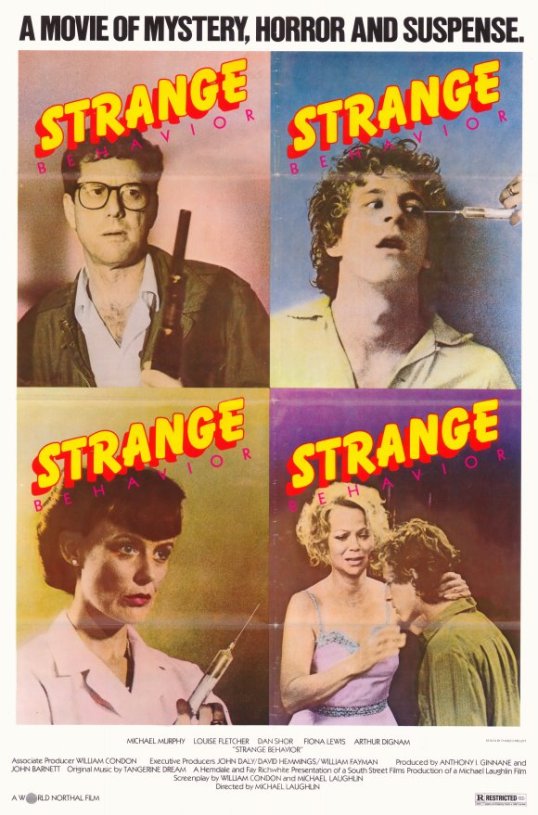
It’s a movie from 1981. It was filmed in New Zealand, even though it takes place in a small town in the American midwest. It was directed by Michael Laughlin and the screenplay was written by Bill Condon, who has since become a director of some note. This was Condon’s first screenplay. In Australia and Europe, this movie is known as Dead Kids. In America, the title was changed to Strange Behavior.
Here, watch the trailer:
It’s a pretty good trailer, actually. That said, as good as the trailer may be, it doesn’t even come close to revealing just what an odd film Strange Behavior actually is. If David Lynch had followed up The Elephant Man by directing a slasher movie, chances are the end result would have looked something like Strange Behavior.
Here’s another scene that I want you watch. It’s kind of a long scene, clocking in at 7 minutes. But I want you to watch it because, in many ways, this scene is the epitome of Strange Behavior:
Strange Behavior is perhaps the only 80s slasher film to feature a totally random and totally choreographed dance number. It comes out of nowhere but, in the world that this film creates, it somehow feels totally appropriate. Of course, the nun is going to announce that she’s not wearing any underwear and then pretend to stab a guy in the back. Of course, the cowboy’s going to throw up and then want to go out to his car with his date. And of course, a bunch of people in costume are going to end up dancing to Lightnin’ Strikes. In Strange Behavior, the strangest behavior is the only behavior that makes sense.
As for the film itself, it’s a mix of small town melodrama, slasher horror, and gentle satire. Teenagers are being murdered by other teenagers and no one is sure why. The chief of police, John Brady (played by character actor Michael Murphy, who gives a quietly authoritative performance that counters some of the weirdness of the rest of the movie), is trying to solve the crimes while trying to cope with the mysterious death of his wife. His son, Pete (Dan Shor), is going to the local college, where classes are taught by a professor (Arthur Dignam) who died years ago but who filmed a few lectures before passing. To make extra money, Pete does what many of the local teenagers do — he volunteers for medical experiments. Researcher Gwen Parkinson (Fiona Lewis) oversees the experiments, handing out pills and occasionally administering a hypodermic needle to the eyes of a test subject. Gwen is always cool, calm, and collected. When one irate father draws a gun on her, Gwen quips, “I can’t stop you. I don’t have a gun.”
But there’s more to this movie than just medical experiments and murder. Strange Behavior is full of wonderfully eccentric supporting characters. Other than John, there’s really nobody normal to be found in either the town or the movie. Pete’s best friend, Oliver (Marc McClure), is cute and dorky. Barbara (Louise Fletcher) just wants to marry John and live in a town where dead bodies don’t turn up in the middle of corn fields, propped up like scarecrows. John’s best friend and fellow cop, Donovan (Charles Lane), has been around forever and has a great, no-nonsense approach to even the strangest of things. When it becomes obvious that John is not going to be able to solve the murders on his own, big city cop Shea (Scott Brady) shows up and wanders ineffectually through the movie, spitting out hard-boiled dialogue like a refugee from a 1930s gangster flick. And finally, receptionist Caroline (Dey Young) sits at her desk in the clinic, gossiping about the patients and smoking cigarette after cigarette. Caroline is probably the smartest person in the movie. As an administrative assistant, I appreciated that.
It’s an odd little movie, which is why I love it. Laughlin, Condon, and the entire cast created a world where everything is just a little off-center. It makes for terrifically entertaining and weird movie, one that works as both satire and straight horror.
Strange Behavior is a film that deserves to much better known than it currently is so my advice is go watch it and then tell you friends to watch it too.


 Through the Shattered Lens