VGM Entry 68: Final Fantasy VI


VGM Entry 68: Final Fantasy VI
(Thanks to Tish at FFShrine for the banner)

Square released quite a number of games for the Super Nintendo, but everyone looked forward above all else to their annual blockbuster, appearing in the latter half of the year, from 1993 until 1995. Secret of Mana was the first of these. Final Fantasy VI was the second.

There is only one logical place to begin a discussion of the music of Final Fantasy VI.

And that would be at the beginning. Final Fantasy VI did not begin like other games. Sure, it was by no means the first to fade out on the title screen and play through an introduction to the plot, but this was different in a lot of respects. It provided barely any background to the story. Ok, there was a devastating war 1000 years ago in which the destructive art of “magic” was lost, and an emerging industrial revolution is beginning to recover remnants of that past. That’s all you directly get. The rest plays out more like a movie. You get hints and clues to what’s going on–a new face here, a key term there–but you’re left curious rather than informed. The intro to this game doesn’t set the plot; it sets the mood. (The revised English translation tragically lost sight of this, such that the original SNES “Final Fantasy III” is really the only port of the game worth playing.)

Nobuo Uematsu’s music went hand in hand with this approach. There is no opening anthem–no catchy piece to hum along to. The sinister organ, the harp-like transition, the windy sound effects, and ultimately the opening credit music all flow from one point to the next, breaking only for the sake of the cinematic experience, not because a particular track is over or the next scene has new “bgm”. Final Fantasy VI had perhaps the first really cinematic introduction for a video game.

http://www.youtube.com/watch?v=wtqXb2FDK0Q

It might be argued that Nobuo Uematsu revolutionized the use of music in video games from the very opening sequence, but nothing made this more apparent than the events at the Jidoor Opera House, where an odd twist in the plot leads the cast of heroes to become involved in a backstage operation during a musical performance. Not only does the opera take place in the backdrop as you work your way through the mission, but as part of the plot device the heroine Celes takes on the lead female roll in the show. Events transition back and forth between action behind the scenes and the live show, and part of the outcome is determined by your ability, as a player, to regurgitate Celes’ lines from the script.

The video I’ve linked here includes the first two songs in a four-part performance. What makes this sequence so important for the history of gaming music is that Nobuo Uematsu’s amazing score plays a direct role in the plot and gameplay. While the simulated pseudo-vocals might sound silly in hindsight, this was also a real first in gaming music in its day. Square’s sound team might not have possessed the technology to incorporate real words, but nothing prevented them from displaying them as part of the script. As an odd consequence, one of the first video games to make extensive use of lyrics had no vocals.

http://www.youtube.com/watch?v=JbXVNKtmWnc

Uematsu’s third major accomplishment, the indisputable quality of his score aside, was to completely derail the limits of acceptable song length. Granted Commodore 64 artists had been busting out 6-8 minute epics back in the mid-80s, the standard by and large still remained firmly below the 3 minute mark. If we take the opera as a single piece (it’s divided into four tracks), Final Fantasy VI had three songs that pushed 20 minutes.

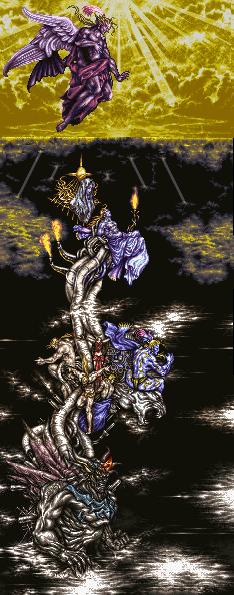
“Dancing Mad” probably remains today the longest final battle music ever written, with the original ost version clocking in at 17 minutes and 39 seconds. This might seem excessive if you haven’t played the game, but within its context nothing less could have possibly sufficed. Kefka was pretty much the greatest video game villain of all time (Luca Blight from Suikoden II might surpass him), and Final Fantasy VI might have had the most apocalyptic plot in the series. Sure, series fans had saved the world from imminent destruction five times before and plenty more since, but Zeromus, Exdeath, they were just icons of evil. In Final Fantasy VI, Square’s obsession with mass destruction finally found a human face. Kefka’s psychopathy was something you could buy into. He was entirely capable of emotion even as he slipped progressively further into insanity. He just attached no moral value to life. Where enemies before and since sought to destroy the world for destruction’s sake, Kefka was in it for the experience of the ultimate tragedy. For once it actually made sense for a final boss to let the heroes creep up on him; the whole agenda would have been pointless if no one was there to experience it with him.

Both visually and musically, the final battle of Final Fantasy VI was beautiful. Nothing else–certainly no 1-2 minute fight theme–would have been appropriate in the context of the story.
VGM Entry 63: Secret of Mana


VGM Entry 63: Secret of Mana
(Thanks to Tish at FFShrine for the banner)

The Super Nintendo may have been video game music’s finest hour with or without them, but three soundtracks in particular carried this system to an unprecedented level of greatness which has really never been matched since. Each was composed by a different artist, and each was released by Square. The first of these was Secret of Mana.

http://www.youtube.com/watch?v=LiA7VtYk3n0

Here is the track list for garudoh’s compilation:

(0:00) Angle’s Fear
(0:53) selection menu track not featured on the ost
(1:23) Into the Thick of It
(2:17) Colour of the Summer Sky
(2:55) Ceremony
(3:53) Star of Darkness
(4:46) Strange Event
(5:46) Spirit of the Night
(6:22) Eternal Recurrence
(7:29) The Sorcerer
(8:15) Leave Time for Love
(8:44) Dancing Beasts
(9:24) Calm Before the Storm

Hiroki Kikuta was brand new to the world of video game music when he scored Secret of Mana, released in 1993. (Called Seiken Densetsu 2 in Japan, the game was technically the sequel to what we commonly know as Final Fantasy Adventure for the Game Boy.) He had worked on the sound effects for Romancing SaGa in 1992, and beyond that he only had two animes to his credit (The Adventure of Robin Hood and The Legend of Snow White, both released in 1990.) Like the more famous Square composer whose 1995 composition would overshadow Kikuta, his work would emerge from pure inspiration, with almost no past experience upon which to build. He single-handedly made an otherwise fairly average game one of the most beloved titles on the system. I suppose average is an odd way to describe Secret of Mana–it was a very unique game within the adventure genre–but its success hinged entirely on the soundtrack. With limited plot potential and almost zero character development (the playable characters are named Boy, Girl, and Sprite for goodness sake), Secret of Mana‘s success was due entirely to Kikuta’s ability to bring the visual environment to life in fantastic ways.

garudoh chose some odd tracks for this compilation, and judging by the fact that some of the songs fade before they’re anywhere near looping (Leave Time for Love for instance) I have to assume he wasn’t personally very familiar with the music. I’ll offer you some additional tracks that didn’t make it into his mix.

Secret of Mana was a game about elements. This was not integrated in any sort of forced way, as with say, the crystals of earth, water, air, etc in the Final Fantasy series, but rather it was a natural consequence of the games strengths and weaknesses. For instance, I doubt anyone remembers why, plot-wise, you ever end up in a desert, but the experience of being there is a lasting memory.

http://www.youtube.com/watch?v=_z3QB1Oz6dA
Secret of the Arid Sands

Kikuta didn’t rely on any stereotypical reference points here. He didn’t give his music a Middle-Eastern vibe or any such nonsense. Instead he chose tones that actually reflected a visual experience of a desert. The accompaniment to the melody here flickers up and down from the bass of the music like boiling bubbles and mirages dancing off the desert sands. It’s largely in these world encounter zones, where the plot was least relevant, that Kikuta’s music is at its finest, because he was at liberty to paint a timeless musical image without any concern for the events taking place there.

This same idea of audio imagery really stands out to me in “Into the Thick of It” (1:23 in the garudoh video), where at the start the plucked sort of harpsichord-guitar line accented by the drum beat and displayed on the backdrop of a simple, confident bass and quiet but encompassing synth creates the image of a forest rushing by. (Much of the drumming is hard to find in the low bitrate youtube sample, with exaggerated alterations in volume obscuring the fact that the staccato metronome-sounding drum hits on every beat.) The bass and synth fill in the earth and sky; the drum sets things in motion; the plucked notes count off the passing tree trunks; the fuzzy guitarpsichord resonance depicts the myriad interwoven branches, tying each note into the next. However pretentious that may sound, and regardless of whether or not it reflects Kikuta’s intentions, I’ve always heard something roughly along these lines in this song. I want to clearly distinguish it from music which captures the sense of being in a forest. This doesn’t tap into emotional reactions to environments so much as it generates an actual physical image of the environment, supported by the game’s graphics proper, upon which the players can impose their own emotional values. It’s fantasy in the purest sense. As “Into the Thick of It” progresses the song flushes out into more obvious visions: woodwinds capturing the blowing breeze and rustling grass, bubbly staccato synth tones depicting passing streams. And this is precisely the graphic environment in which the song is employed.

http://www.youtube.com/watch?v=sajoxHWcr-I
What the Forests Taught Me

“Into the Thick of It”, where the player is rushing on ahead on a well established path, is nicely contrasted by “What the Forests Taught Me”, in which the game sets you in a much more secluded forest. Here the motion is removed, and you get a standing image of a forest clearing full of life. The calm is a bit more displaced from the gameplay, considering you’re hacking and slashing your way through, but this is entirely in keeping with Kikuta’s tendency in such plotless zones to score music descriptive of the visual environment and allow the players to attach their own value to the events taking place there.

http://www.youtube.com/watch?v=5cAii43wOHw
A Wish

The sort of apex to this side of his soundtrack is “A Wish”, which plays in the winter forest combat zones. An environment blanketed in a single, neutral, stagnant substance, full of life but only subtly altered by its motion–Kikuta composed a track perfectly descriptive of what the player, upon taking a break from mechanical combat and visualizing themselves in this fantasy world, would experience. A lot of truly great musicians have attempted to capture this sort of situation–Sigur Rós and George Winston come to mind–but as the nature of video games dictates looping tracks, “A Wish” offers this vision in a uniquely and authentically eternal sort of way.

The mental images in a work of fantasy are not always natural, and for Secret of Mana‘s darker side Kikuta needed to get pretty creative. “Ceremony” (2:55) and “The Sorcerer” (7:29) represent the game’s darkest moments, and the former, though not my favorite track, might be his finest accomplishment in the mix. In a score through which the player is accustomed to deriving physical imagery, Ceremony’s twisted patterns and displaced tones take on added weight. There is nothing natural to latch onto here–no coherent vision, just some disturbing, chaotic mass. It’s got to be one of the creepiest video game songs out there, second on the SNES only to the Final Battle music of EarthBound by Hirokazu Tanaka. “The Sorcerer” is just as if not more disturbing, made only slightly less intimidating in practice by the distraction of having to actually fight a boss while it’s playing.

http://www.youtube.com/watch?v=j-2L2VNmuQg
Steel and Snare

One thing you may have noticed listening through garudoh’s mix is Kikuta’s tendency towards hard-hitting, dominant percussion. It’s one of his strongest consistencies, tying a wide variety of musical styles together under a common feature, and on one of my other favorite tracks, “Steel and Snare”, he really lets it all out. This is one of those songs I’ve wanted to cover in a rock band since the first time I ever heard it, and I remember having the whole thing worked out on bass at one point in my life (along with Meridian Dance; this never really crossed my mind before, but when I first bought a bass it was always Hiroki Kikuta and Ryuji Sasai that I turned to.) The music again drives the setting of the game, with the continuous tone in the background simulating the air around the floating castle, and the drum and bass track giving all of the enemies a decidedly mechanical feel. I don’t actually know that they -were- mechanical. I don’t remember what they looked like precisely. But whatever they were meant to be, the music dictated my memory of the scene.

I’ll leave you with one last song:

http://www.youtube.com/watch?v=bEilQOiuE_g
Premonition

I’ve managed to maintain this as my ringtone for well over a decade, and it’s become such a continuous occurrence in my daily life that I don’t think I can even intelligibly discuss it in the context of the game anymore, but I was in love with it when I first heard it and I still am now. I suppose I should have featured Meridian Dance here instead, as it seems a bit silly to ignore Secret of Mana‘s most epic track through all this, but I’d rather draw attention to the less commonly featured great ones anyway. Enjoy.

VGM Entry 12: Zelda and Dragon Quest


VGM Entry 12: Zelda and Dragon Quest
(Thanks to Tish at FFShrine for the banner)

Two fantasy-style games in 1986 achieved massive retail success and thereby brought the genre to the attention of the masses. These, it should be fairly obvious, were The Legend of Zelda (Nintendo) and Dragon Quest (Enix). Both games are likewise frequently cited among the most important soundtracks for the Famicom/NES. I think this can be a bit misleading.

http://www.youtube.com/watch?v=1jElFHhfIrY

The Legend of Zelda had a truly epic main theme, with which Koji Kondo almost certainly surpassed his work in Super Mario Bros. Whether it was the best video game song written up to that point is really a matter of personal preference; it is not as though it had no competition. Regardless, this was the first installment of Nintendo’s second major franchise gaming series, and the sort of anthem Koji Kondo was able to craft for Link had enormous marketing benefits. It’s not as though lead characters in Nintendo’s games became popular out of the shear force of the company’s good name. No one really remembers say, Professor Hector (Gyromite and Stack-Up) or Mr. Stevenson (Gumshoe). If Link was going to become a franchise character, he was going to need a theme song, and in that regard Koji Kondo pulled through once again.

What else did The Legend of Zelda have going for it musically? Well… very little. I mean, the Underground Level theme (3:18) is pretty cool–all 18 seconds of it. It reminds me of some of Uematsu and Mitsuda’s later works. But there just isn’t much else to this game. The title screen and overworld theme are variations on the same (awesome) melody. Death Mountain (3:48) sounds like it was thrown together in five minutes, and the ending theme (1:42), while catchy, is simply in the wrong game. It is Mario music.

Koji Kondo is one of the most important figures in the history of video game music, no doubt about it, but the bar had not been raised quite so high on the NES in 1986 as it had been in the home computing world. Thus The Legend of Zelda sounds great within the context of its system, but a little primitive in the larger scope of things.

http://www.youtube.com/watch?v=Ntmk5aHaPQ4

The interesting thing about Dragon Quest to my western ears is that the game series was never all that hot here. I seem to recall reading at the time of Dragon Quest VIII‘s Japanese release–and we’re talking 2004 so I may be very much mistaken–that the game franchise had sold more copies than Final Fantasy. At any rate, it is important to recognize that this series was huge in Japan. The original Dragon Quest formalized nearly every stereotype of traditional RPGs. This video should make that fairly clear, and it’s pretty significant to note that this was not a product of Eastern adventure/RPG traditions. Yuji Horii took his inspiration from the Ultima and Wizardy series on the Apple II, and it’s at this point that the two genres really diverge. Japan would become the centerpoint of both Eastern and Western traditions, and just a Legend of Zelda served as the quintessential starting point for the modern adventure game, Dragon Quest permanently defined the RPG.

Like The Legend of Zelda‘s overworld theme, Dragon Quest‘s title theme became a series staple, but “Overture March” took quite a while to grow on me. A good many other ears might hear delicious nostalgia, but its quality does not immediately jump out at me. It’s really how Koichi Sugiyama continually developed and improved upon it in future games that makes the original fun to revisit. The rest of the soundtrack was, like Ultima III and Ultima IV, perfectly well suited for the RPG experience, and wider distribution meant that Sugiyama would be much more influential in standardizing this approach. I would be shocked if “Unknown World” (1:40) did not heavily influence Nobuo Uematsu. It could be a chiptune take on a Final Fantasy VII track, and it’s quite pleasant. Still, and unlike Kenneth W. Arnold’s works, the original soundtrack does have its flaws. The combat music (2:22) is terrible, grating on the ears on the first listen let alone after the constant encounters one expects in an RPG.

http://www.youtube.com/watch?v=HOrfzFPZLAs

But in setting the standards for the series he would faithfully continue to compose for the next twenty five years (the man is now 81 years old and still making music), Koichi Sugiyama also set the standard for what RPGs should sound like. The standard was already in practice, as I hope I have shown, but the enormous influence that the Dragon Quest series would have on video games in Japan probably prevented a lot of deviation from this norm in the future. And much to Koichi Sugiyama’s credit, the music definitely improved over time. Dragon Quest II, released by Enix in January 1987, less than a year after the series debut, would retain the original’s best tracks while replacing the obvious duds with significant improvements.

http://www.youtube.com/watch?v=afXJfo-7XRM

By Dragon Quest III (Enix, 1988), Koichi Sugiyama had firmly established himself as one of the best RPG composers of the 1980s. His emphasis on continuity and improvement of past works rather than wholly original soundtracks allowed each game to feel both refreshing and entirely familiar. In the cases of the best tracks, the changes are barely even noticeable. “Overture March” in Dragon Quest III begins almost identically to the original for instance. The melody is a little more staccato, and that’s it. If it’s not broke, why fix it?

I don’t know that I would call either The Legend of Zelda or Dragon Quest great soundtracks. The Legend of Zelda contained an especially great song, but I feel like allowing one song to carry a game was beginning to be a cop-out by 1986. Dragon Quest formed a more complex whole, and it’s definitely closer to excellence, but I feel like it still lets the shortcoming of the NES get the better of it at times in sound selection for what were certainly wonderful melodies. It’s also got the Combat theme to deal with, and such a reoccurring flaw is hard to ignore. Koichi Sugiyama would continually improve, and Koji Kondo too would be stepping up his game before the Famicom expired, particularly with Super Mario Bros. 2 in 1988.

VGM Entry 11: Ultima


VGM Entry 11: Ultima
(Thanks to Tish at FFShrine for the banner)

Ultima I, Wizardry, Bokosuka Wars, and Dragon Slayer–if we ignore this last title’s half-hearted attempt–all lacked my topic of interest here: music. When music first came to Eastern-style adventure/RPGs is as difficult to pinpoint as a precise definition of the type of game itself. The NES port of Bokosuka Wars had continuous music, albeit much to its detriment, but a December 14, 1985, release date renders this historically insignificant; Koji Kondo’s work in The Legend of Zelda would take the Japanese gaming world by storm only two months later. There may have been others with some music of worth, but they have evaded my notice. Western RPGs are an entirely different matter.

Kenneth W. Arnold’s work experience summary on LinkedIn claims that “Ultima III was the first game for personal computers (Apple II originally) with a musical score.” I have found no reason to doubt this claim. If I have overlooked an earlier RPG with music, it should nevertheless stand that Arnold’s work on Ultima III: Exodus (Origin Systems, 1983) is among the very first.

Much more importantly, it’s amazing. The songs are exquisitely attuned to the properties of the Mockingboard A sound chip. The deep tones carry a real sense of depth into the gameplay, and the natural distortion is wholeheartedly embraced to create a sense of something hinged between danger and mystery–this idea of an old world that is never entirely safe or wholly understood. The style of each song is ideal. It’s got everything you could expect in an RPG soundtrack: an adventurous overworld theme, a peaceful tune for towns, a haunting dungeon, and an especially noteworthy tense combat melody. In what is quite possibly the first RPG soundtrack ever written, one finds style-scenario associations which are pretty much the same today. Kenneth W. Arnold deserves a lot more credit for Ultima III than the history books grant him, not because he invented RPG music–I am inclined to believe such games naturally lend themselves to particular musical styles–but because he did everything right the first shot out the gate, without any previous standard having been set. And he did it so well that his works still stand among the finest today. Cheers to that.

It just got better from there. Ultima IV: Quest of the Avatar (Origin Systems) was released on September 16, 1985, and with it Kenneth W. Arnold achieved a level of quality in RPG music that even Nobuo Uematsu would not be topping any time soon. The Castle theme especially (3:09) is one of the most commanding of its kind for any RPG. Shopping (1:34) presents an audio vision of some medieval market place filled with crooked old cranks peddling dubious potions. The combat theme (5:27) is a mere 12 seconds long, yet its exciting, adventurous spirit lends itself to continuous repetition better than nearly any other RPG non-boss battle music I’ve heard.

Credit goes to Apple Vault for actually reproducing this music. It wasn’t easy to come by. Ultima must be one of the most heavily ported series in history, with Ultima III appearing on the Atari 800, Commodore 64, IBM PC, Amiga, Atari ST, Mac, PC-8801, PC-9801, FM-7, NES, and MSX2, and Ultima IV appearing on the Atari 800, Commodore 64, IBM PC, Amiga, Atari ST, PC-8801, PC-9801, FM-7, FM Towns, Sharp X1, Sharp X68000, NES, MSX2, and SMS. Most of these ports contained the original music adapted for different sound chips, and you can see how the original Apple II Mockingboard take might get lost in the clutter. Some of these ports are pretty good approximations. Others, like the NES version, inexplicably toss out Arnold’s soundtrack altogether. But the game was originally intended to be heard on an Apple II Mockingboard, and I believe this is the most accurate version you’re going to find. Accuracy does matter here, I think. Given the amount of attention to tone quality I think Arnold put into this, preserving the medium is just as important as preserving the melodies themselves.

It’s no matter of chance that many of the best game soundtracks were RPGs. By nature among the most diverse games in setting, they naturally demand a diverse score. Thus it was the case that Ultima III, possibly the first RPG soundtrack ever, might also have been the longest soundtrack up to that time, clocking in at about six and a half minutes in 1983. But it’s the shear quality that deserves most of the attention. Kenneth W. Arnold was brilliant. These are the first truly great RPG soundtracks, and it’s a shame that they have been largely forgotten.