Horror Film Review: The Vampire’s Ghost (dir by Lesley Selander)


1945’s The Vampire’s Ghost takes place in the African port of Bakunda.  It’s the colonial period and the port is full of not just adventurers and local plantation owners but also all sorts of disreputable people who are looking to disappear from civilization for a while.  A series of murders have recently rocked the port.  Victims, almost all of them women, have been discovered drained of blood.  The natives claim that it is the work of vampire but the colonialists dismiss that as superstition.  Plantation owner Thomas Vance (Emmett Vogan) says that there is no such things are vampires.  Thomas’s daughter, Julie (Peggy Stewart), says that there is no such things as vampires.  Julie’s boyfriend, Roy (Charles Gordon), says that there is no such thing as vampires.  Mysterious casino owner Webb Fallon (John Abbott) says that …. well, actually, Webb’s thoughts on the subject are a bit less certain.

Webb Fallon is known to be an expert on the occult and voodoo.  The natives consider him to be a vampire and it turns out that they’re right!  After he is wounded in an assassination attempt, Fallon is forced to reveal the truth of his existence to Roy.  He also puts Roy under his psychic command, forcing him to serve as Fallon’s servant while Fallon proceeds to kill several people.  Can Father Gilchrest (Grant Withers) save Roy from Fallon’s control and also prevent Fallon from turning Julie into his eternal vampire bride?  And why exactly did Thomas think it was a good idea to buy a plantation next to the infamous Temple of Death in the first place?

It may not sound like it from the plot description but The Vampire’s Ghost is actually a fairly interesting take on the traditional vampire story.  The film was made by Republic Studios and, as was so often the case with Republic, the budget was noticeably low and the film’s African locations were obviously just sets on a Hollywood soundstage.  The film was apparently shot in ten days, which was considered to be a long shoot by Republic standards.  And yet, despite the low budget, director Lesley Selander does a good job of creating a properly eerie atmosphere, opening with a POV shot of the vampire stalking a native woman and filling the soundtrack with the sound of beating drums in the distance.  The beautiful Adela Mara appears as a dancer in Abbott’s casino and her dance scene is definitely one of the film’s highlights, a sudden burst of energy that fills the screen with life.  With his somewhat wan appearance, John Abbott may not immediately strike most viewers as the most intimidating of vampires but, as the film progresses, Abbott’s performance win us over.  He plays Webb Fallon as being a calculating villain who suffers from just a touch of ennui.  He’s grown weary of his existence but he’s still driven by his vampiric urges.

This film was an early credit for screenwriter Leigh Brackett.  Apparently, Howard Hawks hired her to adapt The Big Sleep after seeing this film.  Brackett would go on to work on the scripts for Rio Lobo, El Dorado, The Long Goodbye, and The Empire Strikes Back.  And it all started with a vampire named Webb.

Billy The Kid Versus Dracula (1966, directed by William Beaudine)


Dracula comes to the old west!

The count (John Carradine) has been traveling across the frontier, feasting on settlers and stagecoach riders.  When he comes to a town in the middle of nowhere, he poses as the uncle of saloon owner Betty Bentley (Melinda Plowman).  Using the name Mr. Underhill, Dracula hopes to make Betty into his latest bride.  Everything about Mr. Underhill indicates that he is a vampire but Betty refuses to believe it.  Even when she’s told that Mr. Underhill doesn’t cast a reflection, Betty dismisses it as just being “the old vampire test.”  Two German servants recognize her uncle as being a vampire and Betty again refuses to believe them.  Betty’s fiancé, Billy the Kid (Chuck Courtney), realizes that there is something wrong with Mr. Underhill but can he save his future wife?

The idea of vampires in the old west is one that has inspired a surprising number of movies, most of which are considerably better than Billy The Kid Versus Dracula.  In this movie, Chuck Courtney plays one of the old west’s most notorious outlaws but he’s portrayed as being one of the most upstanding members of his community.  John Carradine plays the world’s most notorious vampire but just comes across as being a grouchy old man.  Chuck Courtney is a convincing westerner but not a very interesting actor.  John Carradine sleepwalks through the role and later said Billy The Kid Versus Dracula was the only one of his many films that he actively disliked.  The movie was shot in 8 days and it looks like it.

This was also the final film of director William Beaudine, who had directed his first film 51 years earlier.  The film was released on a double feature with Beaudine’s Jesse James Meets Frankenstein’s Daughter.  Everyone ended up in the old west eventually.

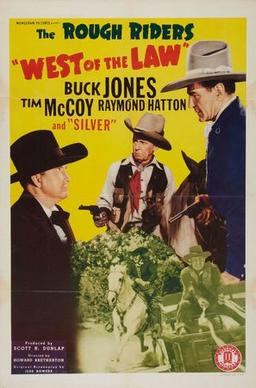
West of the Law (1942, directed by Howard Bretherton)


In the mining town of Gold Creek, an outlaw gang has been hijacking shipments of gold.  Newspaper publisher Rufus Todd (Milburn Morante) has learned that the head of the gang is saloon owner Jim Rand (Harry Woods).  Todd is planning on publishing a story identifying Rand as the outlaw leader on the front page of his newspaper so Rand’s secret partner, businessman John Corbett (Jack Daley) arranges for Rufus’s printing press to be blown up.

Rufus calls in his old friend, Marshal Buck Roberts (Buck Jones).  Buck arrives in town with his fellow Rough Riders, Tim McCall (Tim McCoy) and Sandy Hopkins (Raymond Hatton).  As usual, everyone is working undercover.  Buck pretends to be an outlaw named Rocky Sanders.  Tim claims to be a preacher who is not afraid to draw his gun and force everyone in the saloon to put down their drinks and listen while Rufus identifies Rand as being an outlaw.  Sandy is the new undertaker and his coffins prove useful for smuggling in some much needed equipment.

The eighth Rough Riders film trods familiar ground.  Once again, Buck is framed for a crime he didn’t commit and, as always, the villains are a businessman and a saloon owner.  Still, I enjoyed seeing Tim to pretend to be a preacher and Sandy had some funny moments are the town’s garrulous undertaker.  As always, McCoy, Roberts, and Hatton possessed an authentic western toughness that made them compelling heroes even in B-westerns like this one.

Since Tim McCoy reenlisted in the U.S. Army following Japan’s attack on Pearl Harbor, this was the last Rough Riders film to feature the original three riders and their chemistry and friendship are as strong as when the series first began.  The movie ends with the promise that the Rough Riders would ride again but sadly, it was not to be.  Though West of the Law doesn’t break any new ground, it’s still a decent finale for the original team.

Previous Rough Rider Reviews:

  1. Arizona Bound
  2. The Gunman From Bodie
  3. Forbidden Trails
  4. Below the Border
  5. Ghost Town
  6. Down Texas Way
  7. Riders of the West

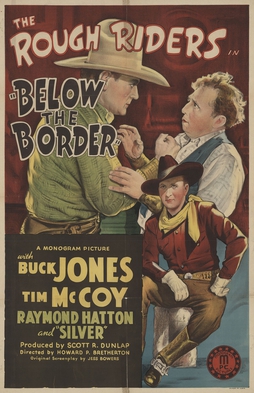
Below The Border (1942, directed by Howard Bretherton)


In the fourth Rough Riders film, the boys head down to Mexico City to defend the Garcia Ranch from a gang of cattle rustlers who are also planning on stealing the Garcia Family Jewels.  (Would the Rough Riders have any legal jurisdiction in Mexico?)  This time, Buck Roberts (Buck Jones) assumes the identity of a well-known outlaw who deals in stolen goods, Tim McCall (Tim McCoy) pretends to be a cattle buyer, and Sandy Hopkins (Raymond Hatton) gets a job sweeping up the local saloon.  As with almost all of the Rough Riders films, the owner of the saloon, Steve Slade (Charles King), is also the leader of the thieves.  Slade is blackmailing a reformed outlaw named Joe (Dennis Moore) into helping Slade and Scully (Roy Barcroft) steal the family jewels.  Joe is in love with Rosita Garcia (Linda Brent).

Below the Border has much in common with Forbidden Trails, the Rough Riders film that came before it, right down to a villainous saloon owner and a former outlaw being blackmailed to return to his old ways.  As usual, the outlaws try to humiliate Sandy Hopkins, just for Tim McCall to show up at the saloon and turn the tables.  Scully is a despicable bully and it feels good when McCall forces him to grab Hopkins’s mop and clean up the bar himself.

It’s not the strongest of the Rough Riders films. The plot is predictable, Linda Brent gives a terrible performance as Rosita, and even the action scenes are by-the-numbers.  The main appeal of Below the Border is to watch the three Rough Riders themselves.  Jones, McCoy, and Hatton all seem to have genuinely enjoyed working together and that comes through in their scenes together.  You never have any doubt that, even though they live in different parts of the country, all it would take is one telegram for them to get back together.  The highlight of each film is the final scene, where the Rough Riders tell each other what they’ve been up to between adventures.  This time, Buck invites everyone to visit him in Arizona but Tim has to get back to Wyoming and Sandy’s running a hotel in Texas.  They ride off separately but there’s little doubt they will reunite as soon as there’s a new rustler who needs to be brought to justice.

Previous Rough Rider Reviews:

  1. Arizona Bound
  2. The Gunman From Bodie
  3. Forbidden Trails