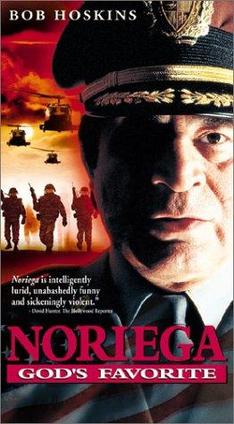
Film Review: Noriega God’s Favorite (dir by Roger Spottiswoode)


Everyone’s an expert on the Panama Canal nowadays.

Largely, that’s a result of President-elect Donald Trump openly musing about taking the canal back from Panama.  As soon as Trump uttered those words, every self-appointed pundit on every social media site in existence immediately jumped over to Wikipedia and skimmed over the articles on Panama, the Panama Canal, and Teddy Roosevelt.  Then, after Jimmy Carter died, those same people jumped onto Wikipedia and skimmed articles about Carter selling the canal to Panama for a dollar and the controversy that followed.  For weeks, it has been impossible to look at Twitter or Bluesky or even Mastodon without seeing someone giving their opinion on the canal, the 1989 American invasion of Panama, and the connection between the CIA and Manuel Noriega, the man who served as Panama’s military dictator for most of the 80s before being deposed and tossed into prison for being a drug smuggler.

Myself, I know better than to get my information from Wikipedia.  Instead, I get my information from movies.  For that reason, I attempted to educate myself on Panama and the canal by watching 2000’s Noriega: God’s Favorite.

Directed by Roger Spottiswoode, Noriega: God’s Favorite opens with a title card informing us of the story so far.  Manuel Noriega was born in the slums of Panama.  He grew up in poverty and was shunned because his mother was not married to his father.  Noriega spent his youth doing whatever he had to do in order to survive.  He was clever and ruthless but it wasn’t until he entered the Panamanian National Guard that he was able to really use those skills to his advantage.  Noriega became a CIA asset and worked his way through the ranks.  In 1983, with the support of American intelligence, Noriega became the de facto dictator of Panama, even though he never officially held any sort of title or executive position.

The film follows Manuel Noriega (Bob Hoskins) over the course of his final years as Panama’s dictator.  He’s portrayed as being a ruthless man who often pretends to be a buffoon in order to get his enemies to underestimate him.  He works with the CIA but still passes along intelligence to Fidel Castro (Michael Sorich), who is seen hitting on Noriega’s wife (Denise Blasor) during a visit to Cuba.  Noriega presents himself as a family man while having a number of mistresses.  He claims to an ally in the United States’s War on Drugs while attending cocaine-fueled parties.  He presents himself as being a pragmatist while actually being very superstitious.  A CIA agent (Edward Ellis) wins Noriega’s trust by manipulatively interpreting Bible verses for him.  When an army officer (played by Nestor Carbonell) tries to lead a coup against Noriega, he can only watch helplessly as Noriega personally executed all of his co-conspirators, going so far as to even chop off one man’s hands.  By the end of the scene, Noriega is drenched in blood but he’s undeniably happy.  Everyone knows that Noriega is an impulsive and dangerous dictator but the CIA allows him to stay in power until he starts to become an inconvenience.  Once Noriega’s notoriety starts to overshadow his usefulness, the U.S. promptly invades and Noriega’s power crumbles around him.

Bob Hoskins might seem like a strange choice to play a South American dictator but he does a good job in Noriega, playing the title character as being both a charismatic dictator and also an overgrown child who has never gotten over the struggles of his youth.  (Early on in the film, he is seen getting treatments to smooth his pockmarked skin, an indication that all the power in the world can’t cure lifelong insecurity.)  In the end, Noriega has much in common with the gangster that Hoskins played in The Long Good Friday.  Noriega is ruthless enough to become powerful but he ultimately falls victim to his own hubris.  When you’re in charge of something as valuable as the Panama Canal, the last thing you should do is anger the country that built it.

Lifetime Film Review: Sinister Stalker (dir by Michael Feifer)


Also known as Sinister Savior, this film tells the story of Karen (Marci Miller), an emergency room doctor and a recovering alcoholic.  One night, as she’s leaving an AA meeting, she’s attacked by an apparent mugger.  Fortunately, for her, Daniel (Kelly Blatz), just happens to be walking by the scene.  He steps forward and fights off Karen’s attacker, probably saving her life in the process.  However, during the fight, Daniel’s arm gets slashed with a knife.

Being a doctor (and, according to her best friend, also being way too trusting), Karen takes Daniel back to her house so that she can take a look at his wounded arm.  Daniel seems friendly-enough.  He says that he’s in real estate and that the reason he was in the neighborhood was because he was checking out potential properties to buy and sell.  Daniel also tells Karen that he’s never been in a real fight before.

Daniel, it turns out, already has several scars.  When Karen notices them and asks about them, Daniel says that he got them in a bar fight.  But …. uhmm, Daniel ….. you said you’d never been in a real fight before.  Daniel quickly explains that he wasn’t actually in the fight, he just got stabbed accidentally.  That may make sense but, even if Daniel isn’t lying about his past history, why does he have pictures of Karen’s house on his phone?

For those of us watching, red flags start to go up as soon as Daniel shows up.  That’s because this is a Lifetime film and, if you’ve seen enough of these films, you know better than to trust any good Samaritans.  The fact that this movie is called Sinister Stalker gives us another reason not trust Daniel.  When Daniel starts to talk about how much he and Karen have in common and makes a rather awkward joke about how they must have a connection, those of us in the audience are like, “Get out of there!”

But, of course, if Karen did that, there wouldn’t be a movie.  So, instead, Karen does stuff like take a shower while there’s a complete stranger hanging out in her home.  Meanwhile, Daniel is walking around the house and basically invading her space.  Various friends of Karen come by to check on her and Daniel tries to send them all away.  We know that there’s something not right about Daniel.  It’s just a question of how long it’s going to take Karen to figure that out as well.

Though the story may be familiar, Sinister Stalker does experiment a little with the typical Lifetime format.  As opposed to most Lifetime films, which usually take place over several days and typically feature a lot of visits to the neighborhood coffeeshop and at least one yoga class, the action in Sinister Stalker takes place in one location and over the course of just one night.  The film almost seems to play out in real time, which actually pays off surprisingly well.  The film actually does a petty good job of generating some suspense as to how long it’s going to take Karen to figure out that Daniel’s motives are not exactly pure.

Kelly Blatz is perhaps a little bit too obviously sinister as Daniel but Marci Miller does a great job in the role of Karen.  She plays up Karen’s hesitation just enough to suggest that she had her doubts about Daniel from the beginning but, at the same time, she also feels that she has an obligation — as both a doctor and someone whose life was saved by Daniel — to check out the wound on his arm.  In the small but important role of an alcoholic who keeps calling Karen for help, Lew Temple makes a good and sympathetic impression.

Sinister Stalker plays with the typical Lifetime format and, for the most part, it pays off.  Watch it the next time you’re tempted to let a complete stranger hang out in your house for a few hours.