 “Where’s the rest of me!?” — Drake McHugh (Ronald Reagan), upon waking up to discover that his legs have been amputated, in Kings Row (1942)
It is with that line that the 1942 best picture nominee Kings Row earns its place in film history. The formerly carefree and rich Drake had lost all of his money due to a crooked banker. However, instead of feeling for himself, Drake got a job working for the railroad and finally started to show that he was capable of acting like a mature, responsible adult. However, when Drake was injured in a boxcar accident, he had the misfortune to be taken to the sadistic Dr. Gordon (Charles Coburn). Gordon felt that it was his duty to punish those who he considered to be wicked and that’s exactly how he felt about about Drake. So, despite the fact that Drake had once been in love with Gordon’s daughter, Gordon proceeded to chop of Drake’s legs.
It’s just another day in Kings Row.
Of course, to an outsider, Kings Row looks like your typically calm and pleasant community. But behind closed doors, this small town is full of sordid secrets. Only those who have grown up in Kings Row understand the truth. Only they can understand how Drake McHugh could end up losing his legs.
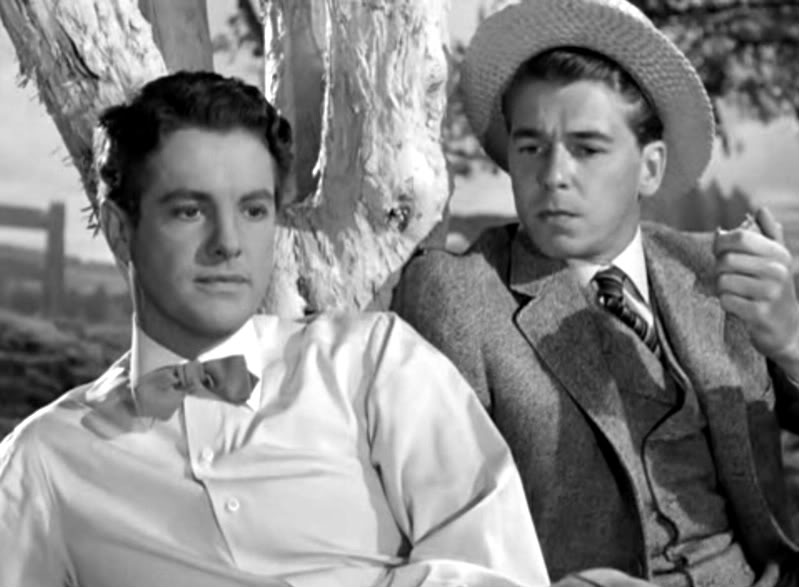
When they were both growing up at the turn of the century, Drake’s best friend was Parris Mitchell (Robert Cummings). While Drake was pursuing Dr. Gordon’s daughter, and being loved from afar by Randy Monaghan (Ann Sheridan), Parris was studying to be a doctor under the tutelage of Kings Row’s other doctor, Dr. Alexander Tower (Claude Rains). While Dr. Tower appeared to be a much nicer man than Dr. Gordon, he definitely had his eccentricities. For instance, there was the wife who was reportedly confined somewhere in the house and never allowed to leave. And then there was Dr. Tower’s daughter, Cassandra (Betty Field). Dr. Tower was very protective of Cassandra, perhaps too protective. How would Dr. Tower react when Parris, his best student, started to develop romantic feelings towards Cassandra?
Again, it’s just another day in Kings Row.
So, by now, it should be pretty obvious that Kings Row is one of those films that deals with big secrets in small towns. That, of course, is a theme that was explored by films that were made long before Kings Row. What made Kings Row unique is that it was perhaps the first film to actually portray that evil as specifically existing and thriving because of the repressive nature of a small town. Whereas other films had featured outsiders bringing bad habits to an otherwise innocent and idyllic community (and be sure to watch Hitchcock’s Shadow of a Doubt if you want a perfect example of this), Kings Row suggested that the very nature of its setting is what led to all of the melodrama. The film suggests that evil men like Dr. Gordon can specifically thrive in a town like Kings Row because his fellow townspeople aren’t willing to risk the placid surface of their existence by exposing him. As such, Kings Row serves as a template for all of the sin-in-a-small-town films and TV shows that have followed.
Beyond the film’s historical importance, Kings Row holds us pretty well as entertainment. As the film’s hero, Robert Cummings is a bit on the bland side but, fortunately, he’s surrounded by an excellent cast of character actors. It’s a bit of a cliché to say that Claude Rains was perfectly cast because, seriously, when wasn’t Claude Rains perfectly cast? But, in the role Dr. Tower, Claude Rains is perfectly cast. Charles Coburn makes for a perfectly terrifying villain. Ann Sheridan is likable and sympathetic as the woman who tries to help Drake recover after Dr. Gordon takes away his legs. And finally, you’ve got future President Ronald Reagan in the role of Drake McHugh. Reagan is usually dismissed a being a pretty boring actor (and I really haven’t seen enough of his films to say one way or the other) but he gave a great performance in Kings Row.
And that’s why, even beyond its historical significance, Kings Row is still a film that is more than worth watching.
 Through the Shattered Lens