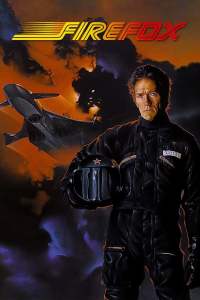
Firefox (dir. by Clint Eastwood)


You’d think someone with a face as chiseled as Clint Eastwood’s, he wouldn’t fit in well in the spy game. You’d recognize him almost anywhere in a line up. However, being able to direct your own films means you can still be the best person for a role. There is no finer example of this than with 1982’s Firefox, my submission for the Eastwood birthday celebration on the Shattered Lens. It’s not the strongest spy film, but it plays it’s hand very well, getting in and delivering the short jabs to set the tale and then finishing with an action packed combo in the film’s third act. 1990’s The Hunt for Red October may be more famous film about smuggling a vehicle from Russia to America, but Firefox did it first (Okay, From Russia With Love may have beaten them both, but we’re talking planes and subs, not a cipher box).

I remember first noticing Firefox while driving by the smaller of two movie theatres at the Green Acres Mall over in Valley Stream with my parents. Not every film hit the Sunrise Multipex, so the little Odeon (at least I think it was called an Odeon) held other films. My family caught Predator, Aliens, and Nine Months there to name a few. When I finally saw the movie, I didn’t care for it (to my credit, I was like 10 or 12), but loved the flying sequences. As an adult, the film makes more sense and deserves a watch despite a few tiny flaws here and there. Firefox marks Eastwood’s first production credit, despite The Malpaso Company having made films way before then.

Based on the 1977 novel by Craig Thomas, Firefox focuses on Mitchell Gant (Eastwood), one of the best pilots in the United States Air Force. Despite having some PTSD, Gant is sent on a mission in the height of the Cold War. His job is to sneak in and steal the Mig-31, Codename: Firefox, an experimental aircraft capable of speeds of Mach 5, extreme stealth and a special thought based firing system. He has all the necessary credentials. He can speak the language, has a good build and can fly the plane. After receiving a brief from his superiors (including Freddie Jones, who was in just about everything in the Early 1980s – Dune, Krull, Firestarter, Lifeforce), he’s dropped into Russia for his mission. Can Gant get the plane without getting in trouble? Unlike Top Gun, which used a fictional aircraft in the MiG-28, there was an actual MiG 31 in existence (or introduced to the world) at the time of filming Firefox, known as the “Foxhound”. The real MiG 31 and the films’ one are different. It was just a coincidence, but I know my Dad would point that out if he watched it.

What I loved the most about Firefox is that Gant’s character has to assume multiple roles/characters in order to blend in with the crowd and keep the KGB off of his tail. While we’re all aboard for seeing the plane in action, the real adventure is getting there and the characters that help along the way. One wrong turn, one wrong move could mean the different between success and failure, and it does get pretty tense in places. There’s one particular scene in a shower where I was like “Uhm, get up, get going, they’re on to you!”, but the pacing of the film is pretty good. As a director, Eastwood keeps the film moving without lingering too long in any one scene unless it’s truly necessary. This, along with some quick cuts and getting the most of the cast’s performances, allows the film to make some good use of the 2 hour and 16 minute runtime.

Firefox has a supporting cast that also helps to move the story along. Outside of Freddie Jones, we also have Kenneth Colley (Admiral Piett from The Empire Strikes Back & Return of the Jedi) as the Russian Colonel on Gant’s tail. Warren Clark’s (A Clockwork Orange) gruff character helps Gant to navigate through the city. Both Nigel Hawthorne (Demolition Man) and Ronald Lacey (Raiders of the Lost Ark) play scientists loyal to Gant’s mission. Wulf Kahler (also from Raiders of the Lost Ark) is on hand as a Russian military advisor. Alan Tivern, who played R.K. Maroon in Who Framed Roger Rabbit? is also in this, as is Toy Story’s John Ratzenberger.

One other element I enjoyed was how they resolved the actual flight sequences. Since Gant is in a fighter plane alone, there really isn’t any need to have any communication. The movie uses the black box in the plane both as a recording device for Gant’s actions, and a way for Eastwood to help narrate his intentions through the course of the third act. It helps to fill what would have normally been a near silent sequence (save for the evasive maneuvering). The flight sequences were developed by Star Wars alumni John Dykstra along with Johnathan Erland, who used a special blue screen effect that allowed reflective objects to move in front of lighter backgrounds or matte photography using UV light. It was pretty innovative at the time, even if it may look a little cartoony now.

Maurice Jarre (who I swore was Australian because of his work on the Mad Max films up until a first time watch of Lawrence of Arabia in 2024) scored Firefox, giving the film a mix between dark synths and patriotic tunes. The music definitely sets the tone leading up to the third act, though

Overall, Firefox is a good watch if you’re looking for a bit of late night espionage. As an actor, Eastwood’s Gant plays a mix of the everyman and spy (knowing when to hush, when to move and when to knock someone out) so well that I could easily imagine this as a recurring role for him, if he wanted to go that route. The film’s supporting cast is where it truly shines, as the contacts Gant makes during his mission are key to his success.

Sahara (1983, directed by Andrew V. McLaglen)


The year is 1927 and famed automobile designer R.J. Gordon (Steve Forrest) dies before he can enter his latest creation into the Trans-African Auto Race across the Sahara Desert.  Wishing to keep her father’s dream alive and prove that she’s just as good a driver as the boys, R.J.’s daughter, Dale (Brooke Shields), enters the race in his place.  Since women are not legally allowed to compete, Dale has to pretend to be a man.  She does this by wearing a fake mustache, which she tosses off as soon she drives over the start line.  It has to be seen to be believed.

Dale and her team set out on the race and they quickly get caught up in a tribal war between two separate factions of Bedouins.  Dale is captured by the lascivious Rasoul (John Rhys-Davies), who attempts to have his way with her.  Fortunately, Dale is rescued by Rasoul’s nephew, Sheikh Jafar (Lambert Wilson).  Jafar is enchanted by Dale’s beauty and wants her to marry him.  Dale eventually agrees but, the morning after the wedding, she sneaks out of Jafar’s tent, jumps back in her car, and rejoins the race.  When she gets captured by the other Bedouins, they force her to stand on a rock while surrounded by panthers.  Like Brooke with a mustache, it has to be seen to be believed.

Sahara was produced by Cannon Pictures.  Menahem Golan, who gets a story credit along with his usual producers credit on this film, was a self-described fan of Rudolph Valentino and Sahara was his attempt to pay homage to Valentino’s performance in The Sheik, as well as cashing in on the adventure zeitgeist that had been launched by the box office success of Raiders of the Lost Ark.  With a budget of $15 million, Sahara was one of Cannon’s most expensive films and the end result was a mix of high production values and typical Golan-Globus goofiness.  The desert cinematography may be impressive but this is still a strangely old-fashioned movie starring Brooke Shields as a race car driver who speeds through the desert without once getting a hair out of place.  As attractive as she was, Brooke was never much of an actress and requiring her to show more than one emotion at a time, as Sahara often does, seems like the ultimate act of hubris.  Say what you will about the films that Cannon made with Bronson and Norris, the two Chucks always seemed like they were perfectly cast.  Shields also has no chemistry with Lambert Wilson, who looks embarrassed at having to pretend to be Rudolph Valentino.  On the plus side, Raiders of the Lost Ark alumni Rhys-Davies and Ronald Lacey are both present in the film and seem to know better than to take any of it seriously.  Rhys-Davies especially always seems to be on the verge of laughing at his terrible dialogue.

Though the view may be impressive, the script is bad and the lead actors are lost.  Avoid Sahara at all costs.

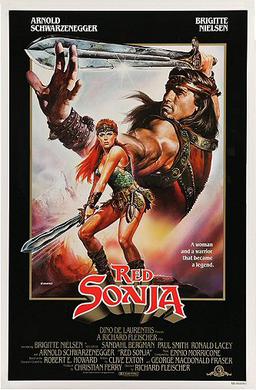
The TSL’s Grindhouse: Red Sonja (dir by Richard Fleischer)


The 1985 film, Red Sonja, invites us to take a journey to a forgotten age, a time of a mythical kingdoms, evil sorcery, epic sword fights, and annoying little child kings who spent a lot of time shouting.  It’s a time of wonder, danger, heroism, and, of course, Arnold Schwarzenegger.

Reportedly, the once and future governor of California has frequently named Red Sonja as being the worst film in which he ever appeared.  When you consider some of the other films that have featured Gov. Schwarzenegger, that’s indeed a bold statement.  In Red Sonja, Schwarzenegger plays Lord Kalidor.  Interestingly enough, Lord Kalidor is absent for the majority of the film.  He shows up briefly at the beginning of the film and then he vanishes for quite a bit of Red Sonja‘s 89-minute running time.  Whenever Schwarzenegger does show up, he wears the smirk of a man who knows that he’s going to get paid a lot of money for doing very little actual work.

The majority of the film focuses on Sonja (Brigitte Nielsen), a warrior who lives in one of those vanished ages, perhaps after the War of the Rings but before the sinking of Atlantis.  When we first see her, she’s being spoken to by what appears to be a puff of smoke, which is apparently meant to be some sort of warrior goddess.  The puff of smoke fills tells Sonja about everything that happened to her before the start of the movie, though we never do learn why Sonja needs to be told her own backstory.  After rejecting the sexual advances of the evil Queen Gedren (Sandahl Begman), Sonja was forced to watch as her parents and brother were murdered and then she was raped and left for the dead by the Gedren’s soldiers.  The Goddess promises to make Sonja into a superior warrior, on the condition that Sonja agree to never have sex with a man unless that man can first beat her in fair combat.  Sonja agrees and is sent off to get trained by the Grand Master.  It’s kinda like Kill Bill, if Bill was a puff of smoke.

Jump forward to …. well, I’m not sure how many years pass.  To be honest, it’s next to impossible to really discern any sort of coherent logic to the film’s narrative progression so let’s just give up on that.  What’s important is that there’s this temple and, inside the temple, there’s a glowing green talisman.  Apparently, the talisman created the world but now it needs to be carefully watched over before being destroyed.  Only women are allowed to handle the talisman (Yay!) but they’re not allowed to destroy it unless directed by a man.  (Booooo!)  The temple priestesses are waiting for Lord Kalidor to arrive so that they can get rid of the talisman.  However, Queen Gedren shows up first.  Not only does she steal the talisman but she kills the priestesses as well.

One of the priestesses was Varna (Janet Agren, who you might recognize from Lucio Fulci’s City of the Living Dead).  Varna just happens to be the sister of Sonja.  (Sonja is now known as Red Sonja, because she had red hair.  From now on, I want to be known as Red Lisa.)  Now, Sonja has yet another reason to want to kill Gedren!  Rejecting Kalidor’s help, Sonja heads off for revenge.  Along the way, she meets an annoying child king named Tarn (Ernie Reyes, Jr.), who is upset that Gedren previously destroyed his kingdom.  Despite hating him, Sonja allows Tarn and his guardian, Falkon (Paul L. Smith), to tag along with her.  Despite not being an official member of the revenge party, Kalidor decides to follow after them because he wants to beat Red Sonja in fair combat, if you get what I mean.

Red Sonja is a spectacularly silly film.  The dialogue is stilted.  Even by the standards of the 1980s ,the special effects are poorly executed.  This the type of film where the evil Queen nearly destroys the world not because she has any sort of grand scheme but instead, just because she’s evil and that’s what evil people do.  Brigitte Nielsen delivers her lines with a forced solemnity while Schwarzenegger, Bergman, and the great Paul L. Smith seem to be struggling not to start laughing.

And yet, there’s a sneaky charm to be found in all of the silliness.  For instance, when Sonja does finally reach the queen’s castle, she has to cross a bridge that appears to basically be the skeleton of giant rhinoceros.  No none in the film seems to be surprised to come across a skeleton a giant rhinoceros and, to be honest, there’s no reason for it to be there.  It’s just there and it’s so wonderfully out-of-place that it becomes rather fascinating.  Add to that, while the portrayal of the evil lesbian queen is problematic in all sorts of ways, this is a film about a strong female warrior who doesn’t need a man to rescue her and that was probably even more rare in 1985 than it is today!

Watching Red Sonja, you get the feeling that nobody involved in the film took it all that seriously and that perhaps the best way to handle the movie is to just sit back and have a laugh.  It’s dumb, it’s campy, it often makes no sense but, at the same time, it’s still a lot easier to follow than Game of Thrones.   Like many bad films, it’s only bad if you watch it alone.  Watch it with a group of your snarkiest friends and you’ll have a totally different experience.