In 1978, Trevor Nunn staged what would become a legendary production of William Shakespeare’s Macbeth. The play was produced in a small studio theatre, with the actors working in the round were minimum sets and costuming. Shifts in location or mood were indicated are by lighting changes. It was a production that captured both the intensity of the play but also the horror of Shakespeare’s play about ambition, guilt, fate, and multiple murders. Macbeth and Lady Macbeth were played by Ian McKellen and Judi Dench.
This production was filmed and, in 1979, broadcast on Thames Television in the UK. Here, for today’s staged horror, is the Trevor Nunn production of MacBeth, starring Ian McKellen and Judi Dench.
Welcome to Retro Television Reviews, a feature where we review some of our favorite and least favorite shows of the past! On Sundays, I will be reviewing the made-for-television movies that used to be a primetime mainstay. Today’s film is 1993’s The Tower! It can be viewed on YouTube!
The plot of 1993’s The Tower could probably best be described as, “Paul Reiser gets a job and gets everyone killed.”
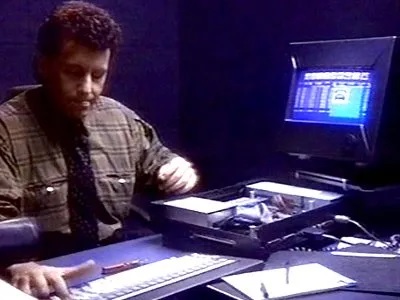
Technically, Paul Reiser is playing Tony Minot, a guy who would rather spend his time in his apartment, composing new age synthesizer anthems and eating left over pizza, than actually go to work. But make no mistake about it. Tony is basically Paul Reiser, all the way down to the neurotic mannerisms and the bad jokes.
Anyway, through the help of an old friend, Tony has gotten a job. He’s going to be working in a state-of-the-art tower, one that is totally run by a computer system known as CAS. CAS is designed to eliminate any and all security threats. For instance, when an unauthorized pigeon lands on the tower’s roof, it doesn’t take long for CAS to reduce that pigeon to a bunch of floating feathers. Tony has been told that it’s very important that 1) he have his security card with him at all times and 2) that he not damage his security card in any way.
So, of course, Tony damages his security card.
With the help of a security guard, Tony still manages to get inside the tower but, since his card doesn’t work, CAS considers Tony to be a security risk. When Tony proceeds to casually violate several security rules and stays in the building after hours, CAS decides to destroy him. Unfortunately, since Tony is kind of needy and always has to have people around him, everyone else in the building ends up getting killed too.
(This is a 1993 film and it was made for television so none of the kills are especially interesting. One guy gets caught in the closing doors of an elevator. Someone else gets trapped in an overheated sauna.)
The majority of the film deals with Tony crawling around the building, just like Bruce Willis in Die Hard. CAS is determined to kill both him and his potential love interest. We’re supposed to be angry at CAS and concerned about the world’s dependence on technology but you know what?
THIS IS ALL TONY’S FAULT!
Seriously, if Tony hadn’t damaged his card, none of this would have happened. Tony was specifically told not to damage his card but obviously, it didn’t occur to him that maybe he should try to follow the rules of his new workplace during his first day on the job!
The Tower is very much a film of its time. That’s obvious just from the cartoonish CGI and the fact that someone thought casting Paul Reiser as a Die Hard-style action hero was a good idea. Beyond that, it’s a film that’s very concerned about the rise of computers and technology. In 1993, I’m sure audiences were like, “OH MY GOD! COMPUTERS CAN’T BE REASONED WITH!” but, when I watched the film last night, I was just like, “So, they don’t have voice or facial recognition? What type of company is this?”
Anyway, The Tower is not exactly a good movie but it’s oddly watchable. Maybe it’s just because of how strange it is to see Paul Reiser doing the whole Die Hard thing. (Before anyone asks, The Tower was not meant to be a spoof. In fact, it takes itself pretty seriously.) Or maybe it’s just the fact that, by the end of the movie, you’ll totally be on the Tower’s side.
Though the Academy of Motion Picture Arts and Sciences claim that the Oscars honor the best of the year, we all know that there are always worthy films and performances that end up getting overlooked. Sometimes, it’s because the competition too fierce. Sometimes, it’s because the film itself was too controversial. Often, it’s just a case of a film’s quality not being fully recognized until years after its initial released. This series of reviews takes a look at the films and performances that should have been nominated but were,for whatever reason, overlooked. These are the Unnominated.
First released in 1983, Star 80 is an examination of fame, obsession, misogyny, and finally madness. All four of those qualities are exemplified in the character of Paul Snider (Eric Roberts), a man with a charming smile, a ludicrous wardrobe, and the personality of a pimp. When we first see Paul Snider, he’s naked and he’s covered in blood and he’s ranting about how the world is trying to destroy him. Even if he wasn’t holding a rifle, he would be terrifying. Suddenly, we flash back to a few years earlier. Snider is being dangled out a window by two men. Snider pathetically begs to be pulled back into the room. The men laugh at him before pulling him up. Snider, looking fairly ridiculous in a cheap suit that he probably thinks makes him look like a celebrity, fights off tears as he says he deserves to be treated with dignity.
Star 80 is based on a true story. Mariel Hemingway plays Dorothy Stratten, the actress and Playboy playmate who was murdered by Paul Snider. Snider, who often claimed credit for having “made” Dorothy, was married to her at the time, though Dorothy had filed for divorce and was dating director Peter Bogdanovich. Unwilling to let her go and return to being a small-time hustler, Snider shot Dorothy and then himself. Director Bob Fosse, who was best known for directing musicals like Cabaretand All That Jazz, was attracted to the story because he understood that type of world that produces sleazes like Paul Snider. According to Eric Robets, Fosse even said that he probably would have ended up like Paul Snider if not for his talent.
Snider, the film quickly establishes, really doesn’t have any talent beyond the ability to manipulate people who are too naïve to see through his bullshit. Snider wants to be a star. He wants to be rich. He wants people to kiss his ass. When he meets Dorothy, he sees her as his ticket. Dorothy’s mother (a poignant performance from Carroll Baker) sees straight through him from the start. Tragically, Dorothy doesn’t realize the truth abut who he is until they’re already in Hollywood. As Dorothy tries to break away from him, Paul desperately tries to find some sort of success, all the while complaining that the world is conspiring to keep him from being a man.
Eric Roberts dominates the film and it’s one of the scariest performances that I’ve ever seen. Roberts is convincing when he’s ranting and raving against the world that he feels is against him but what’s even more disturbing is that he’s convincing when he’s turning on the charm. Paul Snider may not be smart. Paul Snider may not be talented. But he know how to gaslight. He knows how to destroy someone’s fragile confidence, largely because his own confidence has been shattered so many times that he’s become an expert in exploiting insecurity. Snider is a tacky dresser and nowhere near as smooth as he thinks but, intentionally or not, he uses that to his advantage. He tries so hard to impress that it’s easy to see how someone could feel sorry for him and want to help him. However, because Fosse lets us know from the start what Snider is really going on inside of Sinder’s head, we never make the mistake of trusting him. We know who Paul Snider is because we’ve all known a Paul Snider.
Eric Roberts’s performance is so intense that it’s unfortunate but not surprising that it was overlooked at the 1983 Oscars. He was playing a truly repellent character and he did it so convincingly that I imagine many viewers had a hard time realizing that Eric Roberts was not Paul Snider but was instead an actor playing a terrible character. Some probably said, “Why should we honor such a loathsome character?” and again, the answer is because there are many Paul Sniders out there. Roberts captured much more than just one man’s breakdown. He captured a sickness at the heart of a fame-driven culture.
Of course, Paul Snider was not the only symptom of that sickness to be depicted in Star 80. Every man that Dorothy either uses her in some way or just views her as being a commodity. Hugh Hefner (Cliff Robertson) presents himself as being a fatherly mentor but Robertson plays him as being just as manipulative and ultimately narcissistic as Paul Snider. Director Aram Nicholas (Roger Rees, playing a character based on Peter Bogdanovich) seems to love Dorothy but their relationship still feels out-of-balance. Aram, afterall, is the director while Dorothy is the actress. The private detective (Josh Mosel) that Paul hires to spy on Dorothy seems to have no lingering guilty over the role he played. Even Snider’s roommate (David Clennon) is more interested in talking about his dog and his car then about the murder/suicide of two people with whom he lived.
It’s a dark film and not one to be watched when depressed. At the same time, it’s a portrait of obsessiveness, misogyny, and an overwhelming need to be “someone” that still feels relevant today. Along with Sweet Charity, it was the only Bob Fosse film not to be nominated for Best Picture. (This was back when there were only five best picture nominees. Three of the nominated films — Terms of Endearment, Tender Mercies, and The Right Stuff — hold up well. Two of the nominees — The Dresser and The Big Chill — are a bit more iffy.) Eric Roberts was not nominated for the best performance of his career. Again, it’s a shame but not a surprise. This was a dark and disturbing film, a true Hollywood horror story. One imagines that most members of the Academy wanted to escape it far more than they wanted to honor and be reminded of it.
This is our favorite time of the year here at the Shattered Lens because October is horror month. For the past five years, we have celebrated every October by reviewing and sharing some of our favorite horror movies, shows, books, and music!
A part of the tradition of Horrorthon is that we begin every day in October by sharing a free movie. Now, I should warn you that most of these movies will come from YouTube and you know how YouTube is about yanking down videos. So, if you’re reading this in 2024 and wondering where the promised movie disappeared to … well, you should have watched it in 2018!
Let’s start things off with the 1993 made-for-television movie, The Tower!
Have you ever asked yourself what Die Hard would have been like if it had starred Paul Reiser and the Alan Rickman role had been played by an overzealous automated security system? Well, watch The Tower to find out! This is one of those movies where the hero, played by Paul Reiser of all people, manages to get almost everyone in the movie killed and yet we’re not supposed to hold it against him.
By the end of the movie, you’ll totally be on The Tower’s side!


 Through the Shattered Lens