30 Days of Noir #29: Johnny O’Clock (dir by Robert Rossen)


The 1947 film, Johnny O’Clock, invites us to take a behind-the-scenes look at the sleazy and sordid world of casino management.  If that doesn’t intrigue you, just consider that the man character is named Johnny O’Clock.

Seriously, that’s a really kickass name.  I have to admit that, if my last name was O’Clock, I would be tempted to name my child Four Twenty.  But, that said, Johnny is a pretty good name too.  On the one hand, he’s got an all-American name like Johnny but he’s also got a last name — O’Clock — that promises mystery and danger.  Johnny O’Clock is also played by Dick Powell, who was always good at playing tough guys who had a heart of gold.  (Along with appearing in several noir films, Dick Powell was also the first actor to ever play the famed detective, Philip Marlowe.)

Johnny O’Clock is a partner in a casino with Guido Marchettis (Thomas Gomez).  Johnny and Guido are longtime business partners who find the future of their casino threatened when a hat-check girl named Harriet Hobson (Nina Foch) dies under mysterious circumstances.  Even though the crime scene was clearly set up to make it appear as if Harriet committed suicide, it doesn’t take Inspector Koch (Lee J. Cobb) long to figure out that Harriet was actually murdered.

Who killed Harriet?

Was it her boyfriend, Chuck Blayden (Jim Bannon)?  Chuck is a corrupt cop who has been trying to convince Guido to force Johnny out of the casino and instead hire Chuck instead.

Or is the murderer Guido’s wife, Nellie (Ellen Drew)?  Nellie used to be Johnny’s girlfriend and, as soon becomes obvious, she still has feelings for him.  When she attempted to give Johnny a romantic present, Johnny’s response was to give it to Harriet so that Harriet could return it.  Did Johnny’s rejection of Nellie push her over the edge and did she take her anger out on Harriet?

Or maybe the murderer was Guido.  Guido, after all, is a rather shady sort.  Maybe Harriet discovered something that she shouldn’t have.

Then again, you could also say the same thing about Johnny O’Clock….

Inspector Koch isn’t the only person determined to get to the truth!  Harriet’s sister, Nancy (Evelyn Keyes), also shows up and starts to investigate on her own.  Soon, she and Johnny are falling in love but Johnny knows that the situation is too dangerous for either him or Nancy to stick around the casino.  He starts to make plans to flee with her to South America but he’s got just a few things to do before they can leave….

Johnny O’Clock was the first film to be directed by Robert Rossen, who is often credited as being one of the most important filmmaers in development of American film noir.  A year after Johnny O’Clock was released, Rossen’s All The King’s Men would win best picture.  Rossen’s career was derailed when he was accused of being a communist and blacklisted in the 50s.  Like Elia Kazan, Rossen initially took the fifth but he later relented and “named names” to the House UnAmerican Activities Committee.  Though Rossen would later direct the Oscar-nominated The Hustler in 1962, it can be argued that Rossen’s career never recovered from either being blacklisted or from naming names.

Clocking in at 93 minutes, Johnny O’Clock is probably about 20 minutes too long and the murder mystery is never really as intriguing as you might hope it would be.  On the positive side, the casino is stylish and the cast is full of noir talent.  Dick Powell is a likable, if occasionally bull-headed, protagonist and Lee J. Cobb is well-cast as Inspector Koch.  (The film has some fun contrasting the glitz of the casino with the shabbiness of Koch.)  Burnett Guffey’s black-and-white cinematography gives the film a properly noirish look and, while the pace may be slow, the occasional bursts of action are well-handled.  The scene where Johnny is nearly the victim of a drive-by shooting is particularly exciting.  Johnny O’Clock is a flawed noir but the cast is good enough to hold the interest of fans of the genre.

Lisa Watches an Oscar Nominee: The Hustler (dir by Robert Rossen)


Hustler_1961_original_release_movie_posterFor my final Oscar-nominated film of the night, I watched the 1961 film The Hustler.

Filmed in harsh black-and-white and featuring characters who live on the fringes of conventional society, The Hustler is one of those films that’s so unremittingly bleak that it would probably be so depressing as to be unwatchable if not for the talented cast.  Paul Newman plays “Fast Eddie” Felson, a pool hustler who is talented but cocky, a guy who has the talent of a winner and the self-centered, self-pitying personality of a loser.  When we first meet Eddie, he and his manager, Charlie (Myron McCormick) have traveled all the way from Oakland to New York, all so Eddie can challenge and hopefully beat the legendary pool player Minnesota Fats (Jackie Gleason).  Eddie does get his chance to challenge Minnesota (or perhaps I should call him Mr. Fats?) and comes close to winning.  However, in the end, Eddie is too arrogant and impulsive and he ends up losing to Mr. Fats.

Defeated and humiliated, Eddie is hiding his meager possessions in a storage locker at the local bus station when he first meets Sarah Packard (Piper Laurie).  Sarah is an alcoholic and an aspiring writer.  She claims to be a part-time student but we never actually see her in class.  She walks with a pronounced limp and she has a habit of declaring the world to be “perverted, twisted, and crippled.”  Soon, she and Eddie are living together, two lost souls who support and destroy each other at the same time.  When Sarah attempts to write a short story about Eddie, Eddie responds by destroying the page and ordering her to never write about him again.  Charlie views Sarah as a destructive influence and decides that he doesn’t want to have anything else to do with Eddie.

However, Eddie soon finds a new manager.  Bert Gordon (a demonic George C. Scott) is a gambler who says that if Eddie sticks with him, Eddie will not only get rich but he’ll defeat Minnesota Fats as well.  At first, Eddie wants nothing to do with Bert but, when his own attempts at hustling lead to him getting his thumbs broken, Eddie has a change of heart.  Under Bert’s guidance, Eddie find success but he does so at the expense of what little decency that he had to begin with…

Eddie is an interesting character, one who most viewers will probably have mixed feelings about.  On the one hand, he’s a jerk.  He’s an arrogant, cocky jerk who thinks that he’s the best and who either uses or allows himself to be used by almost everyone that he meets.  Though he definitely ends up being exploited by Bert, Eddie knew what he was getting into when he made his deal with the devil.  Though he loves Sarah and she loves him, Eddie still treats her poorly.  There are just so many reasons to dislike Eddie Felson.

Except, of course, Eddie Felson is played by Paul Newman.

Seriously, it is possible to dislike a character played by Paul Newman?  As an actor, Newman was so charismatic and projected an innate goodness that came through even when he was playing a character who didn’t always do nice things.  As written, the character of Eddie spends the majority of the movie acting like a louse.  But, as played by Newman, Eddie becomes a wounded anti-hero, the bad boy that every girl dreams of somehow redeeming.

Ultimately, there are many reasons to see The Hustler.  Gleason and Laurie both give good performances.  George C. Scott, meanwhile, is like a force of nature.  Just listen to him as he shouts, “You owe me money!”  Director Robert Rossen finds an odd beauty in some of the sleaziest parts of New York City.  But, in the end, the main reason to see The Hustler is for Paul Newman’s amazing performance in the title role.  It’s a great performance that elevates the entire film.

I have to admit that I don’t know much about pool.  During my first college semester, I lived in a dorm that had a pool table in the front lobby.  There was always a large group of people gathered around that table, playing pool and generally looking like a bunch of hipster douchebags.  Sitting in the lobby meant having to listen to a constant soundtrack of balls clacking against each other, followed by people saying, “Such-and-such in the corner pocket” or whatever the Hell it is people say when they’re playing pool.  (To be honest, though I could hear the voices, I rarely listened to what they were actually saying.)  I don’t know if the people playing pool in the lobby were any good.  But, after seeing The Hustler, I can say that Eddie Felson would have beaten all of them.


Embracing the Melodrama #10: All The King’s Men (dir by Robert Rossen)


All The King's Men

“The people are my study.” — Governor Willie Stark (Broderick Crawford) in All The King’s Men (1949).

We close today’s embrace of melodrama by taking a look at one of the best political films ever made, the 1949 best picture winner All The King’s Men.

All the King’s Men tells the story of a demagogue named Willie Stark (Broderick Crawford, who deservedly won an Oscar for his powerful and intimidating performance here).  When we first meet Willie, he’s a poor farmer and political activist whose attempts to run for a minor office in an unnamed southern state are defeated by the state’s corrupt political machine.  Instead of being intimidated, Willie is instead inspired to go to law school and become a lawyer who fights for the people.  When an elementary school fire escape collapses and kills several children, Willie sues the construction company that built the school.

This also brings Willie to the attention of cynical political operative Sadie Burke (Mercedes McCambridge, who also won a very deserved Oscar for her performance).  Sadie works for the state’s governor, who happens to be locked in a tight election campaign with a political reformer.  Sadie is dispatched to convince Willie to run for governor, with the idea being that Willie will take votes away from the reform candidate and therefore allow the governor to be reelected.

Everyone originally assumes that Willie is just a hick who will be easily manipulated.  And, at first, Willie proves to be an uninspiring campaigner.  It is only after he over hears his aide Jack Burden (John Ireland) talking to Sadie that Willie realizes that he’s being set up.  Willie responds by going to a country fair, dramatically ripping up his prepared speech, and then launching into a spell-binding speech in which he tells the people at the fair that, since they’re all hicks, they’ll only have power once they elect another hick to the governor’s office.  Newly energized and angry, Willie is nearly elected governor.

Four years later, Willie is back and he’s running for governor again.  He’s still giving loud populist speeches but, as Burden notes in his voice over narration, the difference is that Willie is now the establishment candidate.  He may be giving speeches promising hope and chance and attacking the rich but Willie will still take their money and watch out for their interests if that’s what he has to do to get elected.  (Sound like any Presidents that we might know?)

Once Willie is elected governor, he runs his state like a dictator, engaging in blackmail, demagoguery, and maybe even murder to get everything he wants.  He may still claim to be a hick but, as both Burden and Sadie realize, Willie has become exactly what he originally claimed to be against.  However, after Willie’s son (John Derek) kills a girl in a drunk driving accident and Burden discovers that the woman he loves has become Willie’s mistress, it starts to become apparent that Willie’s corruption has created a world that is spinning even out of Willie’s control.

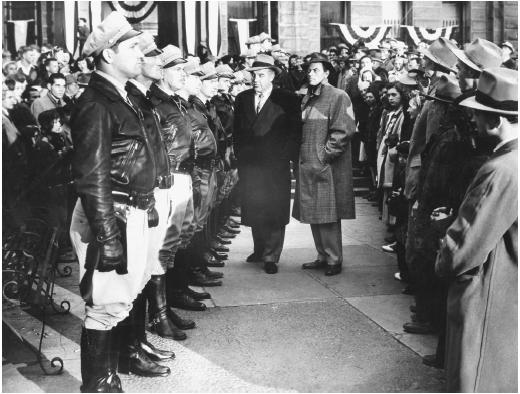
All The King’s Men may be a political film but it feels more like a gangster film, with Willie Stark coming across less as a politician and more like a crime lord.  Director Robert Rossen directs in a style that owes a lot to film noir and the entire film is full of shadowy figures and secret plotting.  Though the film starts out on almost a comical note, with a lot of emphasis being put on Willie Stark’s simple ways, it eventually reveals itself to be a truly disturbing portrait of what happens when one man is overwhelmed by his lust of power.  Rossen is aided by a uniformly excellent cast.  While I already specifically mentioned Crawford and McCambridge, it would be very wrong to review All The King’s Men without mentioning an actor named Walter Burke.  Burke played Willie’s bodyguard.  He said, at most, maybe 3 sentences over the course of the entire film but Burke had such a memorable and intimidating presence that his unsmiling face is one of the defining images of the film.

The short, scary man smoking the cigarette?  That's Walter Burke.

The short, scary man smoking the cigarette? That’s Walter Burke.

Finally, not surprisingly, All the King’s Men remains just as relevant today as when it was first released.  We love our demagogues in America, especially when they pretend to be “just like us.”  (And if anyone doubts that, I suggest they spend a few minutes listening to all of the potential Presidential contenders bragging about how they’ve been dead broke, how they’re known as Average Joe, and how much they hate the very political system that they continue to perpetrate.)   We love to condemn our Willie Starks but, at the same time, we also love to keep electing them.

All The King's Men 2