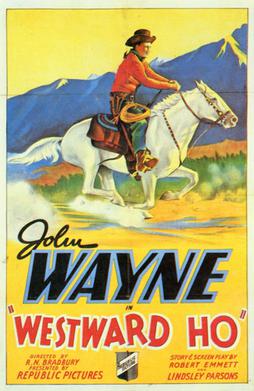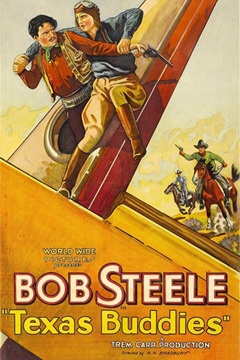
Westward Ho (1935, directed by Robert N. Bradbury)


As a young man, John Wyatt (John Wayne) witnessed an attack on a wagon train by the evil outlaw Wick Ballard (Jack Curtis).  John’s parents were killed and his younger brother Jim was abducted.  Years later, the grown John Wyatt realizes that the law cannot be depended upon in the wild west so he raises his own band of vigilantes and delivers justice to the frontier.  (Wayne’s second-in-command is played by the legendary Glenn Strange.)  Wyatt remains committed to taking down Ballard.  Going undercover as John Allen, Wyatt joins a cattle drive that he thinks will be attacked by Ballard.  Also working undercover as a member of the cattle drive is Jim Wyatt (Frank McGlynn Jr), John’s long-lost brother, who is now working for Ballard!  Both the Wyatt bothers end up falling for Mary Gordon (Sheila Bromley), the daughter of rancher Lafe Gordon (Jim Farley).

This was a good example of the the type of B-movies that John Wayne made in the years before John Ford cast him in Stagecoach.  The story is simple but Wayne gives a commanding performance as Wyatt.  Unlike many of the B-movies that featured Wayne as a callow singing cowboy or a fun-loving rogue, Westward Ho features Wayne playing the type of character that he would often play after he became a star.  Wyatt is determined to get justice for his family and to protect the innocents who are attacked by men like Ballard.  The presence of his brother in the enemy camp adds an extra dimension to Westward Ho.  Wyatt learns that vengeance isn’t everything.

It’s only 61 minutes long but it tells a good story and it has all the gunfights and horse chases that Western fans expect from their movies.  Of Wayne’s poverty row westerns, Westward Ho is one of the better ones.

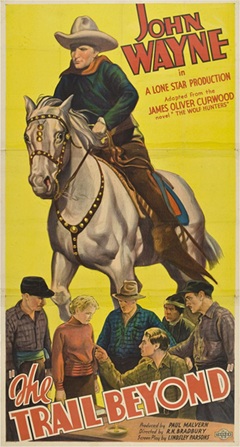
The Trail Beyond (1934, directed by Robert N. Bradbury)


Falsely accused of murder, Rod Drew (John Wayne) and his buddy Wabi (Noah Beery, Jr.) jump off a train and end up in the Canadian wilderness, where they eventually find a deserted cabin, a map to a gold mine, and plenty of trouble when French-Canadian outlaw Jules LaRocque (Robert Frazer) decides that he wants the map and kidnaps Wabi’s girlfriend, Felice (Verna Hillie), to get it.

This was one of the many B-westerns that John Wayne made in between 1930’s The Big Trail and 1939’s Stagecoach.  The film finds the youngish Wayne playing a slightly less upright character than usual.  He’s still the hero but he’s also wanted by the police and spends much of the film fleeing from them.  The movie is only 55 minutes long and the action moves quickly.  The film’s Canadian locations and Robert Frazer’s over-the-top villain gives The Trail Beyond a slightly different and quirkier flavor than most the Duke’s 1930s output.  I think this might be the only film to feature Wayne working with the Mounties.  Even in this low-budget production, John Wayne is a strong hero who just looks like he belongs on a horse and traveling across the frontier.  For someone who was the president of his high school’s Latin Club., Wayne had an automatic authenticity when it came to playing cowboys, even in the years before Stagecoach made him one of the biggest stars in the world.  This is also one of the few films to feature both Noah Beery Sr. and Noah Beery Jr.  While Beery Jr. plays Wayne’s sidekick and is in the film almost as much as John, Berry Sr.’s role is much smaller.  He’s the store owner who is also Felice’s father.

Obviously, this is a film for fans of the genre only but it’s a good example of how John Wayne could make even his Poverty Row productions entertaining and watchable.

Forbidden Trails (1941, directed by Robert N. Bradbury)


Marshal Buck Roberts (Buck Jones) has finally retired after a long and a legendary career.  Two men who Buck arrested are not planning on allowing him to enjoy his retirement.  Having served their sentence for robbing a stagecoach, Fulton (Charles King) and Howard (Bud Osborne) are released from prison and head to Yucca City, Arizona.  They try to recruit their old partner, Jim Cramer (Dave O’Brien), into helping them get revenge on Buck but Cramer wants nothing to do with it.  He’s gone straight and is running his own general store with his fiancée, Mary (Christine McIntyre).  Cramer considers Buck to be a friend because Buck looked after Cramer’s children while Cramer was serving his sentence.

Fulton and Howard ambush Buck and nearly kill him.  With the help of his horse, Silver (of Lone Ranger fame), Buck is able to escape but he’s seriously injured.  His two fellow rough riders, Sandy Hopkins (Raymond Hatton) and Tim McCall (Tim McCoy), head down to Arizona to bring Fulton and Howard to justice.  (Sandy even rides away from his own wedding when he hears that Buck has been injured.)  While the Rough Riders search for Fulton and Howard, saloon owner Ed Nelson (Tris Coffin) works with the outlaws to steal a shipment of goods.

The third of the Rough Riders film, Forbidden Trails is memorable for acknowledging that the three Rough Riders were older than the most of the other contemporary western stars.  Buck Jones, Tim McCoy, and Raymond Hatton were all veteran stars who began their careers during the silent era and who transitioned to B-movies in the sound era.  At a time when their contemporaries were retiring, they were still appearing before the camera and riding the range.  Like the actor playing him, Buck Howard has reached the age when most people retire but he cannot escape his past.  Neither can Jim Cramer, who can’t live the law-abiding life that he desires as long as Fulton and Howard are free.  While Cramer has to escape from his former friends, Buck is lucky to have friends like McCall and Hopkins.  The movie showcases their loyalty and their friendship together and leaves no doubt that will never change, no matter how old the Rough Riders get.  Along with showcasing the friendship of its three stars, the movie is full of chases and gunfights.  The scene where Buck is ambushed is exiting and there’s also a good saloon shootout.  Jones and McCoy are as authentically western as ever.

Dave O’Brien and Christine McIntyre both appeared in the previous Rough Riders film but they’re playing different characters here.  Tris Coffin also played a similar crooked businessman in the first Rough Riders film, Arizona Bound.

Previous Rough Rider Reviews:

  1. Arizona Bound
  2. The Gunman From Bodie

The Lucky Texan (1934, directed by Robert N. Bradbury)


After graduating from college, Jerry (John Wayne) travels down to the ranch owned by his uncle, Grandy (George “Gabby” Hayes).  Jerry wants to look after the cattle but it turns out that Grandy doesn’t have any more cattle.  They’ve all been stolen by rustlers.  What Grandy does have is a dog, some horses, and a granddaughter named Betty (Barbara Sheldon) who Jerry is eager to marry even though the two of them are related.  Things start to look up when Grandy and Jerry discover gold in a nearby creek.  When a crooked assayer named Mr. Harris (Lloyd Whitlock) and a rustler named Joe Cole (Yakima Canutt) find out about the creek, they scheme to steal both it and the ranch from Grandy.  It’s up to Jerry to save the ranch and to expose the bad guys, even after they attempt to frame him for murder.  Fortunately, both Jerry and Grandy have a few tricks up their sleeves.

This was one of the many B-westerns that John Wayne did for the poverty row studios in the years before Stagecoach made him a star.  (Though the film is a western with its ranches and its search for gold, the climax features Gabby Hayes driving a car so it’s hard to say for sure when it’s supposed to be taking place.)  Though he seems too old to be playing a recent college graduate (John Wayne was 27 when he starred in The Lucky Texan but he looked closer to 40), Wayne gives a relaxed and likable performance as Jerry.  Watching him in this film, it’s possible to see hints of the screen presence that led to John Ford casting him as the Ringo Kid in Stagecoach.  As always, Yakima Canutt is on hand to do some impressive stuntwork during the film’s many chase scenes and Gabby Hayes provides the comic relief.  Like most of the poverty row productions, the film can seem more than a little creaky by today’s standards but fans of John Wayne will not be disappointed with either his performance or the film’s action.

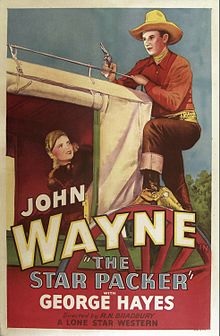
The Star Packer (1934, directed by Robert N. Bradbury)


A mysterious outlaw known as the Shadow is terrorizing turn-of-the-century Arkansas.  He and his gang have killed the last few sheriffs of Little Rock.  No one is sure who the Shadow is or how he communicates with his gang but somehow, he is always one step ahead of the law.  However, the Shadow didn’t count on federal agent John Travers (John Wayne) riding into town and declaring himself to be the new sheriff.  Working with his Native sidekick, Yak (Yakima Canutt), Travers sets out to expose the Shadow and take him down.  Along the way, he falls for Anita (Verna Hillie), the niece of rancher Matt Matlock (Gabby Hayes).  Luckily, Anita knows her way around a gun too.

This is one of the 50 B-westerns that John Wayne made before Stagecoach made him a star.  The Star Packer is more interesting than some of Wayne’s other poverty row productions because The Shadow is a more interesting and much more clever villain than the usual greedy but dumb outlaws that Wayne went up against in these movies.  The Shadow actually has a clearly thought-out plan and, for once, Wayne can’t defeat the bad guys on his own.  In The Star Packer, it takes a community to stand up to evil.  As always with Robert Bradbury’s westerns, the fights and the stunts are impressive.  Fans of Wayne’s B-period will probably especially be interested to see the legendary stuntman, Yakima Canutt, play a good guy for once.  He and Wayne both do a good job in this 52 minute programmer.

The Dawn Rider (1935, directed by Robert N. Bradbury)


Cowboy John Mason (John Wayne) rides into a frontier town.  He is planning on working with his father, rancher Dad Mason (Joseph De Grasse).  Unfortunately, John arrives just in time to witness his father being killed by a gang of thieves.  John is wounded while chasing the thieves but, once he recovers, he’s determined to get vengeance against the man who killed his father.  That man is Rudd Gordon (Dennis Gordon), who is also the brother of Alice Gordon (Marion Burns), the woman who nursed John back to health and who is also engages to marry John’s best friend, Ben McLure (Reed Howes).

There is a little deliberate humor to be found in The Dawn Rider.  Every time someone is shot, the undertaker (Nelson McDowell) steps out of his office and measures the body while the town doctor celebrates having some business coming his way.  Otherwise, this is one of the most serious films that John Wayne made in the years before Stagecoach made him a star.  John Mason is determined to get revenge, even if his obsession means hurting his best friend’s fiancé.  (Though John Mason is less fanatical, it is easy to imagine him growing up to be The Searchers‘s Ethan Edwards.)  Ben has to decide whether to support his friend or the woman that he loves.  (Complicating matters is that John is in love with Alice, too.)  John Wayne and Reed Howes are a good team and Dennis Gordon is a convincing villain.  There’s a good action scene involving John protecting a gold shipment from the gang and the final shootout is handled well.  This 55-minute programmer undoubtedly taught many young viewers about frontier justice, even if they didn’t pick up on the film’s ambiguity.  The Dawn Rider is one of the more mature of John Wayne’s early films and offers hints of the actor that John Wayne would eventually become.

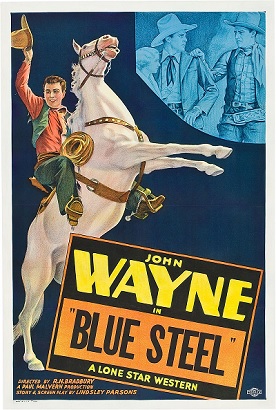
Blue Steel (1934, directed by Robert N. Bradbury)


On a stormy night, frontier Sheriff Jake Withers (George “Gabby” Hayes) and undercover U.S. Marshal Carruthers (John Wayne) both check into the same inn.  They are both searching for the infamous Polka Dot Bandit (Yakima Canutt), who has been burglarizing homes and businesses all over California.  They both figure that, on a rainy night like this, there’s no way that the Bandit is going to be out.  It turns out they are both wrong.  The Bandit breaks into the inn and robs the safe but also leaves behind one of his spurs.  The sheriff comes across Carruthers investigating the safe and mistakenly believes that Carruthers is the bandit.

Later, when Sheriff Winters goes out to Carruthers’s cabin, he’s planning on arresting Carruthers.  Before he can do so, they both hear gun shots.  Outside, another group of bandits is chasing Betty (Eleanor Hunt) and her father.  The Sherriff and Carruthers manage to save Betty but her father is killed.  The grieving Betty is taken in by a local rancher named Malgrove (Edward Peil, Jr.) but it turns out that Malgrove is the head of the Polka Dot Gang and he is planning on killing Betty in order to keep a shipment of supplies from coming to the town!  Carruthers and the sheriff have to work together to thwart Malgrove’s plan and bring the Polka Dot Bandit to justice.

This 54-minute programmer was one of the many B-westerns that John Wayne made for Monogram Pictures in the days before John Ford made him a star by casting him in Stagecoach.  Though Wayne was still learning how to act on camera, the screen presence that would make him a star can be seen in Blue Steel and he and Hayes make a good team.  The story is simple enough but there’s enough horse riding and fistfights to keep most B-western fans entertained.  It’s still hard not to imagine how much different the movie would have been if the sheriff had arrested Carruthers at the scene of the crime instead of letting him ride out to his cabin.  It’s a good thing these old programmers never had to make too much sense.

Riders of Destiny (1933, directed by Robert N. Bradbury)


John Wayne sings!

Well, not really.  Wayne does play a cowboy named Singin’ Sandy Saunders in this early, pre-code Western but his voice was dubbed by someone who didn’t sound anything like Wayne.  Wayne was only 25 when he starred in Riders of Destiny and this was six years before Stagecoach made him a star but he already had his famous way of speaking.

Riders of Destiny starts off with Singin’ Sandy riding through the west.  When he comes across a wounded sheriff and then witnesses a stagecoach being robbed by Ms. Fay Denton (Cecilia Parker), he knows that he’s reached the town of Destiny.  The town is under the control of a land developer named Kincaid (Forrest Taylor).  Kincaid and his henchmen have been extorting the local citizens and stealing money from Fay and her father (George “Gabby” Hayes).  After Singin’ Sandy reveals his skills with a gun, Kincaid offers him a position in his gang and if Sandy accepts, Kincaid will be unstoppable.  Before Sandy’s mysterious appearance, the townspeople wrote to Washington to help and Washington has agreed to send down one of their best agents.  Could that agent be traveling in disguise as a singing cowboy?

It’s always difficult for me to take a Singing Cowboy film seriously.  (That’s especially true after watching Tim Blake Nelson in The Ballad of Buster Scruggs.)  John Wayne is not an actor who was ever meant to be seen playing a guitar and singing a song, even if his voice was dubbed.  But Riders of Destiny is not that bad of a programmer.  If you can overlook the singing, the story is surprisingly mature and violent and Forrest Taylor is a good villain as the oily Kincaid.  (With Kincaid demanding protection money and gunning down anyone who refuses to play it, he has more in common with the type of gangsters who were appearing in Warner Bros. crime films than with the typical western bad guy.)  Cecilia Parker, who would eventually be best known for appearing in the wholesome Andy Hardy films, is sexy as Fay and, because this is a pre-code film, she gets away with robbing a stagecoach.  With a running time of barely an hour, the action has to move quickly and there’s no need for any padding.  Finally, even this early in his career, John Wayne was a perfect western hero, whether he was on his horse chasing the bad guys or walking down a dusty street, singing a song about how the “streets will run with blood” before drawing his guns.

Wayne would go on to play one more Singing Cowboy, in 1935’s The Lawless Range.  Again, his voice was dubbed.  He later said that he abandoned the Singing Cowboy genre because the children who saw the films would often approach him and ask him to sing one of the songs and they were always disappointed to learn that he couldn’t actually a sing a note.  Of course, in 1939, John Ford would select Wayne to play The Ringo Kid in Stagecoach and Wayne would never have to sing again.