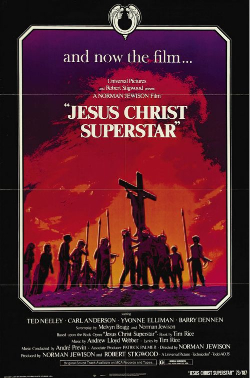
The 1973 film, Jesus Christ Superstar, opens with a desert in Israel. All is still. All is quiet. Suddenly, we see a cloud of dust in the distance. A bus is speeding through the desert and the music on the soundtrack explodes with a sudden urgency.
The bus comes to a stop and we notice that there’s a big cross tied to the top of it. The doors open and suddenly — oh my God, it’s hundreds of hippies! American hippies In Israel! They’re climbing off the bus, one after another. Some of them are being tossed sub machine guns. Another gets a whip. One of them puts on a purple robe and looks like he is slightly disturbed. Others are dressed in black. Makeup is applied. Everyone’s having a great time. One heavy-set fellow, with frizzy hair, climbs to the top of the bus and sits down on a throne. He watches as everyone else pulls down the cross. One long-haired man, who was never seen leaving the bus, is suddenly among the hippies. He’s dressed in white and everyone is suddenly bowing before him.
Well, almost everyone. One of the bus’s passengers, a serious-looking man (Carl Anderson), has walked away from the hippies. From a safe distance, he looks back at them and he seems to be as confused by all of this as we are.
Why is everyone in the desert? That’s relatively easy to explain. They’re performing a Passion Play. Carl Anderson is playing Judas. The man in white is Ted Neeley. Whether he is meant to be an actor playing Jesus or Jesus himself is a question that the movie leaves for you to decide. We never see him get off the bus and, perhaps more importantly, we don’t see him get on the bus at the end.
(Just you watch. I’ll mention that Jesus gets crucified at the end of this movie and someone will pop up in the comments and say, “How about a spoiler alert?”)
Hmmm…religion and hippies. Those are two things that, in the past, I have definitely had issues with. In fact, you would totally be justified in assuming that I would hate Jesus Christ Superstar. And yet, I don’t. I actually rather like it.
True, there are some things that make me cringe. The sound of all the disciples singing, “What’s the buzz, tell me what’s a happening?” always makes me shudder and say, “Oh my God, this is so 1973!” A scene where Judas suddenly finds himself being chased through the desert by a modern tank is just a bit too on-the-nose. Finally, I understand that Ted Neeley’s stage performance as Jesus is highly acclaimed but, to me, his performance in this film will always be known as the Screaming Jesus. Too often, it’s obvious that Neeley is still performing as if he’s on stage and has to project to the back row. It’s interesting to compare him to Carl Anderson, who also played Judas on stage but who, in the movie, gives a performance that is powerful specifically because it’s a cinematic performance, as opposed to a stage performance.
But, even with all that in mind, there’s so much about this movie that works. Based on the rock opera by Tim Rice and Andrew Lloyd Webber, Jesus Christ Superstar is definitely a product of its time, serving as a time machine for amateur historians like me. (Then again, I guess you could say that about any movie the opens with hippies driving a school bus across Israel.) Sometimes, the lyrics are a bit obvious but the songs still stick around in your head. And it’s not just Carl Anderson who gives a good performance. Yvonne Elliman, Josh Mostel, Bob Bingham, Larry Marshall, Barry Dennen — they all contribute strong work, both musically and otherwise.
And then there’s the big Simon Zealotes/Poor Jerusalem production number:
There’s several reasons I love this scene but mostly it just comes down to the fact that it captures the explosive energy that comes from watching a live performance. Larry Marshall (who plays Simon Zealotes) has one of the most fascinating faces that I’ve ever seen in a film and when he performs, he performs as if the fate of the entire world depends on it. As previously stated, I’ve never been sold on Ted Neely’s performance as Jesus but Carl Anderson burns with charisma in the role of Judas.
Mostly, however, I just love the choreography and watching the dancers. I guess that’s not that surprising considering just how important dance was (and still is, even if I’m now just dancing for fun) in my life but, to be honest, I’m probably one of the most hyper critical people out there when it comes to dance in film, regarding both the way that it’s often choreographed and usually filmed. But this scene is probably about as close to perfect in both regards as I’ve ever seen. It goes beyond the fact that the dancers obviously have a lot of energy and enthusiasm and that they all look good while dancing. The great thing about the choreography in this scene is that it all feels so spontaneous. There’s less emphasis on technical perfection and more emphasis on capturing emotion and thought through movement. What I love is that the number is choreographed to make it appear as if not all of the dancers in this scene are on the exact same beat. Some of them appear to come in a second or two late, which is something that would have made a lot of my former teachers and choreographers scream and curse because, far too often, people become so obsessed with technical perfection that they forget that passion is just as important as perfect technique. (I’m biased, of course, because I’ve always been more passionate than perfect.) The dancers in this scene have a lot of passion and it’s thrilling to watch.
Beyond that, there’s the insane burlesque of Josh Mostel’s performance as Herod and Barry Dennen’s neurotic interpretation of Pilate. There’s Yvonne Elliman’s performance of I Don’t Know How To Love Him. There’s that famous closing shot, a happy accident that was achieved when a shepherd just happened to wander past the camera.
And, of course, there’s this:
The performance above pretty much sums up the appeal of Jesus Christ Superstar. It’s both ludicrous and powerful at the same time.
I know there’s some debate as to whether Jesus Christ Superstar is sincere or sacrilegious. In college, there was this girl in my dorm who started the semester as a pagan, spent a month as an evangelical, and then ended the semester as a pagan again. When she was going through her evangelical phase, she would listen to the Jesus Christ Superstar soundtrack constantly. Seriously. 24 hours a day. 7 days a week. After three days, I was sick of hearing it. I found myself wondering if anyone had ever been driven to murder over having to listen to Heaven On Their Minds one too many times. Fortunately, something happened to cause her to once again lose her faith and she went back to listening to Fall Out Boy.
I don’t think that, as conceived by Rice and Lloyd Webber, Jesus Christ Superstar is in any way sacrilegious. At the same time, it does have a potentially subversive streak to it. This is especially true of the film version. At times, director Norman Jewison seems to be almost deliberately parodying the excesses of more conventional religious films. Instead of spending millions to recreate the ancient world, Jesus Christ Superstar uses ruins and desert. Instead of featuring ornate costumes, Jesus Christ Superstar features Roman soldiers who wear pink tank tops. Ultimately, Jesus Christ Superstar reveres Jesus but dismisses the conventions of both organized Christianity and epic filmmaking. Judah Ben-Hur would not have known what to do with himself if he wandered onto the set of Jesus Christ Superstar.
It’s over the top, silly, ludicrous, and ultimately rather powerful. Jesus Christ Superstar is a film that shouldn’t work and yet it does.

 Through the Shattered Lens