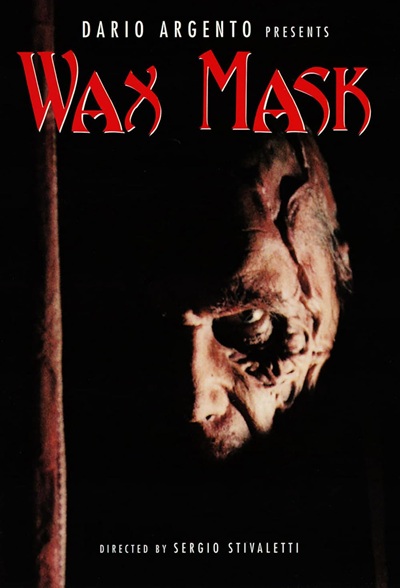
The 1997 Italian horror film, Wax Mask, takes place in Rome at the turn of the 20th Century.
The film opens in 1900, with a young girl named Sonia witnessing the murder of her parents by a man with an iron claw and a wax mask. 12 years later, Sonia (Romina Mondello) steps into a Rome’s newest sensation, a wax museum where all of the wax figures appear to either be victims or murderers. The museum is meant to scare people. One man accepted a dare to spend the night in the museum and he was found dead the next morning, frightened to death. Sonia’s not interested in being scared. She just needs a job. Her mother taught her how to make clothes for wax figures. The owner of the museum, Boris (Robert Hossein), hires her.
When Sonia leaves the museum, her picture is taken by Andrea (Riccardo Serventi Longhi), a reporter who is investigating the mysterious deaths that have been connected to the museum. Meanwhile, Inspector Lanvin (Aldo Massasso) contacts Sonia to let her know that he’s following up some new leads concerning the still-unsolved deaths of her parents. He seems quite concerned about her working at the museum. When Lanvin later turns up dead, Sonia becomes concerned as well.
You can probably guess where all of this is going. Wax Mask is a remake of House of Wax, with the action moved to Rome and also with a lot more nudity and considerably more gore. The murders are brutal and bloody and the same can be said of what Sonia discovers when she starts to take a closer look at the wax figures in the museum. Perhaps the most disturbing aspect of this film is the idea that the wax figures are actually suspended in a state between life and death, aware of what is happening but unable to move, speak, or do anything about it. Wax Mask is a frequently diverting throwback to the bloody but atmospheric giallo films of the 70s. Suspense is mixed with special effects, some of which are more effective than others.
Wax Mask was originally meant to be Lucio Fulci’s final film. Dario Argento saw his old cinematic rival, Lucio Fulci, in 1994, by which point Fulci was using a wheelchair and was in frequent pain. Thinking that working on a movie might be good for Fulci’s state-of-mind and overall health, Argento agreed to produce Fulci’s next film. The idea that they came up with was to remake House of Wax. While Argento wanted to concentrate on spectacular death scenes, Fulci wrote a script that emphasized atmosphere over blood. Tragically, Fulci died in 1997 while the film was still in pre-production. Argento replaced Fulci with Sergio Stivaletti, a special effects artist who has worked on several Argento films.
Stivaletti rewrote the script and put the emphasis back on the special effects. (In the end, the killer has as much in common with The Terminator than with a traditional giallo killer.) Stivaletti does a good job directing the film. There are plenty of scary scenes. The film looks good. Even the special effect shots that don’t quite work still have a certain charm to them. That said, it’s hard to watch the film without thinking about what Fucli, at his best, could have done with the material.
In the end, though, Wax Mask is an effective work of late era Italian horror.
 Through the Shattered Lens