Holiday Film Review: Little Miss Millions (Dir by Jim Wynorski)


A Jim Wynorski Christmas movie!?

Yes, there is such a thing.  First released in 1993, Little Miss Millions tells the story of a cynical but good-hearted private investigator named Nick Frost (Howard Hesseman) who is hired to track down a 9 year-old runway named Heather (Jennifer Love Hewitt, making her feature debut at the age of 12).  Nick is hired by Heather’s stepmother, Sybil (Anita Morris), who only wants Heather back because she’s worth several million dollars.  After Sybil hires Nick, she also decides to frame him for kidnapping Heather so that she can both get back her stepdaughter and get out of having to pay any reward money.  Soon, Nick has two federal agents (played by James Avery and Robert Fieldstell) on his trail.  For her part, Heather just wants to find and live with her birthmother, Susan (Terri Treas).

It’s a pretty simple film, one that borrows heavily from It Happened One Night (minus the romantic element, of course) and every single Christmas film that has ever been made.  This is one of those rather corny family films where you will pretty much be able to guess everything that is going to happen before it happens but that’s not necessarily a bad thing.  It’s a holiday film and no one watches a holiday film to get depressed.  They watch holiday films for the sentimental moments and the heart-warming comedy and the moments that create an idealized portrait of life during the holiday season.  For all of the violence to be found in them, both Die Hard and Die Hard 2 end with John McClane being reunited with his wife for the holidays.  As dark as It’s A Wonderful Life occasionally is, it still ends with that bell ringing and Clarence getting his wings.  Miracle on 34th Street never answers for sure whether or not Kris Kringle is who he says he is but Natalie Wood still gets her house with a tree in back.  A Christmas Story‘s Ralphie does not shoot his eye out.  Lethal Weapon‘s Riggs finds a new family.  And don’t even get me started on Santa Claus Conquers The Martians.  We watch holiday movies for holiday cheer and, in its unpretentious way, Little Miss Millions is full of that cheer.

Of course, it’s still a Jim Wynorski film.  So, while this is definitely a family film without many of the things that are typically associated with the Wynorski brand, Little Miss Millions still finds time for a sudden rainstorm that leaves everyone drenched.  And, of course, Nick and Heather stop off at a biker bar that is inhabited by Rick Dean, Toni Naples, and wrestler Queen Kong.  Peter Spellos, who played the much-abused Orville Ketchum in Sorority House Massacre 2 and Hard To Die, shows up as a bus driver.  It’s still a Wynorski film but it’s also a sweet-natured film, featuring likable performances from Howard Hesseman and Jennifer Love Hewitt.  It’s not a holiday classic but it’s diverting enough for those looking for something with which to pleasantly pass the time.
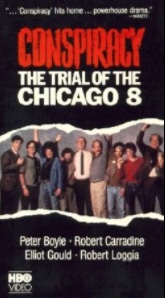
Conspiracy: The Trial of the Chicago 8 (1987, directed by Jeremy Kagan)


The year is 1969 and, in an Illinois courtroom, 8 political radicals stand accused of conspiring to disrupt the 1968 Democratic Convention.  The prosecution is putting the entire anti-war movement on trial while the defendants are determined to disrupt the system, even if it means being convicted.  The eight defendants come from all different sides of the anti-war movement.  Jerry Rubin (Barry Miller) and Abbie Hoffman (Michael Lembeck) represent the intentionally absurd Yippies.  Tom Hayden (Brian Benben) and Rennie Davis (Robert Carradine) are associated with the Students for a Democratic Society.  Bobby Seale (Carl Lumbly) is one of the founders of the Black Panthers while David Dellinger (Peter Boyle) is a longtime peace activist.  John Friones (David Kagan) and Lee Weiner (Robert Fieldsteel) represent the common activists, the people who traveled to Chicago to protest despite not being a leader of any of the various organizations.  Prosecuting  the Chicago 8 are Richard Schulz (David Clennon) and Tom Foran (Harris Yulin).  Defending the 8 are two radical lawyers, Leonard Wienglass (Elliott Gould) and William Kunstler (Robert Loggia).  Presiding over the trial is the fearsome and clearly biased Judge Julius Hoffman (David Opatoshu).

Conspiracy: The Trial of the Chicago 8 is a dramatization of the same story that inspired Aaron Sorkin’s The Trial of the Chicago 7 but, of the two films, it’s Jeremy Kagan’s The Trial of the Chicago 8 that provides a more valuable history lesson.  By setting all of the action in the courtroom and recreating only what was said during the trial, director Jeremy Kagan and his cast avoid the contrived drama that marred so much of Sorkin’s film.  Kagan trusts that the true story is interesting enough to stand on its own.  Kagan includes documentary footage from the convention protest itself and also interviews with the people who were actually there.  While Kagan may not have had the budget that Sorkin did, his film has the authenticity that Sorkin’s lacked.  Kagan also has the better cast, with Michael Lembeck and Barry Miller both making Abbie Hoffman and Jerry Rubin into something more than the mere caricatures that they are often portrayed as being.

The Trial of the Chicago 8 was a film that Jeremy Kagan spent a decade trying to make.  When he first tried to sell the idea behind the film to CBS in 1976, Kagan had Marlon Brando, Walter Matthau, George C. Scott, and Dustin Hoffman all willing to work for scale and take part in the production.  CBS still passed on the project, saying that no one was interested in reliving the 60s.  It wasn’t until 1987 that Jeremy Kagan was finally able to revive the film, this time with HBO.  It actually worked out for the best because, with HBO, there was no need to try to come up with a “clean” version for the language that was used in the courtroom or in the interviews with the actual participants.  The defendants could be themselves.

Though it has been overshadowed by Sorkin’s subsequent film, The Trial of the Chicago 8 is the definitive film about what happened in the aftermath of the the 1968 Democratic Convention.