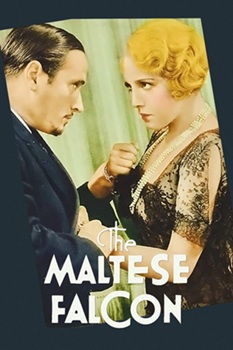
The Maltese Falcon (1931, directed by Roy Del Ruth)


Detective Sam Spade (Ricardo Cortez) may be an immoral lech but when his partner, Miles Archer, is murdered, Sam sets out to not only figure out who did it but to also eliminate himself as a suspect.  Sam was having an affair with Miles’s wife, Ivy (Thelma Todd).  Sam’s investigation leads to him falling for the mysterious Miss Wonderly (Bebe Daniels) and getting involved with a trio of flamboyant criminals who are searching for a famous relic, the Maltese Falcon.  Dudley Digges plays Casper Gutman.  Otto Matieson plays Dr. Joel Cairo.  Dwight Frye plays the gunsel, Wilmer, who Gutman says he “loves … like a son.”

The first film adaptation of Dashiell Hammett’s classic detective novel is overshadowed by the version that John Huston would direct ten years later.  That’s not surprising.  There’s a lot of good things about the first version but it’s never as lively than John Huston’s version and neither Dudley Digges nor Otto Matieson can compare to Sydney Greenstreet and Peter Lorre.  Of the supporting cast, Dwight Frye makes the best impression as the twitchy Wilmer and Bebe Daniels and Thelma Todd are both sexy as the story’s femme fatales.  That doesn’t mean that they’re better than their counterparts in John Huston’s film.  It just means they all bring a different energy to their roles and it’s interesting to see how the same story can be changed by just taking a slightly different approach.  Elisha Cook, Jr. was perfect for Huston’s version of the story.  Dwight Frye is similarly perfect for Roy Del Ruth’s version.

Needless to say, Ricardo Cortez can’t really compare to Humphrey Bogart.  But, if you can somehow block the memory of Bogart in the role from your mind, Cortez actually does give a good performance as Spade.  Because this was a pre-code film, Cortez can lean more into Spade’s sleaziness than Bogart could.  Also, because this was a pre-code film, the first Maltese Falcon doesn’t have to be as circumspect about the story’s subtext.  Spade obviously tries to sleep with every woman he meets and is first seen letting a woman out of his office.  (The woman stops to straighten her stockings.)  Gutman and Cairo’s relationship with Wilmer becomes much more obvious as well.  What’s strange is that, even though this Maltese Falcon is pre-code, it still ends with the type of ending that you would expect the production code to force onto a film like this.

If you’re going to watch The Maltese Falcon, the Huston version is the one to go with.  But the first version isn’t bad and it’s worth watching for comparison.

Lisa Reviews An Oscar Nominee: The Divorcee (dir by Robert Z. Leonard)


Before I get into reviewing the 1930 best picture nominee, The Divorcee, I want to share something that I recently posted on twitter:

I’m not just sharing this because it’s one of the best things that I’ve ever tweeted.  I’m also sharing it because it’s a beyond perfect description of Jerry (played, in an Oscar-winning performance, by Norma Shearer), the lead character in The Divorcee.  (Whenever you tweet something that is beyond perfect, you’ve earned the right to make sure everyone else knows it.)  The Divorcee came out in 1930 so, needless to say, it’s a bit dated but I totally related to the character of Jerry and that’s perhaps the main reason why I enjoyed this film.

The Divorcee tells the type of story that, today, would probably make for a memorable Lifetime film.  It’s a film that follows four friends over several years.  They are the idle rich, the type who go to parties, dance on tables, and cheerfully ignore the ban on liquor.  Jerry (Norma Shearer) loves Ted (Chester Morris).  Dorothy (Helen Johnson) loves Paul (Conrad Nagel).  However, Paul loves Jerry and when Jerry announces that she and Ted are engaged to be married, Paul doesn’t handle it well.  In fact, Paul gets drunk, Paul drives a car with Dorothy in the passenger’s seat, and eventually Paul crashes the car, leaving Dorothy so disfigured that she spends the rest of the movie wearing a black veil.

The years pass.  In order to make up for horribly disfiguring her, Paul agrees to marry Dorothy.  Jerry marries Ted.  They’re happy until they’re not.  On the day of their third anniversary, Jerry discovers that Ted has been cheating on her.  So, Jerry cheats on Ted.  When Ted gets upset, they file for divorce.

Suddenly, Jerry is …. (dramatic music cue) … THE DIVORCEE!

Ted becomes an alcoholic, the type who makes scenes at parties and destroys ornate wedding cakes.  In the past, I assume Jerry would have been forced to wear a scarlet D and she would have made it work because there’s nothing that Jerry can’t do.  However, since this film takes place in the 1920s, Jerry spends her time flirting and plotting to steal Paul away from Dorothy.

And it would have worked too if not for the fact that Dorothy is a complete and total saint…

Drinking, sex, adultery, disfigurement, and Norma Shearer!?  That’s right, this is a pre-code film!  The Divorcee is actually a pretty typical example of a type of film that was very popular during the 1930s and actually remains rather popular today.  This is a film where rich people do stupid things but look good doing it.  When an audience watches a film like this, they can both look down on the rich and vicariously experience their lifestyle.  No wonder these movies are so popular!

Anyway, I liked The Divorcee.  It’s an incredibly silly little film but it’s hard for me not to enjoy something this melodramatic.  Chester Morris and Conrad Nagel are stuck playing heels and Helen Johnson is a bit to saintly but it doesn’t matter because the film is pretty much designed to be a showcase for Norma Shearer, the most underrated of all of the Golden Age actresses.  (Far too often, Shearer is dismissed as simply being Irving Thalberg’s wife.)  Shearer gives a great performance.  She seems to be having the time of her life and it’s fun to watch.

The Divorcee was nominated for best picture but it lost to a far different picture, All Quiet On The Western Front.

the_divorcee_poster

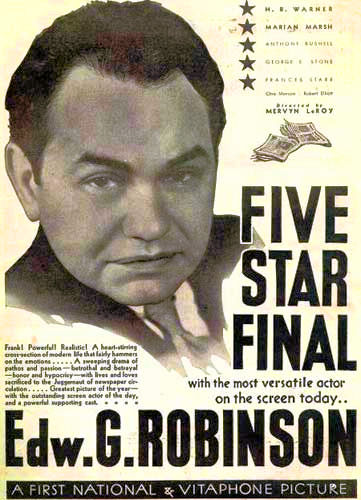
Lisa Reviews An Oscar Nominee: Five Star Final (dir by Mervyn LeRoy)


Five_Star_Final_1931_poster

In 1911, a pregnant secretary named Nancy Voorhees (Frances Starr) shot and killed her boss and lover.  It was quite a scandal at the time but, twenty years later, it has largely been forgotten.  Nancy has married a successful businessman named Michael Townsend (H.B. Warner) and is a respected member of society.  Her daughter, Jenny (Marian Marsh), has no idea about Nancy’s past and believes Michael to be her father.  Jenny is now engaged to marry the handsome and rich Phillip Weeks (Anthony Bushnell).

Everything seems to be perfect but you know what they say about perfection.

Bernard Hincliffe (Oscar Apfel) is the publisher of a struggling tabloid newspaper.  He is frustrated by city editor Joseph Randall (Edward G. Robinson) and Randall’s refusal to do whatever it takes to boost circulation.  “Why, he won’t even print pictures of women in their underwear!” one of Hincliffe’s assistants exclaims.  Finally, Hincliffe orders Randall to publish a series of articles that will take a retrospective look at both the scandal and what has happened to those involved in the years since.  At first, the cynical Randall refuses but eventually, he gives in.

He assigns two reporters to crack the story.  One of them, Kitty Carmody (Ona Munson) is first introduced showing off her legs and bragging about how there’s no way that she won’t be hired to work at the newspaper.  (By the way, if anyone ever remakes Five Star Final and needs someone to play Kitty, I am ready and available.)  The other is the incredibly creepy T. Vernon Isopod (Boris Karloff).  Isopod was a divinity student until he was arrested on a “morals charge.”  Now, he pretends to be a minister as a way to fool people into revealing their deepest secrets to him.  Kitty and Isopod dig into the life of Nancy and Michael.  The stories appear on the front page.  Suicide and melodrama follow and Randall is forced to finally take a stand.

Released in 1931, Five Star Final was nominated for best picture but lost to Grand Hotel.  Seen today, Five Star Final is undeniably stagey (it was based on a play) but it’s still a compulsively watchable melodrama, featuring good performances and a lot of memorably snappy 30s dialogue. Five Star Final is one of several films about journalism to have been nominated for best picture.  Most of these films — like All The Presidents Men, The Front Page, and this year’s front-runner, Spotlight — have featured journalists as heroic seekers of the truth.  Five Star Final, on the other hand, plays more like a pre-Code version of Network set at a newspaper.  It’s a deeply angry film and, when Randall finally tells off Hincliffe, it feels like the 30s equivalent of Peter Finch shouting that he’s mad as hell and not going to take it anymore.

Finally, the best part of the film, for me, was Boris Karloff as the sleazy Isopod.  Karloff made Five Star Final right before he played the creature in Frankenstein and it’s interesting to see him play a totally different type of monster here.  If I had to choose which character is scarier, I’m going with T. Vernon Isopod.

http://www.youtube.com/watch?v=a0qL1fs1c6k