George Romero Closes A Chapter — And Leaves Plenty Of Threads Hanging — In “Empire Of The Dead : Act Two” #5


4326470-05

And so we find ourselves at the close of another act of what is proving to the longest-form epic to ever come from the mind and pen of the father of the modern zombie genre with George Romero’s Empire Of The Dead Act Two #5, and underneath Alexander Lozano’s absolutely superb pulp-inspired cover painting we find that the guy who started it all is ending this one on a decidedly more small-scale — and downbeat — note than the “looming disaster” finale he gave us in his first act.

Not that disaster isn’t still looming — it certainly is, and it’s more mystery-shrouded than ever, but just when everything — and I do mean everything — seems to be boiling over in this issue, Romero takes a side-step, dials back on the danger, and gives us a genuinely personal and frankly tragic cliffhanger to send this five-issue arc out on.I won’t say much more about the finale beyond that since the book just came out today and the few of you out there who are, like myself, following this comic in singles every month may not have had a chance to read it yet, but you may want to prepare yourself to get a little bit choked up come the last page.

What’s most surprising to me about the contrasting tones between the finales of the premier and secondary acts of this developing story, though, is how much more free-flowing, naturalistic, and dare I say even nochalant the fifth issue of Empire Act Two is in comparison to the fifth issue of Empire Act One. There was a sense during the in the concluding chapter of the first arc that Romero was rushing to fit a number of pieces into place and making up for lost time due to some early floundering he engaged in, script-wise, in issues two (especially) and three, whereas here his approach has been a lot more calm and methodical. He’s trusting his characters to take us along with them rather than shoe-horning them into place, and while that may result in a somewhat less “stupendous” conclusion this time around, it means that the entirety of the second act has played out much more evenly than the first. In short, he’s getting a little bit better at this as he goes.

Yeah, okay, the “big revelation” Paul Barnum finally clues Dr. Penny Jones in on is something that we all saw coming from a mile off, but there are still a few surprises to be had here, most notably in the discslosure of a prior relationship between Barnum and somebody extremely close to Mayor Chandrake , and Chandrake proves himself to be an even bigger bastard than we already thought in one scene, so it’s not like everything here is cut-and-dried predictable up until those final few panels. Chandrake’s entire world seems to be in serious danger of crumbling down around him, in fact, as his inability to deal with rival candidate “Chilly” Dobbs calls into question how much efficacy he really has left in him while the investigations of Detective “Bucky” Perez are getting closer and closer to unraveling the thread that might undo the whole ball. The main question our dogged cop is now pursuing :  why are kids being loaded up onto buses when there are no more public schools (guess Chandrake’s a Republican) — and why are they never coming back?

Getting back to those aforementioned final few panels for a moment — one thing that does reduce their impact somewhat is the inking. While I’ve just about gotten used to Dalibor Talajic’s pencil art on this series, and have generally welcomed the addition of inker Rick Magyar, apparently Magyar ran into some deadline trouble with this issue (hey, it happens) and the last four pages are inked by Goran Sudzuka, who employs a mush heavier and less detailed approach with his brush that results in a more blocky, “cartoonish” style. For a few pages here and there I wouldn’t gripe much, but Sudzuka’s work seriously detracts from the impact of the heart-wrenching cliffhanger here, and that’s a real shame.

So — I guess we’ll see where this book goes, art-wise, when it returns for Act Three in April, but I’m feeling more confident than ever in Romero’s storytelling. There are big things ahead, folks, and if you haven’t been following along, catching up with this series by way of trade paperback —the second of which comes out next month — is definitely a smart move, as the next arc promises to be out-and-out explosive.
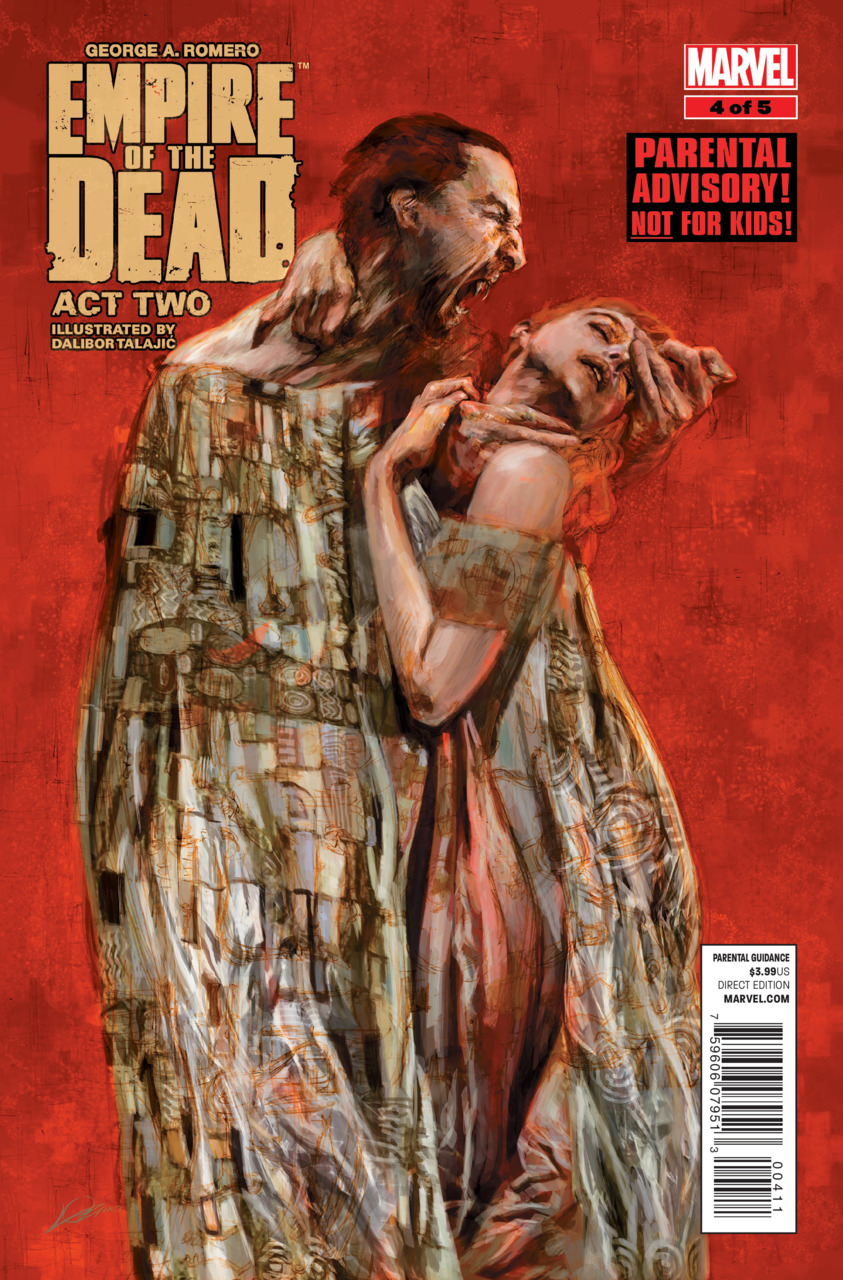
George Romero Finally Picks Out His Hero In “Empire Of The Dead : Act Two” #4


4265326-04

Is it just me, or has the second act of George Romero’s Empire Of The Dead positively flown right by? I mean, here we are with only one issue left to go, and it feels like it was just the other day that the series started up again after the conclusion of the hiatus that followed its first arc. I have no doubt the book lost a fair amount of readers during the break — in fact, like most comics it probably lost a good half of its initial readership right after the first issue — but for those of us who’ve stuck with this thing, the payoff in the form of a big “fireworks” finale does seem to be approaching, albeit slowly. Remember, if all goes according to plan we’ve still got two more five-part acts to go following next month’s wrap-up of the current one, but there seems to be a steady flow to the story that’s been established here in the second chapter that wasn’t there in the first, with its sometimes-fitful starts and stops.

All that being said, though, it’s not like that better overall narrative hasn’t come at a price. George Romero’s Empire Of The Dead Act Two has been plagued with some seriously forced and unnatural dialogue at times — a flaw more apparent than ever in this fourth issue since Romero seems to have fallen back on dropping a whole lot of “—“s into his sentences in order to impart them with some cheap n’ easy pseudo-gravitas, and hey, I’m not ashamed to admit that I still miss Alex Maleev’s art, despite the continued improvement of Dalibor Talajic as he’s grown more comfortable and confident with horror-themed material (the addition of Rick Magyar on inks beginning with issue 3 also helped, as he’s given the imagery a darker, more subdued tone, a trend that I’m pleased to say continues this month).

The biggest qualm that many of us readers have, though, is that eight issues into this sprawling zombie saga, we still don’t know — or didn’t know, at any rate, since that seems about to change — who the hero of the story is supposed to be. There are various points of identification that the average reader can clearly see with a number of the characters, sure, but no clear-cut “good guy,” a la Ben in Night Of The Living Dead, has stepped forward.

And that’s where the often-neglected “zombie wrangler” Paul Barnum enters the picture here. There have been a number of issues where he’s been given precious little — if anything — to do, but now that the “love triangle” between himself, Dr. Penny Jones, and Mayor Chandrake seems to be evaporating — with no one in a position to “get the girl” (and that’s all that I’ll be saying about that due to the internet’s penchant for breeding self-appointed “spoiler police” around every digital corner) — our guy Paul seems to be out to bring the whole vampire cabal running post-zombie-apocalypse New York down. Mess with the girl he’s sweet on, and you’ve messed with him, I guess.

The only other significant story developments in this issue focus on the machinations to replace Chandrake with Chilly Dobbs now that nephew Billy is out of the way and the oncoming aerial-and-land assault being planned for the city by the militaristic forces using Dixie Peach and her southern hell-raisers as their ostensible (and quickly disposable, should the need arise) front. A common theme in both of these plot threads — which do, in fact, intersect in the pages of the comic itself and not just thematically — is that the devil we don’t know is often worse than the one we do, and that “leaders” of various movements — whether in the halls of government or out on the streets — are perfectly interchangeable pawns in the hands of the power brokers who really pull the strings, so that seems to be where Romero is aiming his always-present social commentary in his latest zombie epic.

All in all, then, shaky dialogue and an uncharacteristically impressionistic (and not, I might add, succesfully impressionistic) cover from the otherwise-reliable-to-this-point Alexander Lozano aside, issue four of Empire Of The Dead Act Two is an intriguing piece that Romero has moved into position on his grand chessboard. The focus of the story is tightening, events are coalescing with a kind of subtle yet undeniable force, and I think we’re headed for a bang-up conclusion to the second arc in 30 days or so.

Palace Intrigue Is The Order Of The Day In “Empire Of The Dead : Act Two” #3


4212100-03

Remember that famous scene in The Godfather where Michael Corleone is having his henchmen settle all The Family’s old scores while he attends his infant son’s baptism? George Romero clearly does, because Empire Of The Dead Act Two #3 (or George Romero’s Empire Of The Dead Act Two #3 to be technically correct about things) is all about Mayor Chandrake — who’s front and center in Alexander Lozano’s stunning cover, as shown above — eliminating all threats to his leadership of both New York City and the secret vampire cabal for whose benefit the entire town is run. He’s ruthless, determined and, unlike Michael Corleone, not afraid to get his own hands dirty in the process.

The bloodbath is precipitated, as you might guess, by a visit from the cops — not Chandrake’s own loyal “security” personnel, but actual, rank-and-file NYPD detectives. Apparently, he doesn’t own them all yet, and one newcomer to the story, a certain Buckie Perez, seems to be the post-zombie apocalypse’s answer to Jim Gordon in that he can’t be bought, bullied, or otherwise strong-armed into toeing the mayor’s line. Between a true “good cop” snooping around, the seeming political ascendancy of his nephew, Billy, and the pesky presence of an “unauthorized” victim of vampirism still resting semi-comfortably in the hospital, then,  there are a lot of loose ends to tie up.

The problem is — one of the above-mentioned targets survives their attempted assassination, and there’s still that missing dirigible from a New Jersey warehouse to be accounted for.

Outside Chandrake’s desperate and homicidal machinations, though — which do lead to some interesting, if overly-expository in terms of how they’re handled, revelations (for instance, there are actually a lot fewer vampires than we’d previously been steered into assuming) — some other notable plot developments  do take place here, particularly in The Arena, where the void left by the loss of super-fighter Zanzibar ends up being filled by  — zombies who have actually learned to team up and work together? Trainer/wrangler Paul Barnum sees this, reluctantly, as a positive — but only for the time being, since he knows what it means if the same behavior patterns begin to emerge on the streets.

As for the cliffhanger, it’s a doozy — mistakenly believing that all his problems are solved, Chandrake pays a visit to his latest muse, Dr. Penny Jones, in her newly-equipped-to-the-hilt lab, and let’s just say that she might finally be getting close enough to the fire to be irrevocably burned.

All in all, then, a reasonably solid issue story-wise with one addition to the creative team worth mentioning in the form of the arrival of inker Rick Magyar, who seems to stay fairly true to Dalibor Talajic’s pencil line in that not a whole lot of stylistic difference can be discerned between this and the previous two installments, which Talajic inked himself, apart from an overall “darker” look owing to Magyar leaning a bit more heavily on his brush, so to speak, which suits both the material itself, as well as the mood it creates, quite nicely. A solid effort from all concerned, then,  that has me very much looking forward to next month.