Late Night Retro Television Review: Pacific Blue 2.15 “Black Pearl”


Welcome to Late Night Retro Television Reviews, a feature where we review some of our favorite and least favorite shows of the past! On Tuesdays, I will be reviewing Pacific Blue, a cop show that aired from 1996 to 2000 on the USA Network!  It’s currently streaming everywhere, though I’m watching it on Tubi.
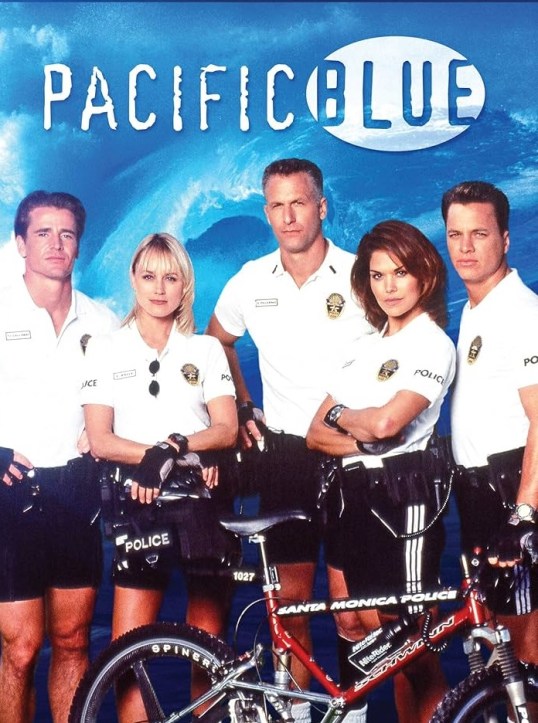
This week, the bicycle mayhem continues.

Episode 2.15 “Black Pearl”

(Dir by Terence H. Winkless, originally aired on January 5th, 1997)

TC arrests a woman named Alana (Angela Shelton) on drug and assault charges, just to discover that she’s an undercover DEA agent.  TC fears that Alana is in over her head and he tells Alana’s superior, Enright (John Michael Bolger) that he needs to pull her out of the operation.  Enright is like, “Whatever, bicycle boy.”

And, to be honest, I think Enright kind of has a point.  Why are the bicycle cops always trying to tell other law enforcement agencies what to do?  Every episode, either TC or Palermo and Chris gets a really angry look in their eyes and starts barking out orders at people they barely know.  It’s bad enough that they ride bicycles.  Do they have to act like a bunch of self-righteous pricks as well?

Speaking of bicycles, Victor has to get recertified to be a bike cop.  Uh-oh, sounds like Victor could lose his job!  Even worse, Victor’s partner in this episode is Chris so not only is Victor in danger of getting fired but he has to spend an entire week listening to Chris put him down.  Seriously, there are few characters in the history of television that I dislike as much as I dislike Chris Kelly.  Chris is the type who dismisses everyone’s problems before then launching into her hundredth monologue about how much it sucks going from being an Air Force pilot to a bike cop.

Victor trains with Hans Rhey.  In this episode, everyone is like, “Oh my God, Hans Rey!”  I had no idea who Hans Rey was.  I looked him up after this episode and apparently, he was a superstar on the bicycle circuit.  Hans does a lot of clunky bike tricks  As was so often the case withe professional athletes who played themselves on shows like this, he wasn’t much of an actor.  If anything, this episode reminded me of how stupid most people look riding their bicycles in the middle of the street.

Victor gets recertified.  Alana ends up dead.  Presumably, TC’s upset but since the actor playing him was only capable of one fascial expression, it can be hard to tell.  In the end, the real tragedy remains how dorky everyone looks on the bicycles.

Cleaning Out The DVR: Boulevard Nights (dir by Michael Pressman)


(I recorded the 1979 film, Boulevard Nights, off of TCM on December 14th, 2017).

Boulevard Nights tells the story of two brothers, living in East Los Angeles.

Raymond Avila (Richard Yniguez) used to be involved with the street gangs but he’s gone straight.  He still likes to cruise the boulevard.  He still likes to make his lowrider hop up and down.  He still knows better than to trust outsiders and he always makes sure that he’s not around whenever the cops show up.  But, unlike many of his old friends, Raymond is now determined to stay out of trouble.  He’s got a job working at a garage and he dreams of the day when he’ll have his own auto shop.  He takes care of his mother.  He keeps an eye on the neighborhood.

Chuco Avila (Danny De La Paz) is Raymond’s younger brother and also his opposite.  Chuco is a high school drop out who doesn’t want to cause trouble but who says that he can’t stop getting angry.  Chuco always carries a switchblade with him, even bringing it to a job interview.  Chuco only feels secure when he’s a member of a gang.  Chuco steals.  Chuco fights.  Chuco huffs paint and gets a snake tattooed on his arm.  Whenever Chuco has to hide out, he goes to a graffiti-covered shack that he shares with a stray cat.

There’s a war coming as random skirmishes between two separate neighborhoods lead to greater and greater violence.  Chuco is looking forward to it.  Raymond just wants to avoid it.  He’s got a good job and he’s planning on marrying Shady Londeros (Marta DuBois).  But, as Raymond explains it to Shady, if a war does break out, he’s going to have his brother’s back.

The plot of Boulevard Nights is a familiar one.  Stories about good and bad brothers have been told since ancient times and anyone who has ever seen a “gang” movie should be able to guess everything that’s going to happen in Boulevard Nights.  It’s not a spoiler to say that the war between the two gangs leads to tragedy.  You can see that tragedy coming from the first five minutes of the film.  It also doesn’t take a psychic to predict that one brother will survive while one brother definitely will not.  The only question is whether the film will end with either Raymond or Chuco wistfully staring out at the Los Angeles skyline.

What does set Boulevard Nights apart from other gang films is that it never glamorizes its violence and it was also shot on location in East Los Angeles.  When Raymond and Chuco drive through their neighborhood, the small and dilapidated houses that they see are the houses that were actually there in 1979 (and which might still be there today).  The use of real locations brought a grittiness to the film that the by-the-numbers script failed to provide.  Boulevard Nights also featured a cast largely made up of amateurs.  Members of the gang were played by actual gang members.  Needless to say, this led to some noticeably uneven performances but it also created an authenticity that would otherwise be lacking.

Boulevard Nights is an uneven film but, because it was shot on location, it functions as a bit of time capsule.  If you want to know what East L.A. looked (and sounded) like in the late 70s, you can either purchase a time machine or you can watch this movie.  For many viewers, watching the movie will be probably be the more practical choice.

Last year, Boulevard Nights was selected for preservation in the United States National Film Registry by the Library of Congress as being “culturally, historically, or aesthetically significant”.