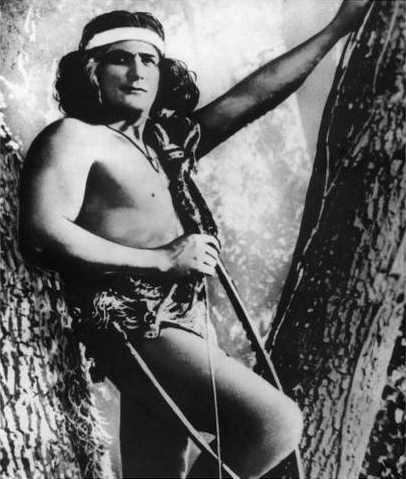
That name may not sound all the imposing but Elmo Lincoln played a very important role in the early days of Hollywood. He was the first actor to play the adult version of Tarzan, the Lord of the Jungle. Originally from Indiana, Elmo Lincoln was a 29 year-old former sailor and boxer when he was selected to replace Stellan Windrow as the star of 1918’s Tarzan of the Apes. (A stunt man, Windrow had already filmed the majority of Tarzan’s stunts before he was drafted to serve in World War I.) Lincoln, who had already appeared in a few of D.W. Griffith’s films, would briefly find stardom as a result of playing Tarzan.
Of course, it takes a while for Lincoln to appear in Tarzan of the Apes. The film was reportedly two hours long when it was initially released but today, it only exists in a 61-minute version. (Because each municipality had its own board of censors, the version of Tarzan of the Apes that played in one city could be quite different from the version that played in another. Unfortunately, with that many censors snipping scenes from city to city, a lot of footage that was cut from the film was undoubtedly lost forever.) The first half of the film deals with the birth of Tarzan while the second half features Tarzan as an adult. Technically, the first actor to play Tarzan was the uncredited baby who appears shortly after Lord Greystoke (True Boardman) and his wife (Kathleen Kirkham) are abandoned by mutineers in Africa. After the baby is given to the Apes, child actor Gordon Griffith takes over the role. Finally, once an expedition is sent to investigate whether or not the stories about Tarzan are true, Elmo Lincoln takes over the role and saves Jane (Enid Markey) after she’s kidnapped by a group of natives. The film ends with Tarzan and Jane just starting to fall in love. (A sequel, The Romance of Tarzan, was released that same year but it’s a lost film.)
In the role of Tarzan, Elmo Lincoln is …. well, he’s okay. He’s not a great actor but he’s a good Tarzan. He’s obviously strong and athletic and he looks convincing when he’s hiding in the trees. Lincoln was not a particularly expressive actor and that natural stiffness is noticeable whenever he’s called upon to demonstrate anything other than grim determination. He has a strong physical presence and, in 1918, that was probably enough to make him a star. When he gazes at Jane and the title cards tells us that he’s saying, “Tarzan is a man and man does not force the love of a woman,” the viewer believes it. If I was lost in the jungle, I’d probably want Elmo Lincoln to help me out. We wouldn’t have much to talk about but I would have faith in his ability to take care of any problems that we ran into on the way back to civilization.
That said, the film is at its best when it depicts Tarzan’s childhood. There’s a sense of fun and wonder to those scenes that is missing from the second half of the film. Gordon Griffith did a good job as the young Tarzan. Louisiana is a surprisingly effective stand-in for the jungles of Africa. By today’s standards, Tarzan of the Apes can seem a bit creaky. (The camera barely moves at all.) But watching it, one can still understand why Hollywood fell in love with the idea of a man raised by apes. One can even understand why, for a brief period of time, Elmo Lincoln became a star.
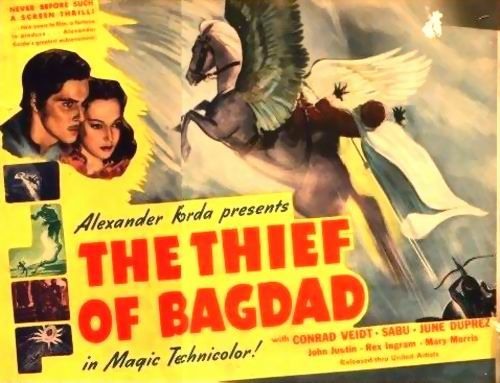
Alexander Korda’s Arabian Nights fantasy THE THIEF OF BAGDAD has stood the test of time as one of filmdom’s most beloved classics. A remake of Douglas Fairbanks Sr.’s 1924 silent classic, Korda and company added some elements of their own, including Indian teen star Sabu as the title character, and some innovative Special Effects. In […]
(Lisa recently discovered that she only has about 8 hours of space left on her DVR! It turns out that she’s been recording movies from July and she just hasn’t gotten around to watching and reviewing them yet. So, once again, Lisa is cleaning out her DVR! She is going to try to watch and review 52 movies by the end of Sunday, December 4th! Will she make it? Keep checking the site to find out!)
On November 8th, I recorded the 1933 film The Emperor Jones off of Retroplex.
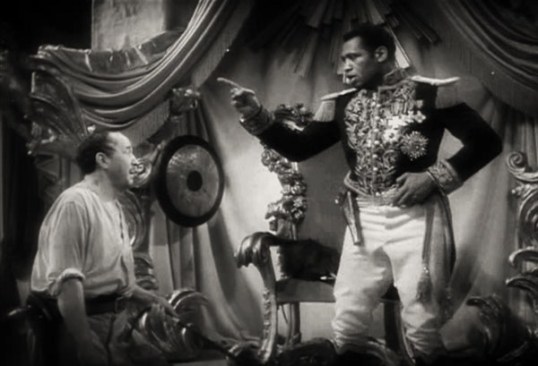
Based on a play by Eugene O’Neill, The Emperor Jones tells the story of Brutus Jones (Paul Robeson). When we first meet Jones, he’s at a small Baptist church. He has recently gotten a job as a Pullman Porter and the church’s congregation has gathered for his send off. He shows off his uniform. He sings a spiritual. The congregation blesses him and Jones swears that he will make them proud. However, soon after he starts working for the railroad, he finds himself in the city. Though he’s a hard worker, he makes the wrong friends. He falls for the beautiful but cold-hearted Undine (Fredi Washington). A fight at a craps gang leads to Jones accidentally stabbing his friend, Jeff (Frank H. Wilson).
Jones is sentenced to hard labor and finds himself working on a chain gang, where he’s watched over by sadistic and racist guards. Jones attempts to serve his time but, eventually, he’s driven to violence by the sight of a white guard beating another prisoner. Jones attacks the guard and then flees. Eventually, he escapes on a steamer ship. Quickly growing tired of shoveling coal in the ship’s engine room, Jones jumps overboard and swims to a nearby island.
On the island, Jones meets Smithers (Dudley Digges). Smithers is an alcoholic merchant who also happens to be the only white man in the island. Working with Smithers, Jones convinces the natives that he has magical powers and overthrows the island’s previous dicttor. Now thoroughly corrupted, Jones declares himself to be the Emperor Jones…
Interestingly enough — and this was probably especially revolutionary in 1933 — almost all of Jones’s corruption is learned from dealing with the white world. It’s through dealing with the condescending and wealthy passengers on the train that Jones comes to understand that money equals power. It’s from dealing with the white guards on the chain gang that Jones learns how people can be controlled through fear and brutality. By the time Jones arrives on the island, he no longer has anything to learn from the white world. Hence, Smithers becomes his servant.
(One thing I found particularly interesting, as I did research for this review, was that The Emperor Jones was banned in cities in both the North and the South. In the North, the film was often banned for its frequent use of the n-word. In the South, it was largely banned because of a scene in which Jones orders Smithers to light his cigarette.)
Seen today, The Emperor Jones is something of an oddity. On the one hand, it’s a very stagey film. The film’s origin as a stage play is obvious in almost every scene. On the other hand, it’s also one of the few films from the 1930s to actually feature black characters as something other than comic relief. If just for that historical reason, The Emperor Jones is still worth watching today.
It’s also worth watching for Paul Robeson’s performance in the lead role. Robeson, whose career was derailed by both his political activism and his refusal to accept roles that he considered to be demeaning, gives a powerful and empathetic performance. Towards the end of the film, Robeson gives a 12-minute monologue as he runs through the jungle. For 12 minutes, it’s just the viewer and Robeson (and the menacing sound of drums in the distance). As Robeson delivers his final monologue, he takes us on a journey through the Emperor’s mind, alternative between periods of delusion and moments of sudden clarity. Even 83 years after it was first filmed, it remains a truly impressive performance.
Keep an eye out for this fascinating historical document.
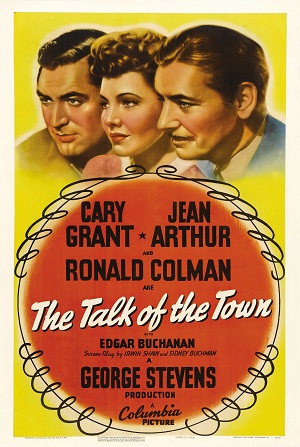
The fourth film on my DVR was the 1942 film, The Talk of the Town. The Talk of The Town originally aired on TCM on March 20th and I recorded it because it was a best picture nominee. As some of our regular readers undoubtedly know, it’s long been a goal of mine to watch and review every single film nominated for Oscar’s top prize.
The Talk of The Town is an odd little hybrid of comedy, melodrama, and a civics lecture. Michael Lightcap (Ronald Colman) is a brilliant attorney and legal professor. He’s been shortlisted for the Supreme Court and he’s also a widely read author. In fact, he’s even rented a house for the summer, so that he may work on a book. The owner of the house — teacher Nora Shelley (Jean Arthur) — will also be acting as his secretary.
As well-read as Prof. Lightcap may be, he’s also rather stuffy and out-of-touch with what’s going on outside of the world of academia. He knows how the law should work but he has little understanding of how the law actually does work. Fortunately, he gets a lesson in reality when he arrives at the house and eventually meets the gardener, Joseph (Cary Grant). Joseph turns out to be surprisingly intelligent and very passionate about politics. Lightcap and Joseph have many debates about whether or not the American legal system actually protects the working man.
What Lightcap doesn’t know is that Joseph is actually Leopold Dilg. Leopold is a labor activist, the type who you always see in old documentaries, standing on a street corner and preaching about unions. Leopold is also a fugitive. He was accused of setting fire to a mill, a fire that apparently led to the death of the foreman. Despite the fact that he loudly proclaimed his innocence, Leopold was arrested and prosecutors announced that they would seek the death penalty. Convinced that he would never get a fair trial, Leopold escaped from jail and fled to Nora’s house.
Nora and Leopold went to school together. They love each other, even though circumstances — mostly his political activism — conspired to keep them apart. When Lightcap moves into the house, Nora and Leopold’s attorney, Sam (Edgar Buchanan), hope that they can convince him to take on Leopold’s case. However, they also have to not only convince Leopold to reveal his true identity but also convince Lightcap to put his supreme court appointment at risk by defending a politically unpopular defendant. Their solution is to trick Lightcap into falling in love with Nora and then convince him to take on the case for her.
However, Nora soons finds herself falling in love with Lightcap for real. Who will she choose in the end? Cary Grant or Ronald Colman? Today, it seems like a pretty easy decision but apparently, in 1942, Columbia Pictures actually shot two different endings for the movie.
The Talk of The Town is an odd little movie. For the most part, it’s a drama. But it also has plenty of comedic elements, mostly dealing with the attempts to keep Leopold’s identity a secret. In the end, it’s a little bit too preachy to really work as either a drama or a comedy. That said, I still liked The Talk Of The Town because it made a strong case for the importance of due process, which is a concept that a lot of people take for granted.
(At the same time, The Talk of the Town was made in 1942 so you never have any doubt that Lightcap’s belief in the American legal system will eventually be vindicated. With America having just entered World War II, 1942 was not a time for cynicism. If Talk of the Town has been made in the 30s, it probably would have been a very different movie.)
Probably the best thing about Talk of the Town is the cast. It may not be a great film but, when you’ve got Cary Grant and Jean Arthur in a scene together, it almost doesn’t matter.
The Talk of the Town was nominated for best picture but it lost to Mrs. Miniver.
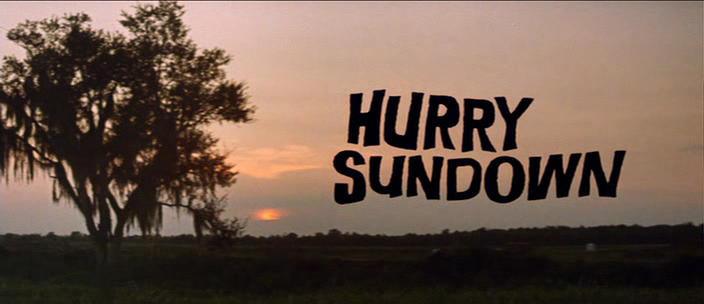
It seems like whenever film bloggers and reviewers are making out a list of the worst films of all time, somebody always mentions Hurry Sundown.
Now, don’t get me wrong. It doesn’t get mentioned as often as Battlefield Earth or Adam Sandler’s latest comedy. And, when it does get mentioned, it’s done with little of the warmth that’s given to Troll 2, The Room, or Birdemic. Instead, one gets the impression that Hurry Sundown is a film so bad that even those of us who appreciate bad films would find little to love about it.
But y’all know me. I’m the type that prefers to judge for herself and I’m also someone who rather enjoys being a contrarian. There’s a reason why one of my most read posts on this site is entitled 10 Reasons Why I Hated Avatar. Add to that, Hurry Sundown was directed by Otto Preminger who also directed one of my favorite films of all time, Anatomy of a Murder. How, I asked myself, could the man who made Anatomy of a Murder possibly also direct one of the worst films of all time? As a result, every time that I saw someone claiming that Hurry Sundown was one of the worst films of all time, I grew more and more determined to someday see the film and judge for myself.
Well, I finally got my chance this weekend. Hurry Sundown was on one of my newest favorite channels, The MOVIES! TV Network. And I proceeded to watch it. I sat through all four hours of this film (that’s including commercials and, oh my God, was I thankful for the distraction that those commercials provided). I watched Hurry Sundown and …. wow. Was it ever bad.
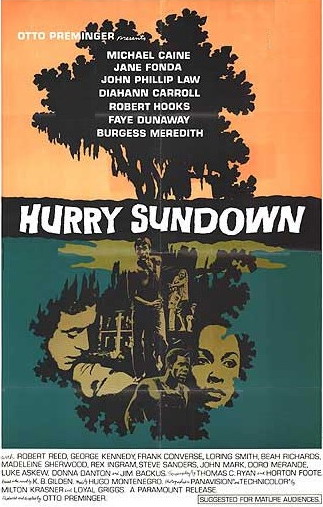
Released in 1967, Hurry Sundown was Otto Preminger’s attempt to take a look at race relations in the deep south. It’s a film full of good, liberal intentions and an apparent lack of knowledge about — well, about everything. As I watched this slow, almost formless blob of a film, I found myself wondering how the director who gave us Laura and Anatomy of a Murder could have possibly directed a film with a gigantic cast but absolutely no interesting characters. I wondered how the director who had been willing to challenge the racist assumptions of 1950s Hollywood by directing Carmen Jones could have been responsible for the corny and subtly condescending look at race relations that was Hurry Sundown.
Hurry Sundown takes place in 1946 and is set in rural Georgia. The war is over, the soldiers are coming home, and nobody in the film can maintain a convincing Southern accent for more than a line or two. (Seriously — I’ve heard a lot of really bad Southern accents in a lot of really bad films but none of those accents were as bad as what I heard in Hurry Sundown.) It’s a brand new world but the South is clinging to the old ways of racism and classism.
Preminger slowly (and clumsily) introduces us to the huge cast of characters who populate the slice of Hollywood Georgia.
There’s the sheriff (George Kennedy) who is so stupid that he can be distracted by an offer of fried chicken. Kennedy actually gives a good comedic performance but his character seems like he belongs in another movie and you have to wonder how civil rights activists in 1967 — many of whom had undoubtedly been arrested and harassed by Southern sheriffs much like this one — reacted to Kenendy’s character being presented as harmless comic relief.
There’s the racist judge (Burgess Meredith) who, much like the sheriff, is presented as being a comedic buffoon as opposed to an actual threat. The judge uses the n-word in every other sentence, which should be shocking and infuriating but, as a result of Meredith’s over-the-top delivery, instead simply comes across as being gratuitous and tasteless.
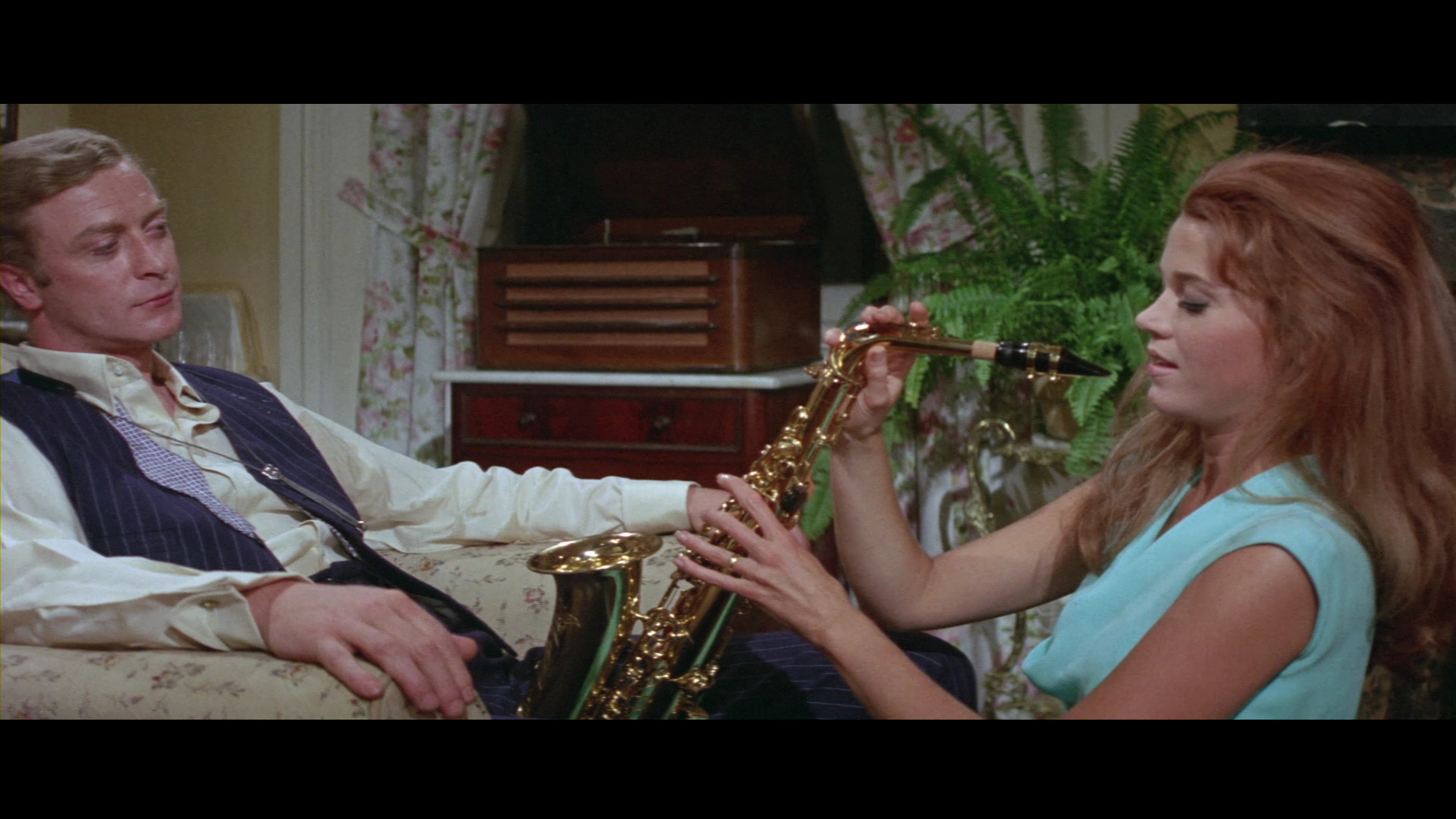
Then there’s Henry. Henry is a businessman who dodged the draft, cheats on his wife, and who has a son who literally spends the entire movie screaming at the top of his lungs. (Whenever that kid was on-screen, I imagined Preminger standing behind the camera and going, “More! More! Scream more!”) Henry is also a racist, though for some reason he loves jazz and often plays the saxophone. I kept waiting for someone in the movie to point out to him that jazz was created by black musicians but nobody did. (If Henry had appeared in Anatomy of a Murder, someone would have.)
Did I mention that Henry is played by Michael Caine? And did I also mention that Caine is the most cockney-sounding Southerner that I’ve ever heard? Because he totally is.
Henry’s wife is named Julie and is played by Jane Fonda. At one point, she suggestively blows on Henry’s saxophone. One can only imagine how audiences in the 60s reacted to that. (Actually, they probably didn’t. They probably just said, “Good thing she’s pretty because she ain’t no musician…”)
Anyway, Harry wants to buy up some farmland but half of that land is owned by Henry’s poor cousin Rad (John Phillip Law) and Rad doesn’t want to move. Rad has just returned from fighting in the war and he views Harry as being a cowardly draft dodger. Rad is married to Lou (Faye Dunaway) and wow, are they ever a boring couple! Dunaway was under a five-picture contract to Preminger when she made this film and apparently, she had such a terrible time on the set of Hurry Sundown that she sued to get out of ever having to make another movie with Otto. Dunaway’s misery comes through in every scene.
The other half of the farmland is owned by Reeve (Robert Hooks), a black farmer whose mother (played by Beah Richards) is Julie’s former mammy. Julie goes down to the farmhouse to convince Reeve to sell and Reeve’s mother responds by having the most (over)dramatic heart attack in the history of cinema. Saddened by death of his mother, Reeve is definitely not going to sell. When he’s not chastely romancing the local teacher (played by Diahann Carroll, who appears to have wandered over from a different, far more glamorous movie), Reeve is singing sprituals and working out in the fields.
One of the things that Reeve does not do — no matter how many times he gets called the n-word or is treated unfairly — is get mad. Rad gets mad. Julie gets mad. A liberal white preacher (Frank Converse) gets mad. But Reeve and the other black characters in the film are never really allowed to get mad or do anything that might make the film’s white audience feel nervous. Watching a film like Hurry Sundown, you can understand why — in just a few more years — Blaxploitation films would suddenly become so popular. It was probably the first time that black film characters were actually allowed to not only get angry over the way they were being treated but to fight back, as opposed to reacting in the Hurry Sundown-way of passive acceptance.
Anyway, Rad and Reeve come together to protect their land and Henry and the evil judge conspire to cheat them out of their land and — well, let’s just say that Hurry Sundown is one of those films that has a lot of plot and very little action. Preminger directs with a stunning lack of pace or grace, the actors deal with a poorly written script by either engaging in histrionics or going catatonic, and Michael Caine’s attempt at a Southern accent will amuse anyone who has ever been south of the Mason-Dixon.
I have to admit that I was really hoping that Hurry Sundown would turn out to be a sordid and tawdry little masterpiece, the type of overheated misfire that you love despite your better instincts. But, no. Hurry Sundown is just boring. The film is such a misfire that it doesn’t even work as a piece of history. The critics were right. Hurry Sundown sucks.
 Through the Shattered Lens