Welcome to Retro Television Reviews, a feature where we review some of our favorite and least favorite shows of the past! On Sundays, I will be reviewing the made-for-television movies that used to be a primetime mainstay. Today’s film is 1972’s The Judge and Jake Wyler! It can be viewed on YouTube.
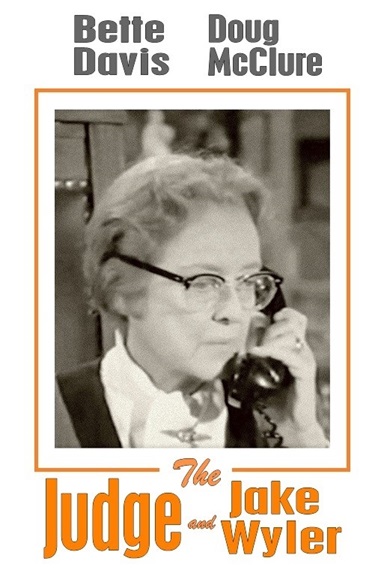
Judge Meredith (Bette Davis) is a retired criminal court judge who has developed a severe case of hypochondria. She lives in a mansion that she never leaves. Anyone who comes to see her must be personally vacuumed by her butler before they can be allowed to stand in her presence. She hates people who take too long to get to the point and she also has little use for people who are rude on the phone. She especially dislikes cigarettes and refuses to have even an unlit one in her presence.
Jake Wyler (Doug McClure) is an ex-con who is currently on supervised probation. Despite his criminal past, he’s a likable and amiable guy and, every morning, he wakes up with a new woman in his bed. Jake enjoys tweaking authority and he always has a pack of cigarettes on him somewhere.
Together, they solve crimes!
They actually do! The judge is dealing with retirement by running her own detective agency, one that is exclusively staffed by people that she previously sentenced to prison. Jake does most of the leg work as far as the agency is concerned. The Judge calls him every morning and demands to know why he’s not working harder. Jake would rather just sleep-in but working for the judge is a part of his parole. She could easily send him and everyone else working for her back to prison. This sounds like a pretty unfair situation to me and the Judge is so demanding that I think it could be argued that she’s an abusive boss. But, because this is a pilot for a TV show and the Judge is played by Bette Davis, everyone is very loyal to her.
At the start of the film, Jake reveals to Robert Dodd (Kent Smith) that his wife, Caroline (Lisabeth Hush), has been cheating on him with Frank Morrison (Gary Conway). When Robert is later found dead in a hospital room, the official verdict is that he committed suicide. However, his daughter, Alicia (Joan Van Ark), claims that her father was murdered. At first, both Jake and the Judge suspect that Alicia just wants to collect a bigger life insurance settlement but it turns out that Dodd’s beneficiary wasn’t even Alicia. The money is going to his second wife, the one who was cheating on him. While the Judge yells at people on the phone, Jake investigates the death of Robert Dodd.
The Judge and Jake Wyler is a mix of comedy and mystery. Jake has a way with a quip and the majority of the suspects, including John Randolph and Eric Braeden, all have their own eccentricities. Director David Lowell Rich does a good job of keeping the action moving and the mystery itself is actually pretty interesting. Surprisingly, the show’s only real flaw is Bette Davis, who seems to be rather bored in the role of Judge Meredith. Even though the character seems to have been specifically written for her trademark caustic line delivery, Davis delivers her lines with little enthusiasm. One gets the feeling that she wasn’t particularly happy about the idea of having to do a television pilot.
Davis need not have worried. The Judge and Jake Wyler did not turn into a series. That said, the movie is an entertaining and diverting murder mystery.
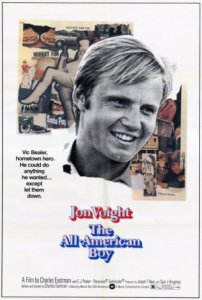 Vic “The Bomber” Bealer is an amateur boxer who appears to be poised to escape from life in his dreary hometown. He is such a good fighter that he is on the verge of making the U.S. Olympic Team and he is so good-looking that everyone, from his teenage girlfriend (Anne Archer) to his gay manager (Ned Glass) to a woman he meets at a gas station, automatically falls in love with him. However, after his girlfriend tells him that she is pregnant, Vic abandons both her and boxing. When she leaves town to have an abortion, Vic starts boxing again but then he learns that she may not have actually had an abortion and Vic leaves for Los Angeles, to see both her and his son.
 Through the Shattered Lens