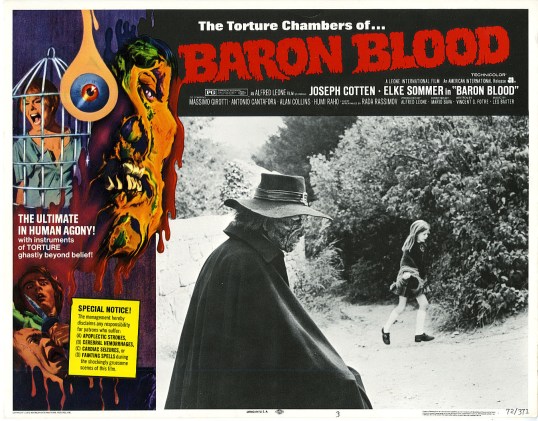
Directed by the great Mario Bava, the 1972 Italian film, Baron Blood, tells a story of gothic horror.
During the 19th century, there was no one as feared in Austria as Baron Otto Von Kleist. Much like the infamous Gilles de Rais, the Baron was a sadist who used his noble background as a cover for his macabre activities. In his castle, he murdered hundreds of villagers and, for that, he was nicknamed Baron Blood. He also had an accused witch burned at the stake. As she died, she cursed the Baron, saying that he would continually rise from the dead just so he could be killed again and again. When you think about it, that’s actually a pretty badass curse.
One hundred years later, the Baron’s American descendant, Peter Kleist (Antonio Cantafora), arrives in Austria to check out the family castle. The castle is being converted into a tacky hotel where tourists can stay in the same rooms where the Baron used to kill his victims. However, Peter is not particularly concerned with what’s about to happen to the castle. Instead, he’s in Austria because he’s discovered a parchment that contains an incantation that will bring the Baron back to life. He wants to give it a try, more for his own amusement than anything else. Neither her nor Eva (Elke Sommer), a college student who is studying the hotel’s architecture, really think that they are going to bring the Baron back to life by reading the incantation at midnight. Of course, they’re wrong.
It’s easy to make fun of Peter and Eva for being so naïve as to think that it wouldn’t be a big deal to cast a magic spell but it’s not like they realize that they’re characters in an Italian horror film. They don’t know that their lives are being directed by Mario Bava. To be honest, if I was there, I probably would have joined them in reading the spell. Sometimes, it can be fun to tempt fate.
That said, in the case, fate should not have been tempted. People are soon dying. When the man behind the hotel project is murdered, a wheelchair-bound millionaire named Alfred Becker (Joseph Cotten) shows up and purchases the castle for himself and announces plans to restore it. Will restoring the castle bring peace to the village or is the witch’s curse too powerful to defeat?
Baron Blood is often described as being one of Bava’s lesser films and is it true that it feels a bit conventional, particularly when compared to the subversive and satiric Bay of Blood and the surreal Lisa and the Devil. Baron Blood was a film that Bava himself was reportedly not enthused about making, one that he took on only because his last few films had struggled at the box office and he didn’t feel he would get any better offers. Perhaps that’s why a definite strain of melancholy and disillusionment runs through Baron Blood, a film in which a beautiful castle is destined to be turned into a tacky tourist trap by a businessman who could hardly care less about either history or aesthetics.
Though the story is a bit predictable (and you’ll have little trouble guessing which character is the Baron in disguise), I actually like Baron Blood. Not surprisingly, considering that it was a Bava film, Baron Blood is heavy on gothic atmosphere, so much so that it feels almost like an extra-bloody Hammer film. Both the castle and the village are full of shadows, from which anyone or anything could emerge at any moments and the cold grandeur of the castle is nicely contrasted with the garishness of 70s Europe. A visually striking scene where Eva flees from an attacker is especially well-directed and the film ends on a properly macabre note, one that once again feels as if it’s putting a distinctly Italian spin on a situation one would usually expect to find in a Hammer production.
Antonio Cantafora is a bit of a stiff but Elke Sommer gives an energetic and committed performance as someone who is torn between preserving the past and embracing the modern world. She doesn’t get to do as much in this film as she did in Lisa and the Devil but she’s still a sympathetic lead and someone to whom most viewers will be able to relate. We care about her character and, as a result, we care about discover just what exactly the Baron has in store for her.
Baron Blood may not have been a critical or a box office success when it was originally released but it has achieved a certain immortality. In a development that could have been lifted from one of Bava’s films, the sounds of the Baron’s victims screaming were later lifted from this film, remixed, and sold as being a recording that had apparently been made of sinners screaming from behind the gates of Hell. To this day, there are sites that insist that this recording is genuine. One hopes that Bava would have appreciated the admittedly dark humor of it all.

 Through the Shattered Lens