Love On The Shattered Lens: The Red-Haired Alibi (dir by Christy Cabanne)


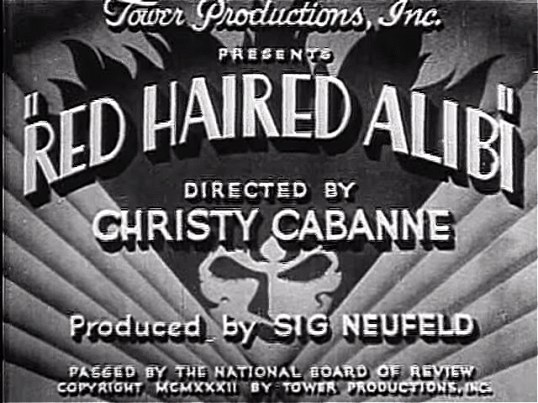
1932’s The Red-Haired Alibi tells the story of Lynn (Merna Kennedy).

When we first meet Lynn, she is working at a store in Manhattan.  She has red hair.  The film is in black-and-white but we have no doubt that her hair is red because every single character who meets her mentions that she has red hair and she continually reminds people that she has red hair.  Everyone seems to be so stunned to meet a redhead!  And I have to say that this is the most realistic part of this movie.  I have red hair.  I’ve had complete strangers tell me that they like my hair.  I’ve also had complete strangers ask me if I’m a natural redhead (and I am!) and some other things that I’m not going to repeat here.  Personally, I love having red hair.  I’m a member of the proud 2%.  I don’t care if some people claim that people with red hair don’t have souls.  When you’ve got red hair, what else do you need?

As for the movie, Lynn meets a charming man named Trent Travers (Theodore van Enz).  Trent offers to give Lynn a job, away from the drudgery of working in sales.  Trent will pay Lynn to be his companion at night.  And since this is a pre-code film, Red-Haired Alibi is pretty open about what that means.  Lynn agrees.  Trent is handsome and rich and who couldn’t use the money during the Great Depression?  I imagine the film’s audience agreed.  One thing that always comes through in these Depression-era pre-code films is that morals don’t really matter when you’re struggling to pay your rent and not starve to death.

The problem is that Trent is a gangster.  Trent spends his nights committing crimes and then using Lynn as his alibi.  Eventually, Lynn realizes that she’s gotten herself into a dangerous situation.  The police suggest to her that she should get out of town before Trent takes things too far.  (I guess they didn’t have witness protection in 1932.)

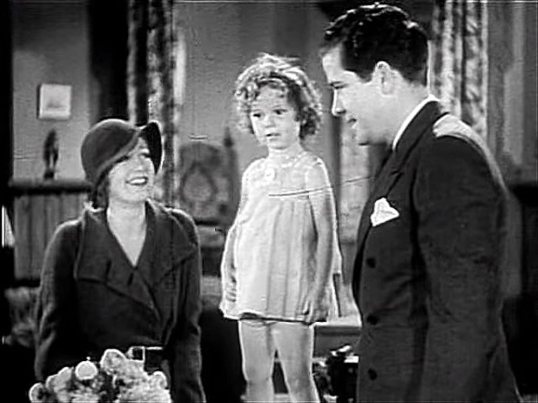
Lynn flees New York and builds a new life for herself in White Plains.  She meets a charming widower named Bob Wilson (Grant Withers).  They marry and settle into a life of domestic bliss.  Lynn becomes the stepmother to Bob’s young daughter (played by Shirley Temple, in what is believed to have been her film debut).  Everything seems to finally be perfect for Lynn.  Or at least it does until Trent shows up….

The Red-Haired Alibi is a generally well-acted but somewhat slow 1930s melodrama.  Comparing this film to some of the other films of the early 30s, it’s a relief to see a cast that knows how to deliver dialogue in the sound era but director Christy Carbanne sometimes struggles to maintain the sort of narrative momentum necessary to make a film like this compelling.  The ending feels a bit silly but, at least during the pre-code era, there wasn’t a need to try to punish Lynn for having a less-than-perfect past.

Dancer and former silent actress Merna Kennedy was best-known for her work with Charlie Chaplin and she gives a likable performance as Lynn.  Two years after making this film, she married Busby Berkley and retired from acting.  Tragically, she died of a heart attack in 1944, when she was only 36 years old.
Lisa Reviews An Oscar Nominee: Alibi (dir by Roland West)


1929 was a transitional year for Hollywood.

On the one hand, more people were going to the movies than ever.  The studio moguls were getting rich and directors, many of whom were influenced by German expressionism, were experimenting with new ways to visually tell their stories.  The days when an motionless camera would just be planted on the floor so that it could record actors moving in and out of the frame were over.

At the same time, Hollywood was also struggling to adjust to the arrival of sound.  Though many assumed that sound would just be a fad, it quickly turned out that audiences preferred sound pictures to the old silent melodramas.  Films that had been originally conceived as being silent were reshot with sound and the results were often mixed as Hollywood technicians struggled to figure out how to get the best and clearest recording possible.  Even harder hit were the actors, who had spent decades giving silent performances but who were now expected to adapt, overnight, to an entirely new style of acting.  Some actors saw their career abruptly end because their voice didn’t match their appearance or because they simply couldn’t memorize the dialogue that they were now required to actually speak.  Even the actors who could handle delivering their dialogue often struggled to find the right balance between acting too much and acting too little.

Take Alibi, for instance.  This crime film was released in 1929 and visually, it’s often a marvel.  But whenever the actors open their mouths and start to recite their dialogue …. yeesh!

Based on a Broadway play, Alibi tells the story of Chick Williams (Chester Morris, whose brooding good looks go a long way towards making up for his awkward screen presence).  Chick is a career criminal who has just been released from prison.  Because he’s a “jailbird,” (as they used to put it in 1929), Sgt. Pete Manning (Purnell Pratt) is convinced that Chick has hooked back up with his old gang and that he’s responsible for a recent robbery that left one policeman dead.  However, Chick has an alibi.  It turns out that, after getting out of prison, one of the first that Chick did was get married.  Chick’s new wife is Pete’s daughter, Joan (Eleanor Griffith)!  And Joan swears that, on the night of the crime, Chick was with her at the theater.

Despite his alibi, Pete is convinced that Chick had something to do with both the robbery and the murder.  Pete decides to send in an undercover cop, Danny McGann (Regis Toomey).  Pretending to be a permanently drunk businessman, Danny works his way into Chick’s mob.  But can Danny find the proof needed to take Chick down?

So, here’s what’s good about Alibi.  First off, it’s a pre-code film, which means that the characters are allowed to occasionally curse and that the gangsters all spend their time at a nightclub, watching the floor show.  It also means that Joan is allowed to openly discuss why she distrusts the police and the film shows the police being brutal in a way that would never be allowed during the production code years.  Secondly, from the very first scene, director Roland West creates an almost dream-like atmosphere, full of looming shadows and art deco sets and close-ups of menacing faces.  West’s camera prowls through the streets and clubs with a restless energy.

But then, as I mentioned earlier, someone will open their mouth and start to speak and the entire film comes to a halt.  The cast — some of whom went on to have long and successful careers — was obviously still struggling to figure out how to act in a sound film and the results are definitely mixed.  Eleanor Griffith delivers all of her lines in the same angry tone while Purnell Pratt stiffly defends the police force.  Regis Toomey, meanwhile, goes so overboard as Danny that you find yourself hoping that he’ll blow his cover and be forced out of the film.  Though he’s occasionally awkward, Chester Morris probably does the best out of the entire cast.  At the very least, he manages to communicate some genuine menace.

Seen today, Alibi is mostly interesting as a historical document.  It represents both the best and the worst of the early sound era.  When it was first released, Alibi was a hit at the box office.  Though no official nominees were announced for the 2nd Academy Awards, notes from the era indicate the Alibi was among the films considered for Best Picture and it’s usually listed as being a nominee.  The award itself was given to Broadway Melody.

Lisa Reviews An Oscar Nominee: Five Star Final (dir by Mervyn LeRoy)


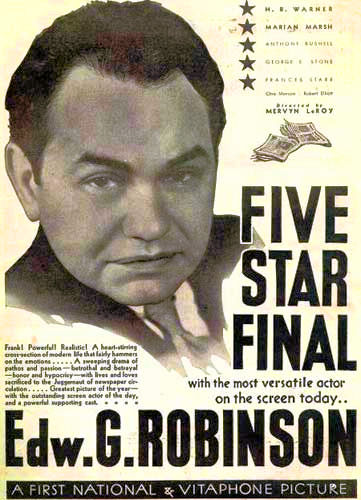
Five_Star_Final_1931_poster

In 1911, a pregnant secretary named Nancy Voorhees (Frances Starr) shot and killed her boss and lover.  It was quite a scandal at the time but, twenty years later, it has largely been forgotten.  Nancy has married a successful businessman named Michael Townsend (H.B. Warner) and is a respected member of society.  Her daughter, Jenny (Marian Marsh), has no idea about Nancy’s past and believes Michael to be her father.  Jenny is now engaged to marry the handsome and rich Phillip Weeks (Anthony Bushnell).

Everything seems to be perfect but you know what they say about perfection.

Bernard Hincliffe (Oscar Apfel) is the publisher of a struggling tabloid newspaper.  He is frustrated by city editor Joseph Randall (Edward G. Robinson) and Randall’s refusal to do whatever it takes to boost circulation.  “Why, he won’t even print pictures of women in their underwear!” one of Hincliffe’s assistants exclaims.  Finally, Hincliffe orders Randall to publish a series of articles that will take a retrospective look at both the scandal and what has happened to those involved in the years since.  At first, the cynical Randall refuses but eventually, he gives in.

He assigns two reporters to crack the story.  One of them, Kitty Carmody (Ona Munson) is first introduced showing off her legs and bragging about how there’s no way that she won’t be hired to work at the newspaper.  (By the way, if anyone ever remakes Five Star Final and needs someone to play Kitty, I am ready and available.)  The other is the incredibly creepy T. Vernon Isopod (Boris Karloff).  Isopod was a divinity student until he was arrested on a “morals charge.”  Now, he pretends to be a minister as a way to fool people into revealing their deepest secrets to him.  Kitty and Isopod dig into the life of Nancy and Michael.  The stories appear on the front page.  Suicide and melodrama follow and Randall is forced to finally take a stand.

Released in 1931, Five Star Final was nominated for best picture but lost to Grand Hotel.  Seen today, Five Star Final is undeniably stagey (it was based on a play) but it’s still a compulsively watchable melodrama, featuring good performances and a lot of memorably snappy 30s dialogue. Five Star Final is one of several films about journalism to have been nominated for best picture.  Most of these films — like All The Presidents Men, The Front Page, and this year’s front-runner, Spotlight — have featured journalists as heroic seekers of the truth.  Five Star Final, on the other hand, plays more like a pre-Code version of Network set at a newspaper.  It’s a deeply angry film and, when Randall finally tells off Hincliffe, it feels like the 30s equivalent of Peter Finch shouting that he’s mad as hell and not going to take it anymore.

Finally, the best part of the film, for me, was Boris Karloff as the sleazy Isopod.  Karloff made Five Star Final right before he played the creature in Frankenstein and it’s interesting to see him play a totally different type of monster here.  If I had to choose which character is scarier, I’m going with T. Vernon Isopod.

http://www.youtube.com/watch?v=a0qL1fs1c6k