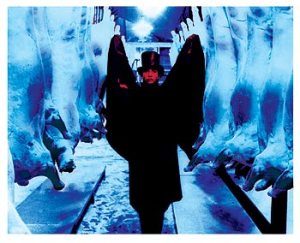
At the risk of sounding like every other girl who has ever sat in a corner of Starbucks and spent a few hours writing emo poetry in her Hello Kitty notebook, I love the Beat Generation. I’ve read all of Jack Kerouac’s novels, Allen Ginsberg’s poems, and William S. Burroughs’ cut-ups. I’ve even tried to listen to the music of the Fugs and I just recently finished reading the very first Beat novel, John Clellon Holmes’ Go. It was my interest in the Beats that led to me discovering Chappaqua.
Originally filmed in 1966 and released a year later, Chappaqua was produced, written, and directed by Conrad Rooks. The son of the president of Avon, Rooks had a lot of money and a lot of addictions. In 1962, Rooks checked into a European clinic where he detoxed and claimed to have been cured of his drug dependency through something called “sleep therapy.” Chappaqua is based on his experiences both as a drug addict and a patient and, since Rooks was something of a hanger-on in the American underground art scene, the final film featured cameos from such counterculture figures as Allen Ginsberg and William S. Burroughs.
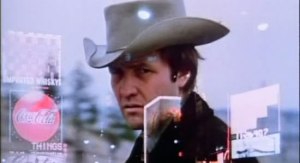
In the film, Rooks plays himself, a young man who is usually seen wandering aimlessly from one location to another. The film is edited in such a way that you’re never quite sure where Rooks is going to be from one scene to another. Most famously, the film’s opening features Rooks wandering across the countryside of Nebraska while images (and sounds) of New York’s 42nd Street are superimposed over his face. Later on in the film, Rooks will just as abruptly turn up walking through the streets of India and meditating with a random guru. Rooks, it quickly becomes apparent, is a man with no true home, a wanderer who seems to randomly alternate between being lost and being on a mission.
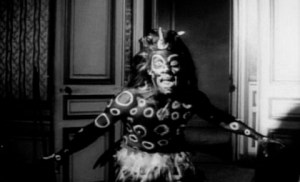
For most of the film, however, Rooks is in a small clinic outside of France. Along with telling his doctor (played by Jean-Louis Barrault) about how he came to be addicted to drugs and alcohol, Rooks goes through withdrawal and has the surreal hallucinations that dominate the majority of the film. During one hallucination, Rooks sees himself as a gangster gunning down a midget in a parking garage. Then, suddenly, Rooks is no longer a gangster and instead, he’s a vampire speaking in an over-pronounced Transylvanian accent. A druid appears and does a jig in the middle of the Stonehenge and a witch doctor shows up and starts to dance through the halls of the clinic. Throughout it all, Rooks is haunted by the image of a stunningly beautiful woman (Paula Pritchett) in a white dress, kneeling by a placid lake. Observing all of this is the menacing figure of Opium Jones (played by William S. Burroughs), who continually encourages Rooks to stay on drugs and who may, or may not, be a figment of Rooks’ imagination.
How to explain the odd (and occasionally frustrating) charm of Chappaqua. This is truly a pretentious mess of a movie, full of symbolism that is both obvious and willfully obscure. However, there’s a strange charm to the film’s pretension. The film may not make much sense but it’s never incoherent. Largely thanks to cinematographer Robert Frank, the visuals of the film are so strong and striking that they often provide the narrative drive that the film would otherwise lack. Chappaqua is, ultimately, just a fascinating film to watch.
My main reason for enjoying and recommending Chappaqua, is that the film truly is a time capsule. Both the film’s strengths and its flaws can be linked back to the fact that it was made in 1966. It’s a true cultural artifact and, therefore, it is a must-see for anyone who is interested in either the Beats or the counter-culture that was indirectly descended from them.
 Through the Shattered Lens