Cleaning Out The DVR: Sodom and Gomorrah (dir by Robert Aldrich)


I think we all know the story of Sodom and Gomorrah.

As told in the book of Genesis, Sodom and Gomorrah were two of the wickedest cities in what was then the civilized world. God grew so sick of their wickedness that he decided to wipe both of the cities and all of their inhabitants out of existence. However, because Abraham’s son, Lot, was living in Sodom with his family, God sent two angels to Sodom to warn Lot. Lot tried to argue that, if he could find 10 good people in the city, Sodom should be spared. However, then the people of Sodom showed up and demanded to “know” the angels and that pretty much sealed their fate. Lot and his family were told to leave the city and to not look back while it was being destroyed. Unfortunately, Lot’s wife just couldn’t resist the temptation and she ended up turning into a pillar of salt.

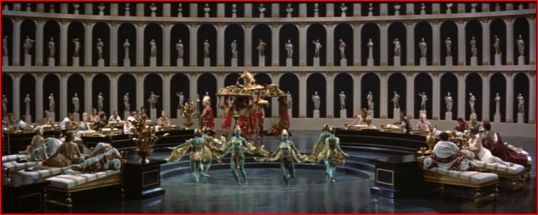
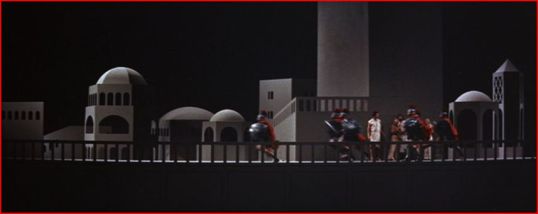
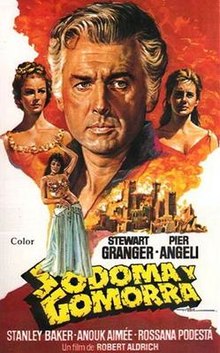
The 1962 film, Sodom and Gomorrah, recreates the Biblical story, though it takes a lot of liberties with the established narrative. Stewart Granger plays Lot. Anouk Aimee plays Bera, the decadent queen of Sodom who refuses to believe that the incoming destruction of her city is anything more than a dust storm. Pier Angeli plays Lot’s wife, who is imagined here as formerly being one of Bera’s slaves. Though she loves Lot, she loves her former life more and …. well, we all know the story. And then there’s several characters who were created specifically for the film. The most prominent of these is Astaroth (Stanley Baker), who is Bera’s scheming brother and who later is attracted to one of Lot’s daughters. The film was directed by Robert Aldrich. If you know anything about Aldrich’s filmography (Kiss Me Deadly, Twilight’s Last Gleaming, and Hustle among others), he’s not exactly the first name that comes to mind when you think of a director who you would expect to find directing a Biblical epic. And indeed, when compared to his other films, Aldrich often does seem to just be going through the motions when it comes to telling the film’s story.

Sodom and Gomorrah suffers from a problem that afflicted many Biblical epics. It takes forever to get to the good stuff. We’re all watching because we want to see the cities get destroyed and we want to watch Lot’s wife get transformed into a pillar of salt. However, this film — which has a running time of two and a half hours — takes forever to reach that point. First, we have to spend a lot of time listening to Astaroth plotting against his sister and scheming how to take over the Salt Trade, which is the source of the wealth of both of the cities. Then we spend an endless amount of time with Lot and his family wandering through the desert. There are a few good battle scenes but the film still feels dragged out. It takes forever to get to the destruction of Sodom and Gomorrah and it’s a bit of a let down when it finally does happen. The ground shakes, Dust fills the sky. Buildings start falling on people. Throughout it all, the Sodomites continue to behave wickedly, which leads to a few odd moments. (A man and a woman stop fleeing for a few minutes to make out against a wall. Naturally, the wall is the next thing to collapse.) After all of that build-up, the destruction scenes are maddeningly pedestrian.

Lot is probably one of the most interesting characters in Genesis, an imperfect man who tried to do the right thing but who often seemed to have terrible luck. Unfortunately, Stewart Granger is a bit of a stiff in the lead role and he’s never convincing as someone who could lead his people through the desert. He doesn’t have the innate authority that Charlton Heston had in The Ten Commandments. Far more successful are the performances of Stanley Baker and Anouk Aimee. Aimee, in particular, seems to being having a blast being bad. Or at least, she is until the walls come tumbling down.
Lisa Cleans Out Her DVR: The Silver Chalice (dir by Victor Saville)


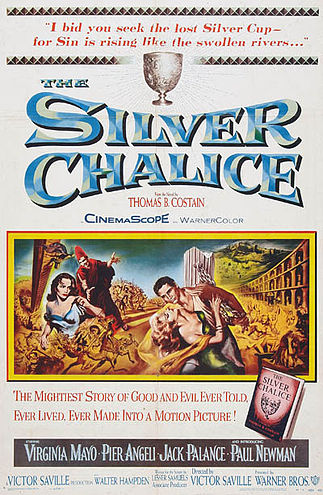
If you ever needed proof that everyone has to start somewhere, look no further than the 1954 biblical epic, The Silver Chalice.

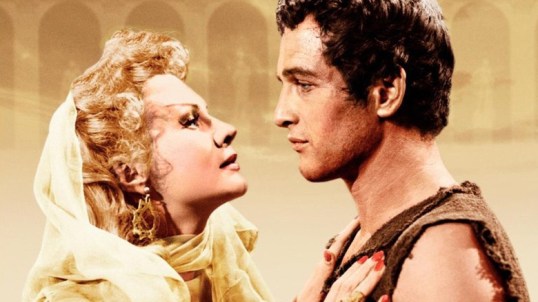
The Silver Chalice features the film debut of Paul Newman, who later proved himself to be a legitimately great actor.  It’s true that, unlike a lot of actors, Newman made his debut in a starring role.  He never had to humiliate himself with any one-line roles or walk-on bits.  No, Paul got to humiliate himself with a starring role.

Paul Newman was 29 years old when he played Basil, a former slave turned sculptor.  Not only did Newman bear a disconcerting resemblance to Ben Savage (of Boy Meets World fame) but he gave a performance that was so bad that it’s kind of a shock that he ever worked again.  Basil is a passionate artist, one who survived being betrayed by his adopted family and slavery.  Newman comes across like a nice, young man from Iowa.  Usually, Newman looks miserable but occasionally, he flashes a somewhat weak smile.  When Basil gets mad, Newman speaks in a squeaky voice.  When Basil is feeling reverent, Newman furrows his brow like a hungover Russell Brand staring straight into the sun.

“But me and Topanga are soul mates…”

Then again, I’m not sure that any actor could have given a good performance as Basil.  The Silver Chalice has a terrible script, one that was written by Lesser Samuels.  (I’ll avoid the obvious joke about whether or not The Silver Chalice would have been better if written by Greater Samuels.)  Apparently, before Newman was cast, the producers pursued James Dean for the role.  I’m sure we all would have enjoyed seeing Dean slouch his way through the film but I doubt that even he could have done much with The Silver Chalice.

The Silver Chalice is based on a novel, which perhaps explains why there’s so many characters and so many unnecessary subplots.  Basil follows a path that will be familiar to anyone who has seen a 1950s biblical epic.  He’s a young Greek who is adopted into a noble Roman family.  When his kindly stepfather dies, Basil’s stepsiblings sell him into slavery.  It’s not an easy life but Basil is a talented sculptor so Joseph of Arimathea commissions him to make a silver chalice for the Holy Grail.  Basil goes from poor to rich to poor again to rich again to ultimately saved by grace.  He even gets to do the same walking towards Heaven thing that Richard Burton did at the end of The Robe.

Meanwhile, Simon Magus (Jack Palance) is wowing the citizenry with his magic tricks and claiming to be the risen Messiah.  Simon’s assistant just happens to be Helena, who knew Basil when he was younger.  Young Helena is played by dark-haired Natalie Wood.  Grown-up Helena is played by blonde Virgina Mayo.  They were both good actresses but there’s seriously no way that Natalie Wood would have ever grown up to be Virginia Mayo.

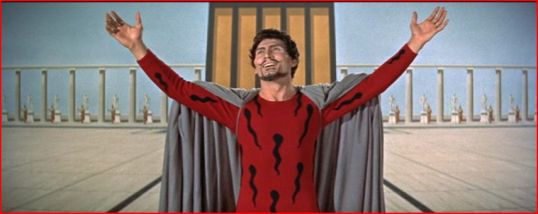
Jack Palance pretty much steals the movie, mostly because he gets to wear the silliest costumes:

Poor Paul Newman has to settle for a tunic and a miniskirt, while Jack Palance gets to wear this:

Personally, I’ve always enjoyed the story of Simon Magus.  He tried to show off by flying over the Roman Forum so St. Peter said a prayer and Simon promptly plunged to his death.  Take that, you Gnostic!

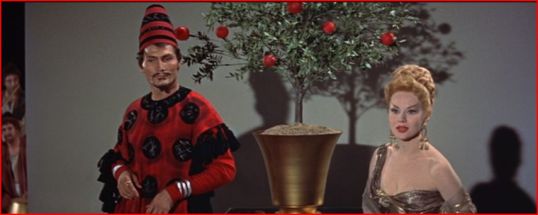
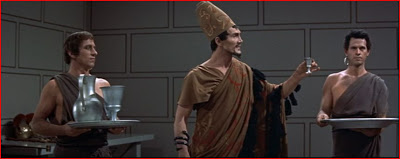
Another interesting thing about The Silver Chalice is that the sets are very deliberately fake.  I don’t mean that they look cheap.  I mean, much as in the style of German Expressionism, the sets are specifically designed to remind you that you’re watching a movie.

For instance, look at the wall behind Palance:

Look at this pleasure palace:

Look at Rome at night:

The sets are extremely dream-like and yet everything else about the film is extremely slow and conventional.  One wonders if director Victor Saville was trying to make an art film, though there’s nothing else in his long filmography that would suggest that Saville was anything other than a workmanlike director.  In fact, most biblical epics of the time took a lot of pride in looking as expensive and “accurate” as possible.  Major studios in the 1950s were not known for artistic experimentation, especially when it came to Biblical epics.  It’s hard to know what to make of The Silver Chalice‘s artistic flourishes, which is why it’s easier to just focus on what a terrible performance Paul Newman gives.

That’s certainly what Paul did!  In 1966, when The Silver Chalice finally premiered on TV, Newman took out a newspaper ad in which he apologized for his performance and then asked people not watch.  Apparently, he also used to show the movie during parties on the condition that his guests mock the film while watching it.

I don’t really blame him.  It’s an amazingly dull film and Newman looks absolutely miserable in nearly every other scene.  However, because it did star Paul Newman, The Silver Chalice will always have a life on TCM.

Speaking of TCM, they last broadcast this film on February 24th as part of their 31 Days of Oscar.  (It was nominated for both its sets and its score.)  That is when I recorded it.  And, after watching it yesterday, I was more than happy to erase it.