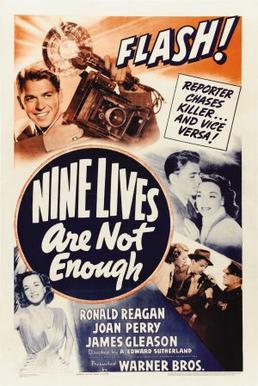
Matt Sawyer (Ronald Reagan) is a junior reporter whose enthusiasm for breaking the big news is always getting him in trouble. Sometimes, he runs with a story before getting all of his facts straight and the newspaper gets sued. If not for his enthusiasm and his affability, Matt would have been fired a long time ago. Instead of losing his job, Matt just finds himself demoted to riding in a squad car with Sgt. Daniels (James Gleason) and the slow-witted Officer Slattery (Edward Brophy). Matt still manages to find a story when he and the cops discover a dead man in a flophouse.
The man turns out to have been a millionaire. The coroner rules his death a suicide but Matt is convinced that it was murder. How could the man have shot himself if he died with his hands in his pockets? Over the objections of the police and his editors, Matt investigates the man’s death. Helping him out is the man’s daughter, Jane Abbott (Joan Perry).
NineLivesAreNotEnough is one the many B-pictures that Ronald Regan made for Warner Bros. It’s only 63 minutes long and, despite the murder mystery, the emphasis is more on comedy than drama. For all of his reputation for being a stiff actor, Reagan proves himself to be surprisingly adroit when it comes to exchanging snappy dialogue with his editor. This film showcases the innate likability that made Reagan a success as both an actor and a politician. What he lacks in range, he makes up for in sheer affability. Watching Reagan in movies like this, it is easy to see the limitations that kept him from being a major star while also revealing why he later had so much success asking people to vote for him.
Considering how the press felt and still feels about Ronald Reagan, it’s entertaining to see him cast as a reporter who has a reputation for getting the story wrong. When it’s really important, though, Matt Sawyer gets it right.
1941’s Underground tells the story of two brothers on opposite sides in Nazi Germany.
Kurt Franken (Jeffrey Lynn) is a patriotic German who believes that the country got a raw deal at the end of World War I and who is a strong supporter of the Nazis. He served in the army, fighting on the front. When he returns home to Berlin, he’s missing an arm. Whenever his friends and his family say that they’re sorry that he lost his arm, he replies that he was happy to make the sacrifice for his country. When someone starts to mourn for his son who was killed in the fighting, Kurt accuses the man of being a traitor for doubting the wisdom of the government. Kurt is a true believer, just the type to be recruited by the SS and tasked with helping to investigate who is behind a series of anti-Nazi radio broadcasts. Kurt believes that, if the government says it, it must be right. Laws must be obeyed and orders followed without question. Kurt, in other words, is a very familiar type.
What Kurt doesn’t realize is that the man behind the broadcasts is his own brother, Eric (Phillip Dorn). As Kurt investigates, he falls in love with Sylvia (Kaaren Verne) without realizing that she is also a part of the resistance. While Kurt tries to discover who is behind the underground radio station, Eric and his fellow resistance members attempt to stay one step ahead of the Gestapo.
For a film made in 1941, the film’s doesn’t flinch from showing the brutality of the Gestapo. Like all authoritarian dictatorships, The Third Reich is determined to quash any and all signs of dissent and they investigate the underground radio station with a ruthlessness that even takes Kurt by surprise. Witnessing first hand the brutality and sadism of the government for which he gave his arm, Kurt starts to doubt his previous beliefs. But will Kurt’s doubts come in time to save the lives of Eric and his fellow resistance members?
Made at a time when the United States was still officially neutral in the violent conflict that was sweeping the rest of the world and released just a few months before the U.S. officially declared war on the Axis Powers, Underground is a powerful look at life under a dictatorship. Shot in a noir style, the film’s black-and-white imagery perfectly captures the harshness of life in Germany while the shadows in the background perfectly capture the paranoia of knowing that saying the wrong word could lead to arrest, torture, and death. The film’s final minutes involve a guillotine sitting ominously in the background, a reminder that Nazi Germany was not the first authoritarian regime and that it would not be the last.
The film is well-acted, with Jeffrey Lynn epitomizing the otherwise intelligent people who allow themselves to get caught up in the madness of the majority. His discovery of the truth about Germany was obviously meant to mirror the awakening of the Americans who previously supported a policy of neutrality. By the end of the film, both Karl Franken and the audience understand that the time for neutrality has passed.
In this western, Anthony Quinn plays Dave Robles, a Mexican gunslinger who rides into the town of Mesa, searching for an outlaw named Dan Ritchey (Barry Atwater). When Dave finds Ritchey, he discovers that Ritchey has been invited to Mesa by one of the town’s richest men. Dave doesn’t let that stop him from gunning Ritchey down in the street.
No one in town is upset that Ritchey’s dead. Instead, they’re impressed with how quick Dave is on the draw. When Dave runs another group of outlaws out of town, the townspeople decide to hire him as their new sheriff. Reluctantly, Dave agrees. At first, saloon keeper Ed Bannister (Peter Whitney) thinks that Dave will be easy to control but Dave surprises him by taking his new position seriously. Soon, Dave is having to fight off all sorts of bad guys. Meanwhile, Estella (Katy Jurado), the town’s nurse, goes from distrusting Dave to falling in love with him and begging him to set down his guns and join her in a peaceful life.
Man From Del Rio is a surprisingly good and intelligent B-western. Anthony Quinn gives a brooding performance as Dave, who is a far cry from the type of upright lawmen who typically appeared in the westerns of the period. As played by Quinn, Dave Robles is a brute who becomes the film’s default hero just because everyone else is even worse than he is. Dave may be an outlaw and a killer but he’s neither dishonest nor a sadist, which is what sets him apart from the other bad men who ride through Mesa. Dave only kills when he feels that he has to and he doesn’t do it for pleasure. Because he’s inarticulate and uncomfortable with the trappings of civilization, men like Bannister assume that Robles will be easy to control but he proves them wrong. Quinn’s outstanding performance sets the stage for the type of morally ambiguous western heroes who would become prominent in the late 60s and the 70s. He gets good support from Katy Jurado and, in the role of the town’s previous sheriff, Douglas Spencer.
Along with an interesting plot, Man From Del Rio also has all of the gunfights and tough talk that a western fan could hope for. Capped off by Anthony’s Quinn’s star turn, it’s a superb B-western.
The 1967 film, In the Heat of the Night, tells the story of two very different men.
Chief Gillespie (Rod Steiger) is the police chief of the small town of Sparta, Mississippi. In many ways, Gillespie appears to the epitome of the bigoted Southern cop. He’s overweight. He loses his temper easily. He chews a lot of gum. He knows everyone in town and automatically distrusts anyone who he hasn’t seen before, especially if that person happens to be a black man or from the north.
Virgil Tibbs (Sidney Poitier) is a black man from the north. He’s a detective with the Philadelphia Police Department and he’s as cool and controlled as Gillespie is temperamental and uncouth. Tibbs has no patience for the casual racism that is epitomized by lawmen like Chief Gillespie. When Gillespie says that Virgil is a “fancy name” for a black and asks what people call Virgil in Philadelphia, Virgil declares, “They call me Mister Tibbs!,” with an authority that leaves no doubt that he expects Gillespie to do the same.
Together …. THEY SOLVE CRIMES!
For once, that old joke is correct. When a Chicago industrialist named Phillip Colbert is discover murdered in Sparta, Chief Gillespie heads up the investigation and, assuming that the murderer must be an outsider, orders Deputy Wood (Warren Oates) to check out the train station for any suspicious characters. When Wood arrives at the station, he discovers Virgil standing on the platform. Virgil is simply waiting for his train so that he can get back home to Philadelphia. However, Wood promptly arrests him. Gilespie accuses him of murdering Colbert, just to discover that Virgil’s a police detective from Philadelphia.
Though neither wants to work with the other, that’s exactly what Gillespie and Virgil are forced to do as they investigate Colbert’s murder. Colbert was planning on building a factory in Sparta and his wife (Lee Grant) makes it clear that, if Sparta wants the factory and the money that comes with it, Virgil must be kept on the case. Over the course of the investigation, Gillespie and Virgil come to a weary understanding as both of them are forced to confront their own preconceived notions about both the murder and life in Sparta. In the end, if it’s impossible for them to truly become friends, they do develop a weary respect for each other. That is perhaps the best that one could have hoped for in 1967.
I have to admit that it took me a few viewings before I really appreciated In the Heat of the Night. Though this film won the Oscar for Best Picture of 1967, it’s always suffered when compared to some of the films that it beat. One can certainly see that the film was superior to Doctor Dolittle and Guess Who’s Coming to Dinner. But was it a better film than The Graduate or Bonnie and Clyde? Did Rod Steiger really deserve to win Best Actor over Dustin Hoffman and Warren Beatty? (Amazingly, Poitier wasn’t even nominated.)
To be honest, I still feel that In The Heat of the Night was probably the 3rd best of the 5 films nominated that year, superior to the condescending Guess Who’s Coming To Dinner but nowhere near as groundbreaking as Bonnie and Clyde or The Graduate. The first time I watched In the Heat of the Night, I thought Steiger blustered a bit too much and the film’s central mystery didn’t really hold together and, to a large extent, I still feel like that.
But, at the same time, there’s a lot to appreciate about In the Heat of the Night. On subsequent viewings, I came to better appreciate the way that director Norman Jewison, editor Hal Ashby, and cinematographer Haskwell Wexler created and maintained an atmosphere that was so thick that you can literally feel the Mississippi humidity while watching the film. I came to appreciate the supporting cast, especially Warren Oates, Lee Grant, Scott Wilson, Anthony James, and Larry Gates. (Gates especially makes an impression in his one scene, playing an outwardly genteel racist who nearly cries when Tibbs reacts to his slap by slapping him back.) I also came to appreciate the fact that, while the white cop/black cop partnership has subsequently become a bit of a cliche, it was new and even controversial concept in 1967.
And finally, I came to better appreciate Sidney Poitier’s performance as Virgil. Poitier underplays Virgil, giving a performance of tightly controlled rage. While Steiger yells his way through the film, Poitier emphasizes that Virgil is always thinking. As in the same year’s Guess Who’s Coming To Dinner, Poitier plays a dignified character but, here, that dignity is Virgil’s way of defying the demands and expectations of men like Gillespie. When Virgil does strike back, it’s a cathartic moment because we understand how many times he’s had to hold back.
In the Heat of the Night may not have been the best film of 1967 but it’s still one worth watching.
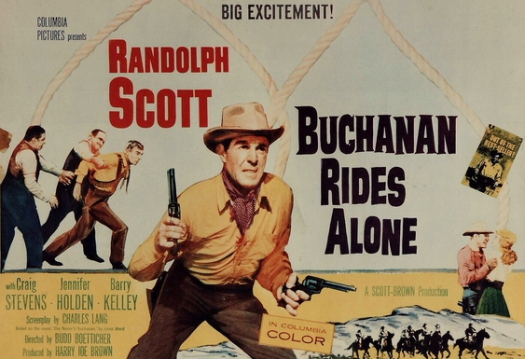
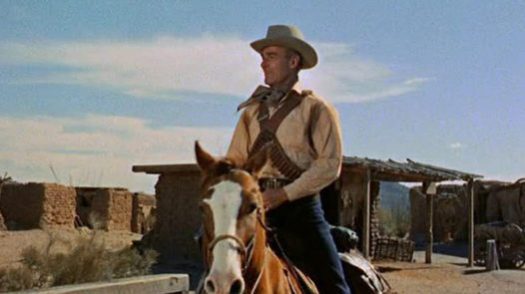
The usually stoic Randolph Scott gets to show a sense of humor in BUCHANAN RIDES ALONE, his fourth collaboration with director Budd Boetticher. The humor comes from Burt Kennedy’s script, who did an uncredited rewrite of Charles Lang’s original, foreshadowing his own, later comic Westerns. The result is a good (not great) little film that’s not up to other Scott/Boetticher teamings , but still a gun notch above average.
This one finds Scott as the title character, crossing the border from Mexico to the unfriendly Agry Town, where it seems everyone’s an Agry, and they don’t cotton to strangers. Buchanan just wants to make a pit stop on his way back to West Texas, get himself a nice steak, a bottle of whiskey, and a good night’s sleep. But he runs into trouble at the saloon with young Roy Agry, who is gunned down by Juan de la Vega. Apparently…
George Marshall has long been a favorite director of mine. Though he excelled in all genres (particularly Westerns), it’s his comedies that first caught my attention. Marshall guided W.C. Fields through his first for Universal, YOU CAN’T CHEAT AN HONEST MAN (with radio foils Edgar Bergen and Charlie McCarthy), did some of Bob Hope’s best films (THE GHOST BREAKERS, MONSIER BEAUCAIRE, FANCY PANTS), and directed MY FRIEND IRMA, the debut of Dean Martin & Jerry Lewis, later teaming with the pair for SCARED STIFF. He’s also responsible for the classic comic Western DESTRY RIDES AGAIN with James Stewart and Marlene Dietrich, and the remake with Audie Murphy. But his wackiest comedy is undoubtably the off-the-wall MURDER, HE SAYS.
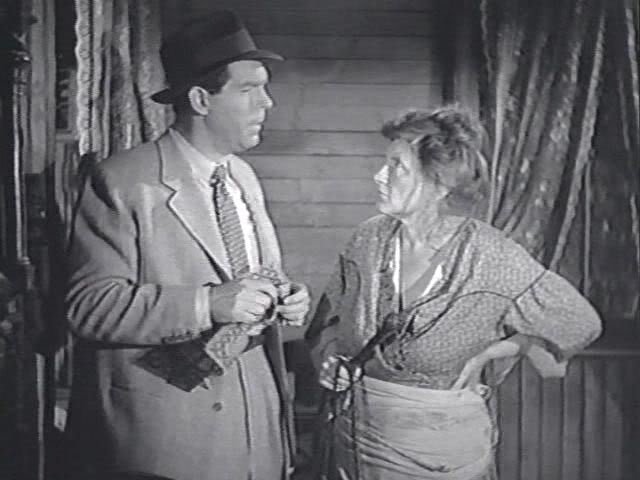
This black comedy gem stars the underrated Fred MacMurray as Pete Marshall, pollster for the Trotter company (“Like the Gallup Poll, but not as fast”), sent to tiny rural Potowanamie to find missing coworker Hector P…
 Matt Sawyer (Ronald Reagan) is a junior reporter whose enthusiasm for breaking the big news is always getting him in trouble. Sometimes, he runs with a story before getting all of his facts straight and the newspaper gets sued. If not for his enthusiasm and his affability, Matt would have been fired a long time ago. Instead of losing his job, Matt just finds himself demoted to riding in a squad car with Sgt. Daniels (James Gleason) and the slow-witted Officer Slattery (Edward Brophy). Matt still manages to find a story when he and the cops discover a dead man in a flophouse.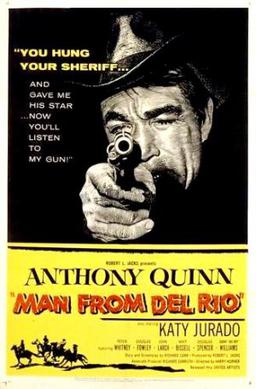



 Through the Shattered Lens