Review: By Dawn’s Early Light (dir. by Jack Sholder)


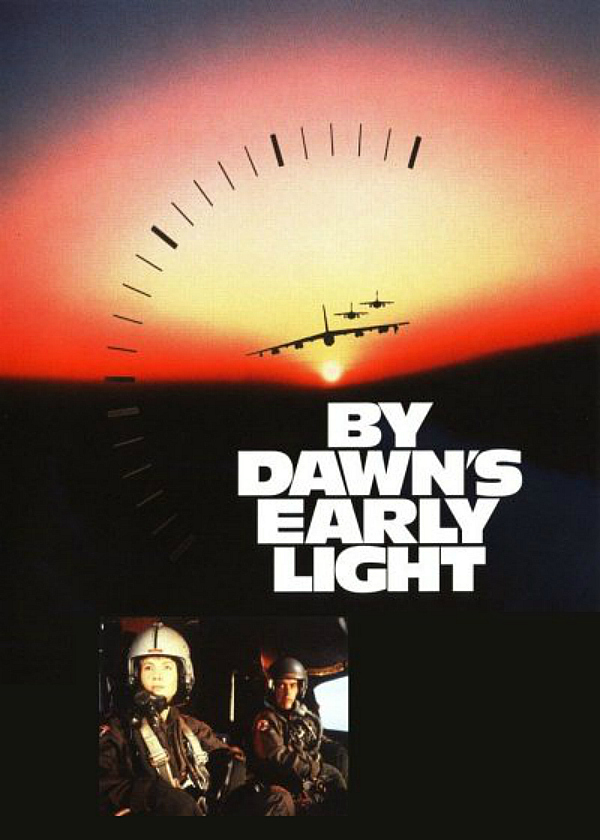
1990’s By Dawn’s Early Light is a film adaptation by HBO of William Prochnau’s novel Trinity’s Child. The film, when it first aired on HBO, seemed dated since the Soviet Union was ultimately going through its death throes as the military build-up initiated during the Reagan Administration crippled the USSR economically (they too tried to match the build-up in conventional and nuclear forces). Yet, despite the ending of the Cold War, recent events domestically and around the world has shown that the world never truly left behind the shadow of nuclear war.

The film is simplicity in the way the plot unfolds. A failed coup by dissident Soviet military commanders fails, but it’s after-effects of creating a “hot war” between the US and the USSR succeeds as both US President and Soviet Premiere make mistakes in their decisions. Decisions heavily influenced by their military commanders who see only black and white in how their respective nations should respond militarily. By Dawn’s Early Light shares some similarities to the classic 60’s Cold War films like Dr. Strangelove and Fail-Safe. Both films deal with the human frailties and flaws helping influence events that could lead to nuclear Armageddon for the whole planet. By Dawn’s Early Light concentrates on several storylines to highlight the stress and difficulties individuals must face to either follow their orders to their inevitable conclusion or allow their conscience to help make the moral decisions in trying to stop the madness spiraling out of control. Though some people’s decisions are left wanting, the film ends with a glimmer of hope that may just bring the world from the brink of annihilation.

The acting by the cast of Rebecca DeMornay, Powers Boothe, James Earl Jones, Darrin McGavin, Martin Landau and Rip Torn are well done. Rebecca DeMornay and Powers Boothe anchor one of the subplots as romantically involved B-52 crew pilots whose conflict comes from their own intimate closeness affecting command decisions and from the stress of families lost by the rest of the bomber crew. Darrin McGavin, Rip Torn and Martin Landau anchor the other subplot of competing Presidents. One a physically incapacitated US leader trying to avert escalating the conflict to the point of no return with another recently sworn in who fears of losing a nuclear war and thus wanting to strike back full and hard. In between these two leaders is the diabolical performance by Rip Torn as a warmongering Army colonel who sees only winning the war as the only objective. At times, the performances do become hampered by the simplicity of the script, but the cast power through to the end.

In the end, the film might look a bit dated in its production design (this was 1990 and many years before HBO became known for premiere television production) but the story itself is very current and relevant.  What might have been a nice Cold War relic fairy tale when it first aired in 1990 on HBO has taken on more of a cautionary tale as more nations begin to acquire nuclear weapons with some of these nations not just enemies of the US and the world in general, but also led by men whose hold on sanity seem tenuous at best. By Dawn’s Early Light is a great piece political “what if” that hopefully remains just that and not a prediction of reality to come.
Horror on TV: Tales From The Crypt 6.1 “Let The Punishment Fit The Crime” (dir by Russell Mulcahy)


For tonight’s excursion into televised horror, we present you the premiere episode of the 6th season of HBO’s Tales From The Crypt!

In Let The Punishment Fit The Crime, attorney Geraldine Ferrett (Catherine O’Hara) is pulled over while driving through a small town in upstate New York.  It turns out that Geraldine didn’t have enough numbers on her licence plate.  (That’s because she has a vanity plate that reads, “Sue me.”)  It doesn’t sound like a huge crime but, as everyone at the courthouse keeps trying to warn her, she is in “a very strict town.”  Let The Punishment Fit The Crime is a satirical look at our overregulated and overlitigious society.

This episode originally aired on October 31st, 1994 — hey, this is a Halloween episode!

Enjoy!


Quick Review: Dragonslayer (dir. by Matthew Robbins)


DragonslayerPosterBefore I came on board here at The Shattered Lens, I joined in on Live Tweeting, where you watch a movie with a group  of people, while tweeting about it at the same time. Imagine being one of those audience members in Mystery Science Theatre 3000, and you’ve a rough idea of how fun it can get. Our own Lisa Marie Bowman does this every Saturday with her group, the Snarkalecs, as they cover the SyFy Movie of that week.

On Saturday Nights around 11pm Eastern(or just about every Saturday), Kevin Carr (over at Fat Guys at the Movies) hosts his Late Night Live Tweet, which I’ve participated in from time to time over the last 3 years. Tonight, they’re talking on 1981’s Dragonslayer on Netflix Instant.

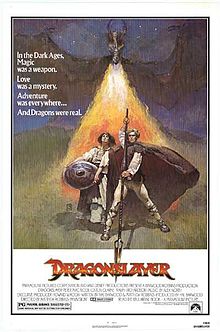
Dragonslayer is one of those films that flopped at the box office, but remains iconic for its representation of dragons and for having been Industrial Light and Magic’s first Visual Effects production outside of any of the Lucasfilm movies (Raiders of the Lost Ark and the first two Star Wars films). Even though ILM was popular for what it did for those films, they were considered somewhat exclusive (or rather it’s my belief that they were). Dragonslayer became ILM’s test of whether they were a go to effects studio for the rest of Hollywood. It didn’t quite work out for the film, but at least ILM did well. At one point, the amount of lens flares in this movie would make J.J. Abrams proud.

Walt Disney Pictures, wanting to get into something a little more adult, came up with Dragonslayer just before Tron, but because of then graphic nature of the film (at least by their standards) supposedly had Paramount Pictures handle the distribution of the film and keep their hands clean. The movie contains blood, immolation and a hint of nudity, which seemed unbecoming of the Disney label. Over the years, Disney would come up with Touchstone Pictures, Buena Vista Pictures, and Hollywood Pictures for their more adult fare. I think Disney even had Miramax at one point.

The story behind Dragonslayer is pretty straight forward. In a faraway land in the Dark Ages, a group a people seek out an old wizard named Ulrich (Sir Ralph Richardson – Watership Down and one of my favorites, Time Bandits) to have him slay the dragon known as Vermithrax Pejorative. Why would anyone want to kill a dragon? Well this particular dragon spends it’s time burning nearby villages and to keep it from doing so, the land has a lottery where the winner – a young maiden – is offered as a sacrifice. On looking at the evidence provided – some scales and a claw (to which Urlich exclaims “That’s not a claw, by the gods….that’s a tooth!”), the wizard refuses and asks the team to look for another Dragonslayer. They inform him that he is indeed the last of his kind. His apprentice, Galen Bradwarden (Ally McBeal’s Peter MacNicol) feels that maybe they could do the job, but before Ulrich can get on his way, he is challenged by the head of the King’s Guard, which leads to the wizard’s demise.

Galen, on cleaning up the wizard’s castle, stumbles upon a glowing amulet that enhances his magic ability. then takes it upon himself to get rid of the Dragon after discovering one of Ulrich’s glowing amulets and the ability to perform magic. As a kid, I thought that amulet was the coolest thing. There are of course some complications, mainly the fact that the Monarchy believes having the sacrifices and the Dragon are a good thing, but like all Disney movies, it all works out.

From an acting standpoint, Dragonslayer is okay. None of the performances are really award winning, and actor Peter MacNicol has gone on to say that he was embarrassed to have done the film, and doesn’t even mention it when referencing anything he’s done. Actor Ian MacDiarmid, who played Emperor Palpatine in the Star Wars films, plays a priest in Dragonslayer, which was nice to see.

ILM’s biggest contribution to Dragonslayer was the use of a then new effect called “Go-Motion”. The idea was that most effects at the time were stop motion, similar to what you’d see in a Harryhausen film like Clash of the Titans, As a result, it was often very easy to tell when stop motion was being used due to the jerky but accepted movements of characters. Go Motion used puppets on computers to track their movements, inducing a motion blur and give the appearance that puppets were moving more naturally. I guess it was a lot like rotoscoping for the Lightsaber effects. ILM tried this out with some success in The Empire Strikes Back, and a combination of either Stop Motion or Go Motion was used in many films right up until CGI came along. The look of the Dragon itself was very aggressive and its look can be seen in similar films like Reign of Fire. Most of the effects haven’t held up very well at all under HD, and you can clearly see some of the areas where effects start and end.

It should be noted that Stop Motion is still in use today and is very popular with animated fares like The Nightmare Before Christmas, Coraline, and the Academy Award Nominated Film, Frankenweenie.