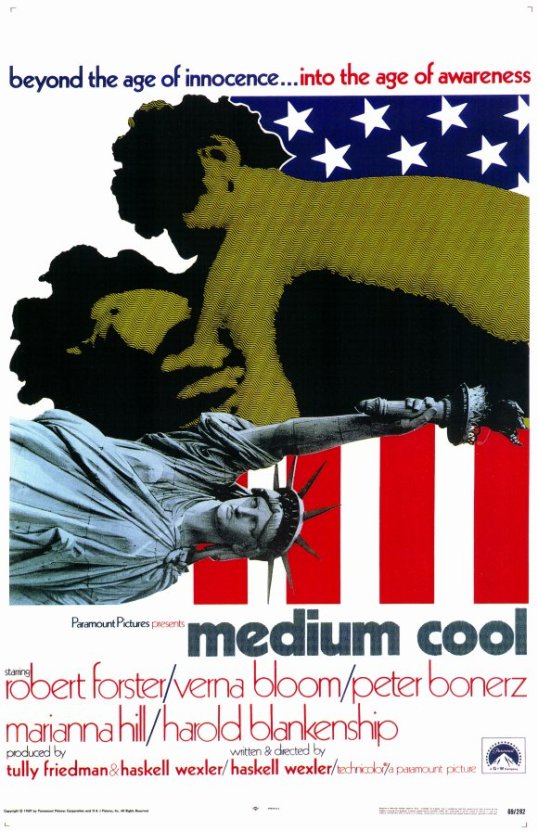
Shattered Politics #27: Medium Cool (dir by Haskell Wexler)


Film_Poster_for_Medium_CoolFor the past few days, I’ve been chronologically reviewing 94 films about politicians and, to a lesser extent, politics.  Four days ago, I started in on the 60s by taking a look at Sunrise at Campobello, one of the most traditional-minded and pro-American movies ever made.  And now, I’m closing out the decade by taking a look at 1969’s Medium Cool, a film that is — in style, ideology, and content — the exact opposite of Sunrise at Campobello.

I should admit that I’m cheating a bit by including Medium Cool in this series of reviews.  When I first started Shattered Politics, I said that I would be reviewing films about politicians.  While Medium Cool is a fiercely political film, there are few elected officials to be seen on screen.  That said, it was shot during the infamous 1968 Democratic National Convention and, as such, the politicians are present regardless of whether or not they’re seen.

Plotwise, the film follows a news cameraman, John (Robert Forster), and his sound guy (Peter Bonerz) as they go around Chicago, searching for stories.  Along the way, they interview the disturbingly cheerful owner of a gun club (played, in his film debut, by Peter Boyle), several people who volunteered on Robert Kennedy’s presidential campaign, and, in one of the film’s best and most awkward scenes, a group of Black Panthers.

Throughout the first half of the film, John remains detached from the stories that he covers.  He’s more concerned with getting the footage and getting a good soundbite than in really listening to what anyone is saying.  (In many ways, he’s like a less sociopathic version of the character played by Jake Gyllenhaal in Nightcrawler.)  It’s not until John discovers that his station is sharing his footage with the FBI that John finally starts to show some political awareness.  Unfortunately, he also shows some anger and ends up losing his job as a result.

Now unemployed, John meets Eileen (Verna Bloom), a single mother who has recently moved to Chicago from West Virginia.  Now that he’s free from the detachment of his job, John actually starts to develop feelings for both Eileen and her son, Harold (Harold Blankenship).  When Harold runs away, Eileen and John search Chicago for him.  Unfortunately, their search happens at the same time as the 1968 Democratic Convention.  While John and Eileen search, the Chicago police are busy beating protestors in the street.

(The video below is long, but worth watching, as is the entire film.)

Now, I know that, in the past, I’ve been critical of many of the counter culture films of the late 60s and early 70s, describing their politics as being shallow, trendy, and faux Leftist.  (And if you doubt me, read my reviews of Getting Straight, Zabriskie Point, and R.P.M.)  However, Medium Cool is an exception to those films, in that it actually works.  Medium Cool was directed by famed cinematographer, Haskell Wexler.  Wexler began his career shooting documentaries and, in many ways, that’s exactly what Medium Cool is.  Though Robert Forster may be an actor, many of the people that he interviewed in the film were not.  When he talks to the former Kennedy campaign workers, he’s talking to actual volunteers and getting their true feelings, as opposed to something written for them by an out-of-touch screenwriter.  When we see John and Eileen trying to survive the violence outside the Democratic Convention, we’re also seeing Robert Forster and Verna Bloom attempting to do the same thing.  The protestors being attacked were real.  The cops doing the attacking were real.  The violence was real.

And, considering that Medium Cool was released 46 years ago, the issues raised by the film are still real.  When the Black Panthers suspiciously view John and his sound guy, we’re reminded of the protestors in Ferguson demanding that the national media get out of their way.  When we see the protests outside the 1968 Democratic Convention, how can we not compare them to the protests that we still see every day?  When the cops line up in military precision and we hear that orders must be followed, are we watching Medium Cool or are we watching CNN?

During one of Medium Cool‘s better known moments, an off-screen voice is heard to shout, “Look out, Haskell!  It’s real!,” warning director Haskell Wexler that the violence he’s filming is actually happening.  And that’s a warning that’s still appropriate and relevant today.  We may be watching from the safety of our homes but it’s still real.

(Of course, it should be mentioned that, according to Wexler himself, “Look out, Haskell!  It’s real!” was actually added to the scene in post production.)

It’s perhaps indicative of how much American culture changed in the 60s that a decade that started with Ralph Bellamy playing Franklin D. Roosevelt would end with Medium Cool.  Fortunately, Medium Cool gives us plenty of evidence about how that change happened.


Scenes That I Love: The Candidate


(SPOILER WARNING)

It’s election day!  Today is the day that American citizens select the person that they’ll be angry with for the next four years.  Have you voted yet?  I did and, after I turned in my ballot, this guy at the polling place told me that I was the prettiest voter that he had seen all day.  Awwwwww!

Today’s scene that I love is particularly appropriate for Election Day.  In The Candidate (1972), Bill McKay (played by Robert Redford) runs for the U.S. Senate.  Directed in a documentary fashion by Michael Ritchie, The Candidate features excellent supporting performances from Melvyn Douglas and Peter Boyle and it’s one of the best films ever made about the American political system.

The scene below takes place at the end of the film, after the votes have been counted.  And, of course, the entire scene is a spoiler so don’t watch it if you haven’t seen The Candidate.

Film Review: Joe (dir. by John G. Avildsen)


(Warning: This review contains some spoilers.)

On Monday night, my movie before bedtime was an old one from 1970, John G. Avildsen’s Joe.  Though Joe is an occasionally uneven and rather heavy-handed film, it’s also a brutally effective one that I haven’t been able to get out of my mind since watching it.

Joe opens with Melissa Compton (played by Susan Sarandon, in her film debut) and her boyfriend, Frank Russo (Patrick McDermott).  It is quickly established that Melissa is a “rich girl” who has dropped out of society while Frank is a drug dealer.  Frank, incidentally, is probably one of the least likable characters in the history of cinema.  When we first meet Frank, he’s taking a bath but it makes no difference as the character just seems to covered in a permanent layer of grime.  Both Frank and Melissa are also drug addicts.

Patrick McDermott (left) and Susan Sarandon

When Melissa has a drug overdose and ends up in the hospital, Frank doesn’t really care but her father, advertising executive Bill Compton (Dennis Patrick) does.  He promptly goes over to Frank’s apartment and after Frank taunts him by saying that Melissa “had a real hang-up about you,” Bill beats Frank to death in a fit of rage.  Shaken by his actions, Bill goes to a neighborhood bar where he runs into a factory worker named Joe Curran (Peter Boyle).   A drunken Joe rants about how much he would like to kill a hippie.  Bill replies, “I just did.”

This leads to an odd relationship between the two men.  While Bill originally fears that Joe wants to blackmail him, Joe appears to just want to be his friend.  Soon, Joe is introducing Bill to his bowling league and Bill introduces Joe to his colleagues at the advertising firm.  Bill and his wife even have a memorably awkward dinner with Joe and his wife.  Bill’s wife worries that Joe might be dangerous but Bill smugly assures her that he is Joe’s hero.

Meanwhile, Melissa is released from the hospital and moves back in with her parents.  One night, she hears them talking about how Bill killed Frank.  Melissa flees from the apartment and when Bill chases after her, she shouts at him, “Are you going to kill me too!?” before disappearing into the New York night.

Searching for Melissa, Bill and Joe go to various hippie hangouts in Manhattan.  Every hippie they meet tends to be dismissive of the suit-wearing Bill and the uneducated Joe.  However, once Bill reveals that his car is full of drugs that he stole from Frank, the hippies are suddenly a lot more friendly.  A group of hippies take Joe and Bill back to their apartment.  At Bill’s insistence, both of the men smoke weed for the first time and then have sex with two of the hippie girls.  While they’re busy doing it, the rest of the hippies steal their money and all of the drugs.

Suddenly, Joe takes charge of the situation, leaving Bill to watch helplessly as Joe repeatedly slaps one of the girls until she tells them where her friends have gone.  (I’ve seen a lot of movies and I like to think that there’s little I can’t handle watching but the scene where Joe interrogates the girl was genuinely disturbing and I actually had a hard time watching it.  This was largely due to the intensity of Boyle’s performance.)  Joe drags Bill to the commune where the hippies live.  Standing outside the house, as snow falls around them, Joe gets two hunting rifles out of his car and tosses one to Bill before the film reaches its inetivable conclusion. 

Joe With Friend

Like many films released in the early 70s, Joe is distinguished by a continually shifting tone. The film’s opening (which feature Susan Sarandon getting naked and then watching her disturbingly unhygienic boyfriend shooting up) feels almost like it’s composed of outtakes from some lost Andy Warhol Factory film while the scenes immediately following Melissa’s drug overdose feel like a melodramatic Lifetime special.  After Bill kills Frank, the film briefly becomes a Hitchcockian thriller just to then segue into heavy-handed social satire as we watch the development of Joe and Bill’s unlikely, hate-fueled friendship.  The awkward comedy continues for a while until, somewhat jarringly, Joe suddenly becomes a violent revenge film.  While many films have been doomed by the lack of a consistent tone, it actually works here.  Joe‘s odd mishmash of comedy, tragedy, and exploitation actually perfectly reflects the uncertain worldview and hidden fears of Bill Compton.  Much as the audience is often times left uncertain whether they’re watching a comedy or a tragedy, Bill is a man who is no longer sure how to react to the world around him.

And make no doubt about it, Joe may be the title character but the film is truly about Bill Compton.  It’s Bill’s repressed anger (and desire for his own daughter) that fuels the plot.  As played by Dennis Patrick, Bill Compton is the type of smugly complacent figure whose outward confidence hides the fact that he’s been rendered impotent by the world changing around him.  For the majority of the film, Bill looks down on both sides of the cultural divide, looking down on both his daughter’s hippie friends and his new blue-collar acquaintance Joe.  (He assures his wife that Joe would never attempt to blackmail him because Joe “looks up” to him.)  It’s only at the film’s conclusion that Bill realizes just how powerless he is to control anything.  In those final scenes, Dennis Patrick’s face reveals what the audience has already figured out.  By trying to place himself above it all, he’s left himself with nowhere to go. 

Dennis Patrick (left) and Peter Boyle

That said, the film truly is dominated by Peter Boyle’s demonic performance as Joe.  For much of the movie, Joe is a buffoonish figure (he even gets his own mocking theme song “Hey Joe” which plays as he wanders around his house and scratches his navel) and it’s sometimes hard not to feel like you’re watching a long-lost episode of Everybody Loves Raymond where Frank Barone remembers the time that he killed a lot of hippies.  However, once Bill and Joe find themselves searching for Melissa among the hippies, Boyle slowly starts to pull back the layers and a new, far more threatening Joe emerges.  By the end of the film, Joe has become a nightmarish figure and we’re forced to reconsider everything that we’ve previously assumed.  By the film’s end, Joe almost seems to be a direct personification of Bill’s Id, a man who exists solely to force Bill to do what he’s always secretly wanted to do.*

When Joe was first released back in 1970, it apparently made a lot of money, generated a lot of controversy, and even managed to score an Oscar nomination for best original screenplay.  Oscar nomination aside, Joe is the epitome of a well-made and effective exploitation film.  While Joe and Bill are basically counter-culture nightmares of a murderous American establishment, the film’s hippies are portrayed as being so smug and so scummy that I’m not surprised to read that apparently audiences cheered once Joe and Bill started gunning them down.  (Peter Boyle, however, was apparently so shocked that he swore he would never make another film that “glamorized violence.”)  By embracing the best traditions of the grindhouse and attempting to appeal to both sides of the cultural divide in the crudest way possible, the filmmakers ended up making a film that, over 40 years later, somehow feels more honest than most of the other “generation gap” films of the 60s and 70s. 

As any film lover knows, any film made between 1966 and 1978 tends to age terribly, to the extent that often times they’re impossible to take seriously when watched today.  (And anyone who doubts me on this should track down films like R.P.M, Thank God It’s Friday, Skatetown  U.S.A.,  Getting Straight, and Zabriskie Point.)  However, watched today in our present age of Occupiers and Tea Partiers, Joe still feels relevent and, at times, downright prophetic.

—-

* In many ways, Joe Curran is a cruder, balder version of Tyler Durden.