Embracing the Melodrama Part II #9: A Star is Born (dir by William Wellman)


A_Star_Is_Born_1937_poster

“Hello everybody.  This is Mrs. Norman Maine.”

— Mrs. Norman Maine (Janet Gaynor) in A Star Is Born (1937)

When I first saw the red neon of the opening credits of the 1937 best picture nominee, A Star Is Born, I thought to myself, “This is a real movie movie.”  And I was so impressed by that thought that I even jotted it down in my review notes and now, looking down at my notes, I’m struggling to figure out how to explain just what exactly it was that I meant.

I think that what I was trying to say, in my own way, was that, when we think of a typical big budget Hollywood romance, A Star Is Born is the type of film of which we tend to think.  It’s a big, glossy film that is shot in vibrant technicolor and which features a self-sacrificing woman (Esther Blodgett, played by Janet Gaynor) falling in love with a self-destructive but ultimately noble man (Norman Maine, played by Fredric March).  It’s a film that has romance, humor, and tragedy.  It’s a film that’s designed to make you laugh, cry, and ultimately fall in love.  It’s pure melodrama, the type of film that would probably be made for Lifetime today.  (And, in fact, it has been remade for Lifetime a number of times, just never under the title A Star Is Born.)

It’s a familiar story that, if I may indulge in a cliché, as old as the movies.  Esther is a girl who lives on a farm in North Dakota and she wants to be a star, despite being told by her aunt that she need to start concentrating on finding a man and having children.  Esther’s grandmother (Fay Robson) tells Eleanor to pursue her dreams and loans her some money to take with her to Hollywood.

With stars in her eyes, Esther goes out to California and deals with rejection after rejection.  (She does, however, manage to rent out an apartment.  The weekly rent is $6.00.)  Esther does befriend an assistant director (Andy Devine) who gets Esther a job as a waitress at a party.  As Esther serves the food, she imitates everyone from Katharine Hepburn to Mae West, all in an attempt to get noticed.

And, amazingly enough, it works!  She meets film star, Norman Maine.  With Norman’s help, she gets her first screen test and, after her name is changed to Vicki Lester, Esther is put under contract to a studio.  She and Norman also fall in love and soon end up married.  However, while Vicki Lester is rising to stardom, Norman is descending into irrelevance.  He’s an alcoholic who has managed to alienate almost everyone in Hollywood.  When Vicki wins her first award, Norman shows up at the ceremony drunk and destroys what little is left of his career.

Will Vicki be able to save Norman from his demons?  And will she be able to do so without destroying her own career?

Well, you probably already know the answer.  A Star Is Born is one of those stories that everyone seems to know, regardless of whether they’ve actually seen the film or not.  (And even if they haven’t seen the 1937 version, chances are that they’ve seen one of the many remakes or ripoffs.)  The original Star Is Born is an undeniably familiar and old-fashioned movie but it holds up as a celebration of both old Hollywood glamour and a heartfelt romance.

And it’s in the public domain!

Watch the original A Star is Born below!
http://www.youtube.com/watch?v=d1tnE0dqln8


Shattered Politics #8: Magnificent Doll (dir by Frank Borzage)


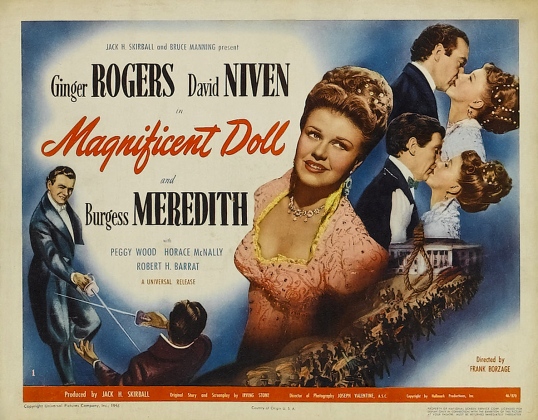
Poster - Magnificent Doll_02

I’ve always been tempted to write one of those quizzes that you always see on Facebook, “Which American first lady should you be?”  That’s a question that I’ve often asked myself.  I know that I would not want to be any of our most recent first ladies.  (Sorry, Michelle.  Sorry, Laura.  Sorry, Hillary.)  Occasionally, I think that I would have liked to have been Jacqueline Kennedy, if not for what happened in Dallas.  Teddy Roosevelt’s daughter, Alice, is definitely a historical role model for me but it’s debatable whether she could truly be considered a first lady.  And, of course, there’s always Grover Cleveland’s wife Julia but ultimately, for me, there’s really only one choice.

If I could be any American first lady, I would be Dolley Madison.

Dolley, of course, was the wife of James Madison, who was not only our fourth President but also one of the smartest.  Madison was a skilled writer and scholar but he had absolutely no social skills.  Dolley, on the other hand, was vivacious and was, by the standards of the dentistry-free days of the 19th Century, one of the most beautiful women in America. Whereas James was uncomfortable meeting with people and struggled to express himself, Dolley was the world’s greatest hostess, bringing opposing forces together through the sheer force of her own charm and ability to throw a great party.  When the British invaded Washington D.C. during the War of 1812, Dolley was the one who saved the famous portrait of George Washington from being burned with the rest of the White House.

So, yes, I would definitely be Dolley Madison.

(Yes, I know that there’s some debate over whether her name should be spelled Dolly, Dolley, or Dollie.  I spell it Dolley and since I would have been her, I think my opinion counts for something.)

It’s a shame that there haven’t been many movies made about Dolley Madison.  Perhaps the best known is 1946’s Magnificent Doll, which is not a very good movie but which is amusing if you know something about history.

Magnificent Doll opens with young Dolley Payne (Ginger Rogers) being forced to marry John Todd (Horace McNally), a much older lawyer.  (John saved the life of Dolley’s father and, in gratitude, Dolley’s father gave him his daughter.)  Though John falls in love with her, Dolley refuses to show him any sign of affection and good for her!  (Seriously, arranged marriages suck.)  But then John dies of yellow fever and Dolley declares that she did love him all along.

But life goes on!

Soon, Dolley and her mother are running a boarding house in Philadelphia.  Fortunately, they happen to be running it at the same time that the Continental Congress is attempting to write the Constitution.  Several of the delegates are staying at the boarding house and two of them take a romantic interest in Dolley.

First there’s Aaron Burr (David Niven), a charming scoundrel who appeals to Dolley’s wild side.  Aaron does things like take her to a bar and kiss her underneath a staircase.  Aaron is vain.  Aaron is self-absorbed.  Aaron is an ambitious and charismatic brooder whose moods can be unpredictable.  Aaron is exiting!  Aaron is dangerous!  Aaron is a rebel!

And then you’ve got Aaron’s friend, James Madison (Burgess Meredith).  James is shy and gentle.  He’d rather read a book than go out.  He’s the type of smart kid who all the other kids make fun of but he’s also a good, decent man who has a great future ahead of him.  He just needs someone to bring him out of his shell.

In short, Aaron is the type of boy that you hope invites you to prom.  James is the type of boy that you marry.

And, when Dolley does marry James, it sends Aaron Burr into such a tail spin that he nearly prevents Thomas Jefferson from becoming President in 1800…

And, needless to say, this film is in no way historically accurate.  It is true that Aaron Burr was nearly elected President in 1800 and, had he been, Thomas Jefferson would never have been President.  However, most historians seem to agree that has more to do with Aaron Burr being ambitious and nothing to do with Dolley Madison.  In the end, Magnificent Doll may be amusing in its inaccuracies but bad history is still bad history.

That said, there’s still a part of me that enjoyed Magnificent Doll, despite the fact that it moves way too slowly and none of the actors (with the exception of David Niven) appear to be all that invested in their roles.  I think, ultimately, the reason I enjoyed Magnificent Doll was because it really is basically just a YA version of American history and, as a result, it does have some curiosity value.  One gets the feeling that if Magnificent Doll were released today, it would be split into two different films and that it would be promoted on social media with hashtags reading #TeamAaron and #TeamJames.

That said, if there’s any first lady who deserves a biopic (one that’s good as opposed to so-bad-its-interesting) it’s Dolley Madison.  (Personally, I would cast Amy Adams in the role.)  #TeamDolley all the way!