During the waning days of the Civil War, Lt. Frank Hewitt (Audie Murphy) is a man without a country. A Texan, he joined the Union Army even as his home state was voting to secede from the United States. In the Army, Hewitt is viewed with distrust by his autocratic superior, Col. John Chivington (Ainslie Pryor). When Hewitt learns that Chivington has ordered a surprise attack on an unarmed local Indian tribe in order to drive them into Texas where they will attack the nearest settlement for revenge, Hewitt deserts the Army to warn the people left in his hometown.
When Hewitt arrives, he discovers that all of the men in town have left to join the Confederate Army. Only their wives, mothers, and sisters remain. Though Hewitt is, at first, accused of being a traitor, he sticks around and trains the women on how to fight not only the incoming Comanches but also any outlaws who ride into town looking to take advantage of the situation.
The Guns of Fort Petticoat is an interesting B-western that holds up well today. Even though the film ends with a Comanche attack, it’s made clear that the attack would not have happened if not for the actions Col. Chivington. Chivington, who doesn’t care that the victims of his actions would not be Confederate soldiers but instead just helpless woman and children, is the film’s true villain, even if he only appears in the first and final scenes. Audie Murphy, who was America’s most decorated World War II veteran, not only starred in but produced the movie. Murphy was a stiff actor but he looked believable in uniform and obviously knew how to convincingly shoot a rifle and that’s all this role really demands of him. Kathryn Grant plays the woman who goes from distrusting Hewitt to falling in love with him and she and Murphy work well together. The final battle between the women and the Comanches is exciting and well-shot by veteran western director George Marshall. The movie’s final scene may not be totally believable but it’s still very satisfying.
Fans of the western genre and Audie Murphy will find much to enjoy about The Guns of Fort Petticoat.
Motorcycles have always been unbelievably sexy and, in 1953, so was Marlon Brando.
1953 was the year that Brando played Johnny Strabler in The Wild One. Johnny’s the leader of the Black Rebels Motorcycle Club. He wears a leather jacket and always has a cap tilted rakishly on his head. When Johnny moves, he makes it a point to take his time. He doesn’t run from anyone and, perhaps most importantly, he doesn’t run to anyone. Johnny’s a rebel and he doesn’t care who knows it. “What are you rebelling against?” Johnny is asked. “Whaddya got?” Johnny replies and, when he says it, you not only believe him but you want to join him in his rebellion.
And yet, from the minute that we see Johnny, it’s obvious that there’s more to him than just his jacket and his attitude. He speaks softly and when he smiles, there’s something almost shy about the expression. You look into his brooding, soulful eyes and you know that Johnny isn’t just about making trouble. He’s searching for something that society alone can’t deliver. Johnny’s a bad boy, the type who you fool yourself into thinking that you — and only you — can reach and help heal.
At least, that’s the way that Kathie (Mary Murphy) feels about him, even though she’s way too smart to accept his invitation to go to a dance with him. Kathie works at a diner in a small California town. When Johnny and his gang ride into the town, all of the boring, responsible citizens want to force him to leave. Kathie, alone, sees that Johnny’s not as bad as everyone assumes he is. And if there’s any doubt about the fact that Johnny’s got a good soul despite his brooding nature, Chino (Lee Marvin) shows up to remind everyone of what a truly bad biker is like.
Chino and Johnny may both love their motorcycles but otherwise, they’re opposites. If Johnny has the soul of a poet, Chino has no soul at all. Johnny’s searching for freedom while Chino is merely searching for power. Chino and Johnny were once friends, all part of the same gang. However, Johnny eventually went off on his own and took the younger gang members with him. Chino, in many ways, represents America’s destructive and wild path. He’s an old west outlaw who rides a motorcycle instead of a horse. Johnny, meanwhile, is a wanderer who represents the part of America that created Kerouac and Dylan.
(Interestingly enough, both Brando and Marvin were 29 years old when they made The Wild One. However, Brando looked much younger and Marvin looked considerably older, which only added to the film’s theme of generational conflict. Brando, himself, has never rode a motorcycle before making The Wild One and reportedly avoided the actual bikers who were hired to act as extras. Lee Marvin, on the other hand, was an experienced rider and fit right in with the film’s cast. To be honest, Lee Marvin is actually more convincing than Brando but Brando had the eyes and the wounded way of speaking whereas Marvin was every single guy who needlessly revs his motorcycle’s engine in the middle of the night.)
Anyway, needless to say, the townspeople are even less happy once Chino’s gang shows up. Unfortunately, few of them understand the difference between Johnny and Chino. In fact, the majority of the upright citizens prove themselves to be just as and, in some cases, more violent than the bikers that they’re trying to run out of town. It all leads to violence, tragedy, and, ultimately, understanding. This was a 50s film after all. Director Laszlo Benedek may have played up the more sordid aspects of the story but the film was produced by the reliably and safely liberal Stanley Kramer and the film concludes on a very Krameresque note.
If you only know Marlon Brando from the latter half of his career, when he was best known for his weight, his eccentricities, and his personal tragedies, than watching The Wild One is quite a revelation. It’s a well-directed film with a host of effective supporting turns but it’s Brando who makes the film unforgettable. Watching the film, you understand why Brando became a star and you also see just how much he inspired so many of the actors who came after him. James Dean’s performance in Rebel Without A Cause owes a huge debt to Brando’s work here. In fact, every rebel owes a debt to The Wild One. In the role of Johnny, Brando invites and inspires us all to ride down the road and see what we find.
The Wild One was a huge hit in 1953, leaving teenagers excited and parents concerned. That same year, Brando also played Mark Anthony in Julius Caesar and received an Oscar nomination for the performance. The Wild One was ignored at the Oscars but lives on whenever anyone hit the road and goes searching for America.
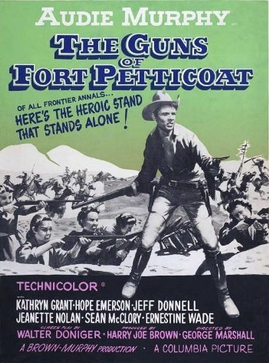 During the waning days of the Civil War, Lt. Frank Hewitt (Audie Murphy) is a man without a country. A Texan, he joined the Union Army even as his home state was voting to secede from the United States. In the Army, Hewitt is viewed with distrust by his autocratic superior, Col. John Chivington (Ainslie Pryor). When Hewitt learns that Chivington has ordered a surprise attack on an unarmed local Indian tribe in order to drive them into Texas where they will attack the nearest settlement for revenge, Hewitt deserts the Army to warn the people left in his hometown.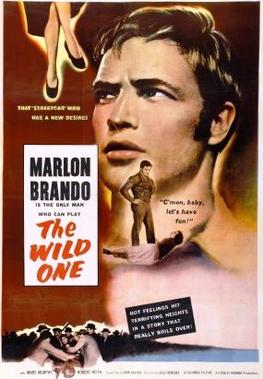
 Through the Shattered Lens