Lisa Reviews A Cannes Winner: Maria Candelaria (dir by Emilio Fernandez)


The very first Cannes Film Festival was held in 1946.  (The festival was originally schedule to debut in 1939 but the start of World War II put those plans on hold.)  45 films from 18 nations were entered into competition and, when it came time to announce that winner of the Grand Prix (which later became known as the Palme d’Or), the result was a tie.  With the number of films competing, that’s not surprising.  In fact, there have been many ties over the history of Cannes.  What is surprising is that the tie was between a total of 11 films: Brief Encounter, Hets, The Last Chance, The Lost Weekend, Men Without Wings, Neecha Nagar, Red Meadows, Rome Open City, La symphonie pastorale, Velikiy perelom, and Maria Candelaria.

Last night, Jeff and I watched Maria Candelaria on YouTube.

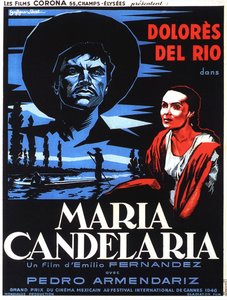
Directed by Emilo Fernandez (who many consider to be the father of the Mexican film industry), the majority of Maria Candelaria takes place in Mexico in 1909, shortly before the start of the Mexican Revolution.  Delores del Rio plays Maria, an indigenous woman who is shunned by the people of her village because her mother was a prostitute.  The corrupt and greedy store owner, Don Damian (Miguel Iclan), is entranced by Maria’s beauty and wants her for himself.  However, Maria loves a poor but honest farmer named Lorenzo (Pedro Armendariz).  Though Maria and Lorenzo want to get married, they find their efforts thwarted at every turn by the jealous Don Damian, with Damien going so far as to shoot the pig that Lorenzo was hoping to be able to sell to have the money to not only marry Maria but also to pay off a long-standing debt that he owed Damian.  When Maria grows ill, Damian spitefully refuses to sell Lorenzo the medicine that she needs.  When Lorenzo breaks into the store and attempts to steal it, he’s sent to prison.  Now desperately needing money to get Lorenzo out of prison, Maria poses for a well-meaning painter (Alberto Galan).  When the villagers find out that Maria is posing, a chain of events are unleashed that lead to tragedy.

After reading all of that, you may be wondering how many bad things can happen to one well-meaning and loving couple.  Nothing seems to go right for Maria and Lorenzo over the course of this film but, at the same time, their love never falters.  They remain innocent, regardless of how much they are wronged by the greedy Damian and judged by the hypocritical villagers.  Though the film focuses more on melodrama and romance than politics, the pro-revolutionary message is easy to see.  The Mexican Revolution, the film argues, had to be fought for the honor of people like Maria and Lorenzo.

It’s all a bit heavy-handed but it’s effectively directed and acted and it’s hard not to get caught up in a film that is so unapologetic about embracing the melodrama.  Delores del Rio was a Hollywood starlet who, tiring of the stereotypical roles that she was being offered, returned to Mexico and made several films with Emilo Fernandez.  She and Pedro Armendariz have a very real chemistry as Maria and Lorenzo and they both bring a certain world-weariness to their parts that prevents Maria and Lorenzo from becoming idealized stereotypes.  Maria and Lorenzo may be optimistic and often naïve but they’re not fools.  They know that life will never be easy.  Visually, the film is full of striking images of the Mexican countryside, which Fernandez portrays as being slowly corrupted by the growth of civilization.

Maria Candelaria was a hit not only at Cannes but also in Mexico.  It’s still regularly cited as one of the best movies to come out of Mexico’s film industry.  Though she eventually tired of working with the moody Fernandez, del Rio would continue to appear in movies in both Mexico and Hollywood.  Fernandez went on to spend several decades as Mexico’s most popular director, before eventually falling out of favor for Luis Bunuel.  Today, most cineastes remember him for playing the evil General Mapache in Sam Peckinpah’s The Wild Bunch.
The Fabulous Forties #49: Tulsa (dir by Stuart Heisler)


Tulsa_DVD_Cover

The 49th film in Mill Creek’s Fabulous Forties box set was the 1949 “epic” Tulsa!

I put epic in quotation marks because Tulsa is only 90 minutes long and I personally don’t think you can really have an epic unless you also have epic length.  Giant is an epic, whereas Tulsa is an “epic.”  That said, Tulsa does have a goal worthy of an epic.  Tulsa is about oil and the men and women who sacrifice so much to get that oil out of the ground.  Some of them lose their lives, some of them lose their happiness, and some of them make a lot of money.  I know that makes this film sound a lot like There Will Be Blood but it’s really not.  There Will Be Blood is an epic.  Tulsa is an “epic.”

I have to admit that I was intrigued by this film, just because my family lived in Tulsa for a handful of months, way back when I was 9 years old.  That said, I did groan a little bit when the film opened with a folksy guy named Pinky Jimpson (Chill Wills) standing in front of a white fence and staring straight at the camera.  “Howdy, cousins,” Pinky says, before launching into a monologue about how Oklahoma is the greatest place on Earth.  As a Texan, I was legally required to roll my eyes at Pinky’s claims but, to be honest, Oklahoma’s a pretty nice place.  It’s certainly better than Vermont.

(Take that, Vermont!)

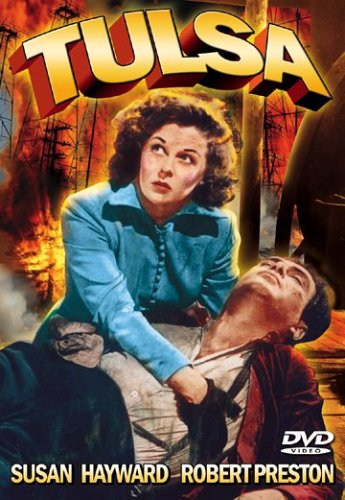
Anyway, once the story gets started, we discover that it’s about Cherokee Lansing (Susan Hayward).  After Cherokee’s rancher father is killed when an oil derrick falls over on him, she decides to get her revenge by entering the oil business herself.  At first, everyone is doubtful that a woman — especially a woman whose only apparent friend is a Native American named Jim Redbird (Pedro Armendariz) — can succeed in a man’s world.  But she proves them wrong by befriending eccentric oilman John Brady (Ed Begley).  After Johnny is killed in a bar fight (because Tulsa is a dangerous place), he leaves all of his land and drilling rights to Cherokee.  He also leaves behind a far more sober-minded son, Brad (Robert Preston), who goes into business with Cherokee.

Soon, Cherokee and Jim Redbird are rich and powerful.  But, as often happens, they are in danger of losing sight of why they wanted to become rich and powerful in the first place.  Jim, in particular, turns out to be a big ol’ sellout.  Brad is disgusted with all of them but then, fortunately, there’s a big oil fire which leads to a lot of stuff blowing up and everyone learning an important lesson…

Or, at the very least, Pinky assures us that they all learned a lesson.  He also talks about how everything in the world now runs on oil.  He mentions that you can get oil from other parts of the world but the best oil comes from Tulsa.

(And again, as a Texan, I am contractually obligated to roll my eyes while noting that people from Oklahoma are some of the nicest folks that you’ll ever meet…)

Anyway, as a film, Tulsa never quite works.  90 minutes isn’t enough time to tell the story that it’s trying to tell and some of the acting is rather inconsistent.  However, the fire at the end is still impressive (Tulsa’s special effects received an Oscar nomination.) and I enjoyed watching Susan Hayward go totally over-the-top in role of Cherokee.  Compared to her subtle and kind of depressing performance in Smash-Up, Hayward actually appears to be having fun in Tulsa and good for her!

Tulsa was the 2nd to last film in the Fabulous Forties box set.  In my next review, I will conclude this series by taking a look at Lady of Burlesque!

James Bond Film Review: From Russia With Love (dir. by Terrence Young)


Hi there!  The name’s Bowman, Lisa Marie Bowman.  And tonight, I’m continuing the Shattered Lens’ look at the James Bond film franchise by reviewing 1963’s From Russia With Love.

The 2nd film in the Bond film series, From Russia With Love is considered by many to be one of the best entries in the franchise.  I happen to agree with them.  There’s a lot of talk right now that Skyfall could be the first James Bond film to receive an Oscar nomination for best picture.  Personally, I think From Russia With Love (and not Tom Jones) should have been named the best picture of 1963,  (Seriously, has anyone actually tried to watch Tom Jones recently?)

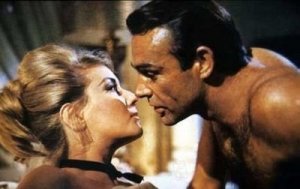
From Russia With Love opens with a tuxedo-clad James Bond sneaking around outside the type of opulent estate that every Bond villain seems to own.  Suddenly, Bond is attacked by a hulking assassin named Red Grant (played by a pre-Jaws Robert Shaw) and, as the audience watches shocked, Bond is apparently killed.  It’s only after Bond’s dead and on the ground that we learn the truth.  The man in the tuxedo wasn’t James Bond at all — instead, he was just some random henchman in a James Bond mask!  It turns out that Grant works for the villainous organization SPECTRE and this is all part of his training routine.  Now, you would be justified in wondering why SPECTRE would go through the trouble to make a next-to-perfect James Bond mask for a simple training routine but. ultimately, it doesn’t matter.  It’s a great sequence, that manages to be both fun and suspenseful at the same time.  It’s also a great set-up for the rest of the film.

SPECTRE and its mysterious leader (and this is the first time in which we get to see that iconic image of a hand stroking a white cat while a disembodied voice says evil things) want Bond dead.  The job of arranging Bond’s assassination is given to Kronsteen (played by Vladek Sheybal, who has a truly fascinating skeletal face).  When he’s not off being evil, Kronsteen is a chess grandmaster and, not surprisingly, he views his assignment as if it’s just one big chess game.  In order to kill Bond, he knows that he’s going to need a pawn.

That’s where Tatiana Romanova (played by Daniela Bianchi) comes in.  Tatiana is a cipher clerk at the Russian Embassy in Istanbul.  She is approached and given an assignment by Rosa Klebb (Lotte Lenya), a Russian intelligence agent who, unknown to Tatiana, is also working for SPECTRE.  Tatiana contacts MI6 and tells them that she’s willing to defect but only to James Bond.  Tatiana explains that she came across Bond’s picture in a Soviet Intelligence file and the insinuation is that she fell in love (or, at the very least, lust) with that picture.

(Interestingly enough, this parallels the fact that audiences had previously seen Sean Connery in Dr. No and, like Tatiana, spent the year between the two films fantasizing about James Bond themselves.  In that way, Tatiana is the perfect audience surrogate.)

James Bond is sent to Istanbul by M (Bernard Lee) but before he goes, he meets with the head of Q branch.  Desmond Llewelyn makes his first appearance in the Bond franchise here.  In a historic moment of film history, he gives Bond his first booby-trapped briefcase.

When Bond arrives in Istanbul, he meets with station head Kerim Bey (played by Pedro Armanderiz, who tragically committed suicide before From Russia With Love was released).  With the help of Kerim Bey and Tatiana (who Bond first meets with she turns up, naked, in his bed), Bond steals the Lektor decoder device from the Russian consulate.  Though Bond doesn’t realize this, he’s aided in this task by none other than Red Grant.  Grant has been following Bond and perversely, he’s been protecting Bond from KGB assassins so that he might have the chance to kill Bond himself.

Bringing the Lektor device with them, Bond, Tatiana, and Kerim Bey board the Orient Express.  It’s on the train that they meet Nash, a British agent who says that he’s been sent by MI6 to help make sure that Bond and Tatiana safely make it back to England.  Of course, what the audience knows, is that the somewhat smug Nash is none other then … Red Grant!

I love From Russia With Love.  Everything that makes the James Bond series so special — romance, memorable villains, spectacular locations, exciting action, and a rather sardonic sense of humor — is present in From Russia With Love.  Playing Bond for the second time, Connery is more confident with the role here than he was in Dr. No and, as opposed to some of his later appearances in the series, Connery appears to be enjoying bringing this iconic character to life.  There’s none of the boredom that marred some of Connery’s later performances.  Instead, Connery is exciting to watch and it helps that he and Bianchi have a very real chemistry in this film.  As opposed to some Bond girls, Tatiana is a believable, multi-layered character and you actually care what happens to her.  The relationship between Tatiana and Bond feels real and, therefore, the film has a surprising emotional resonance to it.

As opposed to Dr. No, with its somewhat bland title character, the villains in From Russia With Love are a fascinating quartet of rogues.  Lotte Lenya brings an unexpected amount of depth to the role of Rosa and her final battle with Bond is one of the best in the history of the franchise.  Even more exciting than Bond’s fight with Rosa is his final fight with Red Grant.  As played by Robert Shaw, Grant comes across as if he’s the literal personification of Bond’s dark side.  Both men are killers and both are rather smug about it but the difference is that Bond is capable of caring about Tatiana whereas Grant has surrendered whatever emotions he may have once had.  Shaw’s performance so dominates the film that, when I rewatched the film, I was surprised to discover that Grant is only in a handful of scenes.

If Dr. No was an enjoyable B-movie, then From Russia With Love was a cinematic masterpiece that transcended the limitations of genre.  If Dr. No established the basic conventions of James Bond, From Russia With Love showed that those conventions could be used to make a great film.

Tomorrow, we’ll be taking a look at the third film in the Bond franchise, Goldfinger.