(Lisa recently discovered that she only has about 8 hours of space left on her DVR! It turns out that she’s been recording movies from July and she just hasn’t gotten around to watching and reviewing them yet. So, once again, Lisa is cleaning out her DVR! She is going to try to watch and review 52 movies by the end of Sunday, December 4th! Will she make it? Keep checking the site to find out!)
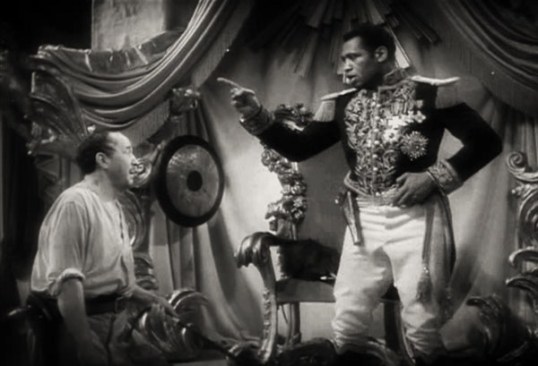
On November 8th, I recorded the 1933 film The Emperor Jones off of Retroplex.
Based on a play by Eugene O’Neill, The Emperor Jones tells the story of Brutus Jones (Paul Robeson). When we first meet Jones, he’s at a small Baptist church. He has recently gotten a job as a Pullman Porter and the church’s congregation has gathered for his send off. He shows off his uniform. He sings a spiritual. The congregation blesses him and Jones swears that he will make them proud. However, soon after he starts working for the railroad, he finds himself in the city. Though he’s a hard worker, he makes the wrong friends. He falls for the beautiful but cold-hearted Undine (Fredi Washington). A fight at a craps gang leads to Jones accidentally stabbing his friend, Jeff (Frank H. Wilson).
Jones is sentenced to hard labor and finds himself working on a chain gang, where he’s watched over by sadistic and racist guards. Jones attempts to serve his time but, eventually, he’s driven to violence by the sight of a white guard beating another prisoner. Jones attacks the guard and then flees. Eventually, he escapes on a steamer ship. Quickly growing tired of shoveling coal in the ship’s engine room, Jones jumps overboard and swims to a nearby island.
On the island, Jones meets Smithers (Dudley Digges). Smithers is an alcoholic merchant who also happens to be the only white man in the island. Working with Smithers, Jones convinces the natives that he has magical powers and overthrows the island’s previous dicttor. Now thoroughly corrupted, Jones declares himself to be the Emperor Jones…
Interestingly enough — and this was probably especially revolutionary in 1933 — almost all of Jones’s corruption is learned from dealing with the white world. It’s through dealing with the condescending and wealthy passengers on the train that Jones comes to understand that money equals power. It’s from dealing with the white guards on the chain gang that Jones learns how people can be controlled through fear and brutality. By the time Jones arrives on the island, he no longer has anything to learn from the white world. Hence, Smithers becomes his servant.
(One thing I found particularly interesting, as I did research for this review, was that The Emperor Jones was banned in cities in both the North and the South. In the North, the film was often banned for its frequent use of the n-word. In the South, it was largely banned because of a scene in which Jones orders Smithers to light his cigarette.)
Seen today, The Emperor Jones is something of an oddity. On the one hand, it’s a very stagey film. The film’s origin as a stage play is obvious in almost every scene. On the other hand, it’s also one of the few films from the 1930s to actually feature black characters as something other than comic relief. If just for that historical reason, The Emperor Jones is still worth watching today.
It’s also worth watching for Paul Robeson’s performance in the lead role. Robeson, whose career was derailed by both his political activism and his refusal to accept roles that he considered to be demeaning, gives a powerful and empathetic performance. Towards the end of the film, Robeson gives a 12-minute monologue as he runs through the jungle. For 12 minutes, it’s just the viewer and Robeson (and the menacing sound of drums in the distance). As Robeson delivers his final monologue, he takes us on a journey through the Emperor’s mind, alternative between periods of delusion and moments of sudden clarity. Even 83 years after it was first filmed, it remains a truly impressive performance.
Keep an eye out for this fascinating historical document.
 Through the Shattered Lens