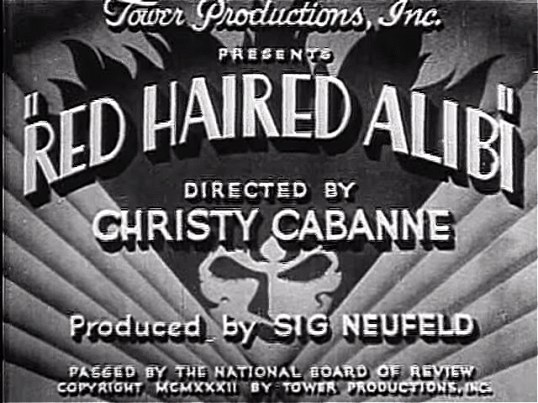
Love On The Shattered Lens: The Red-Haired Alibi (dir by Christy Cabanne)


1932’s The Red-Haired Alibi tells the story of Lynn (Merna Kennedy).

When we first meet Lynn, she is working at a store in Manhattan.  She has red hair.  The film is in black-and-white but we have no doubt that her hair is red because every single character who meets her mentions that she has red hair and she continually reminds people that she has red hair.  Everyone seems to be so stunned to meet a redhead!  And I have to say that this is the most realistic part of this movie.  I have red hair.  I’ve had complete strangers tell me that they like my hair.  I’ve also had complete strangers ask me if I’m a natural redhead (and I am!) and some other things that I’m not going to repeat here.  Personally, I love having red hair.  I’m a member of the proud 2%.  I don’t care if some people claim that people with red hair don’t have souls.  When you’ve got red hair, what else do you need?

As for the movie, Lynn meets a charming man named Trent Travers (Theodore van Enz).  Trent offers to give Lynn a job, away from the drudgery of working in sales.  Trent will pay Lynn to be his companion at night.  And since this is a pre-code film, Red-Haired Alibi is pretty open about what that means.  Lynn agrees.  Trent is handsome and rich and who couldn’t use the money during the Great Depression?  I imagine the film’s audience agreed.  One thing that always comes through in these Depression-era pre-code films is that morals don’t really matter when you’re struggling to pay your rent and not starve to death.

The problem is that Trent is a gangster.  Trent spends his nights committing crimes and then using Lynn as his alibi.  Eventually, Lynn realizes that she’s gotten herself into a dangerous situation.  The police suggest to her that she should get out of town before Trent takes things too far.  (I guess they didn’t have witness protection in 1932.)

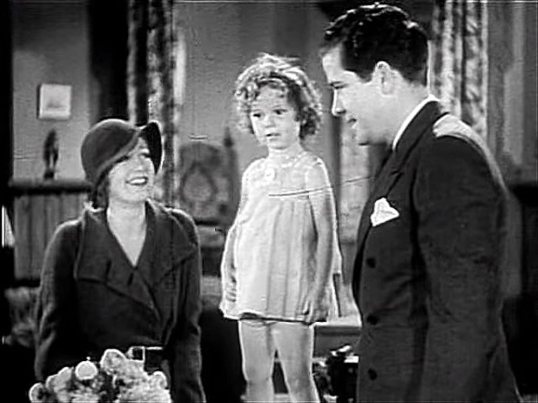
Lynn flees New York and builds a new life for herself in White Plains.  She meets a charming widower named Bob Wilson (Grant Withers).  They marry and settle into a life of domestic bliss.  Lynn becomes the stepmother to Bob’s young daughter (played by Shirley Temple, in what is believed to have been her film debut).  Everything seems to finally be perfect for Lynn.  Or at least it does until Trent shows up….

The Red-Haired Alibi is a generally well-acted but somewhat slow 1930s melodrama.  Comparing this film to some of the other films of the early 30s, it’s a relief to see a cast that knows how to deliver dialogue in the sound era but director Christy Carbanne sometimes struggles to maintain the sort of narrative momentum necessary to make a film like this compelling.  The ending feels a bit silly but, at least during the pre-code era, there wasn’t a need to try to punish Lynn for having a less-than-perfect past.

Dancer and former silent actress Merna Kennedy was best-known for her work with Charlie Chaplin and she gives a likable performance as Lynn.  Two years after making this film, she married Busby Berkley and retired from acting.  Tragically, she died of a heart attack in 1944, when she was only 36 years old.
Horror on the Lens: Svengali (dir by Archie Mayo)


In this atmospheric film from 1931, sinister singing teacher Svengali (John Barrymore) used hypnotism to not only turn Trilby O’Ferrall (Marian Marsh) into the most popular singer in Europe but he also takes control of her mind.  Trilby’s former boyfriend, Billie (Bramwell Fletcher) attempts to break Svengali’s hold over her, with results that are …. well, you’ll have to watch the movie.

And really, you should watch the movie!  There are moments of dream-like beauty to be found in Svengali, with my favorite being an extended sequence in which the camera seems to float above the streets of Paris.  John Barrymore gives one of his best performance as Svengali, playing the role with a mix of menace and sly humor.  The film keeps you guessing as to how much of Trilby’s actions are of her own free will and how many of them are due to Svengali’s influence.

(Interestingly enough, Barrymore’s Svengali is a dead ringer for the infamous Rasputin.)

With its dark humor and its “arty” style, Svengali struggled with audiences but it has since been recognized as one of the best of the early psychological thrillers.

Enjoy!

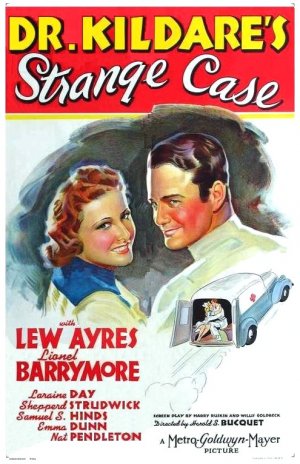
The Fabulous Forties #16: Dr. Kildare’s Strange Case (dir by Harold S. Bucquet)


Dr._Kildare's_Strange_Case_FilmPoster

The 16th film in Mill Creek’s Fabulous Forties box set was 1940’s Dr. Kildare’s Strange Case.  It’s about a doctor who investigates a medical case and wow, is it ever a strange case.

Apparently, there was a whole series of Dr. Kildare films that were released in the 30s and 40s.  I guess the films were the cinematic equivalent of a TV show like Grey’s Anatomy or ER or Children’s Hospital or… well, every medical show that’s ever shown up on TV since the beginning of time.  Dr. James Kildare (Lew Ayres) is a passionate young doctor who may break the rules but he gets results!  His mentor is Dr. Gillipsie.  Gillipsie is played by Lionel Barrymore and since the character is cranky and confined to a wheelchair, it was impossible for me to watch him without thinking about Mr. Potter from It’s A Wonderful Life.  Whenever Kildare went to him for advise, I kept expecting Gillipsie to glare at him and say, “You once called me a warped old man…”

Anyway, Dr. Kildare works in a hospital and, when he’s not silently judging everyone else that he works with, he’s busy silently judging the wealthy Dr. Lane (Sheppard Strudwick), a brain surgeon whose patients keep dying.  Kildare and Lane are also both in love with the same nurse, Mary Lamont (Laraine Day).  Mary wants to marry Kildare but Kildare would rather be poor and single than compromise his medical principles.  Lane, on the other hand, sends her a box full of silk stockings.  Plus, he’s rich!

Seriously, how is this even a competition?  Forget Kildare and marry Lane!

Except, as I mentioned earlier, all of Lane’s patients keep dying.  Is Lane incompetent or, as Kildare suggests, is it possible that brain surgery is just really, really hard?  I imagine it was even harder in 1940, when this movie was being made.  While Kildare and Lane are operating on brains, Dr. Gillipsie is still using leeches to suck sickness out of the poorer patients.

(You don’t actually see it happen in the movie but Gillipsie comes across as being a leech man.)

Anyway, eventually, Kildare has to cure a schizophrenic and it turns out that he can do this by putting the man into an insulin coma.  As is explained in great detail, forcibly putting a patient in a coma will cause that patient’s mind to go back to a reset point.  It’s kind of like how Windows sets up a restore point before doing a major update.

And that therapy sounds so crazy that you just know it had to be based in an actual practice.  I checked with Wikipedia and I was not shocked to discover that apparently Insulin Shock Therapy used to be a thing!

Anyway, Kildare’s gets into a lot of trouble for putting his patient into a coma and attempting to erase a huge part of his mind.  Will Kildare’s results vindicate his methods or will Gillipsie have to use leeches to suck the crazy out of the patient’s brain?

Watch the film to find out!  Or don’t.  Dr. Kildare’s Strange Case was directed by Harold S. Bucquet, who did a pretty good job with The Adventures of Tartu.  His direction here is flat and uninspired, which only serves to make this entire film feel like an old TV show.  I’m tempted to recommend the movie just because of the scene where it’s explained that insulin shock therapy causes patients to devolve so that they can re-evolve but otherwise, Dr. Kildare’s Strange Case is forgettable.

If you want to see it, you can watch it below!

http://www.youtube.com/watch?v=8UPFyrlNiGM

Or you can just watch this classic episode of Children’s Hospital!

http://www.youtube.com/watch?v=dpBjqgVaEbk