
Cadillac Man is a film that I had never heard of until I came across it while skimming what was available OnDemand last week. It was a film that I only watched because it starred Robin Williams. I have to admit that I have mixed feelings about including it in a tribute to Robin Williams because Cadillac Man was definitely one of his lesser films. However, while Cadillac Man may not be a very good movie, it does feature a very good performance from Robin Williams.
Released in 1990, Cadillac Man tells the story of Joey O’Brien (Robin Williams), who is the type of car salesman who has no problem approaching a widow at a funeral and telling her that now is the time to consider buying a new car. Joey’s a good salesman but he’s also deep in debt. He not only owes alimony to his ex-wife (Pamela Reed) but he also supporst two mistresses, a married one (a hilarious Fran Drescher) and a single one (Lori Petty). He’s also owes money to the local mafia don and, as the film begins, he’s been told that he has to sell 12 cars in two days or else he’ll lose his job.
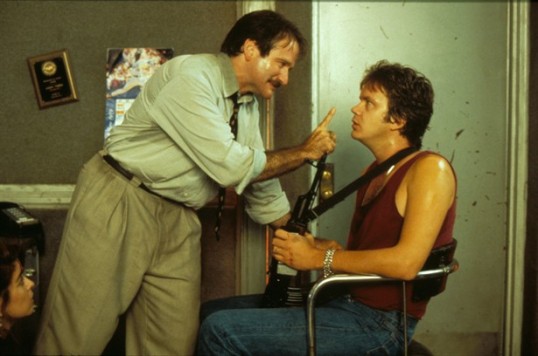
On top of all that, Joey also has to deal with Larry (Tim Robbins), an insane jerk with a motorcycle and an assault rifle who takes the entire car dealership hostage because he’s convinced that his wife (Annabella Sciorra) is cheating on him. Larry spends most of the movie firing his rifle up in the air and screaming at the top of his lungs (and yet, it’s also clear that the audience is supposed to like him). As the cops surround the car dealership, Joey attempts to keep Larry under control while also trying to get back together with his ex-wife…
After I watched Cadillac Man, I looked up the rest of director Roger Donaldson’s credits. What I discovered was that Donaldson has directed a lot of movies (including guilty pleasure Cocktail and the upcoming The November Man) but only one of them has been a comedy. The majority of his films are dramas like Thirteen Days and action films like November Man. In short, Roger Donaldson is not a comedy director. And when directors who aren’t experienced with comedy attempt to make a comedy, they almost always resort to having all of the actors shout their lines and run around like characters in a live-action cartoon. That is certainly the approach that Donaldson took in Cadillac Man and the end result was a film that far too often tried to substitute chaos for genuine comedy.
(As just an example of Donaldson’s lack of comedic touch, Annabella Sciorra went through almost the entire film with a bloody cut on her forehead. Even if her lines or her character had been funny, I would have never known it because I was spending too much time worrying about what the eventual scar would look like.)
And yet, here’s the thing. As bad as Cadillac Man turned out to be, Robin Williams was actually pretty good in it. Joey isn’t exactly a likable character but you root for him because of who is playing him. What’s interesting is that the role, even though it was definitely comedic, didn’t lend itself to the manic intensity that was the trademark of much of Williams’s comedy. Instead, the humor comes from the way that, while everyone else in his life is essentially going crazy, Joey O’Brien struggles to maintain his facade of calm and confidence. Williams portrays Joey as being the ultimate salesman and when Joey has to try to convince Larry to release his hostages, he approaches it almost as if he’s trying to sell Larry a car and it’s impossible not to admire Joey’s determination to close the sale without anyone else getting shot. As played by Tim Robbins, Larry is thoroughly unhinged. In fact, it’s probably one of the worst performances of Tim Robbins’ career but it’s obvious that he and Williams enjoyed playing off of each other. Whenever Robbins’ performance goes over-the-top, Williams’ performance brings things back down to Earth and provides whatever pleasure one can hope to get from a film like this.
And that’s why, despite the fact that Cadillac Man is not a particularly good film, it’s an appropriate tribute to the talent of Robin Williams. It’s one thing to give a good performance in a good film. However, it takes true talent to give a great performance in a total misfire.
And that’s exactly what Robin Williams did in Cadillac Man.
 Through the Shattered Lens