A Movie A Day #210: Who’s Harry Crumb? (1989, directed by Pat Flaherty)


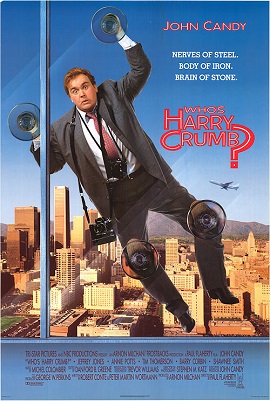
Who’s Harry Crumb?

He is a private detective, the latest in a long line of gumshoes.  While Harry’s father and his grandfather may have been great detectives, Harry is about as incompetent as can be.  He is a self-styled master of disguise but not much else.  He is employed at Crumb & Crumb Detective Agency, solely because of his family background.  When the head of the agency, Eliot Draisen (Jeffrey Jones), engineers the kidnapping of a millionaire’s daughter, he gives the case to Harry because he knows Harry will never be able to solve it.

Who’s Harry Crumb?

He is John Candy, the much beloved and much missed comedic actor from Canada.  As anyone who has ever seen an old episode of SCTV knows, John Candy could be one of the funniest men alive but Hollywood rarely knew what to do with him.  Other than the movies that he made with John Hughes, Candy was always stuck in either supporting roles or in bad comedies.  In Art Linson’s A Pound of Flesh, veteran film producer Linson writes that, because of Candy’s size, some Paramount executives wanted to cast him as Al Capone in The Untouchables.  That is something that I would have enjoyed seeing.  Instead, some actor named Robert De Niro got that role and Candy ended up making movies like Who’s Harry Crumb?

Who’s Harry Crumb? tries to be a mix of comedy and mystery but, due to a weak script and uncertain direction, it does not really succeed as either.  John Candy delivers a few laughs because he was a naturally funny actor but, as a character, Harry Crumb is not that interesting.  Instead, the film is stolen by Annie Potts, playing a duplicitous femme fatale.  Potts and Candy previously came close to working together in the original Ghostbusters.  (Candy pulled out of the role of Louis Tully so that he could play Tom Hanks’s brother in Splash.  He was replaced by his SCTV co-star, Rick Moranis.)  The rest of the cast seems bored and uninterested in what they are doing.  Even Jeffrey Jones, usually so reliable in smarmy bad guy roles, seems bored.

John Candy died just 5 years after the release of Who’s Harry Crumb?, leaving behind two intriguing dream projects, one a biopic of Fatty Arbuckle and another an adaptation of A Confederacy of Dunces.  Sadly, Hollywood never really figured out what to do with this talented comedian.


The Fabulous Forties #39: My Man Godfrey (dir by Gregory La Cava)


My_man_godfrey

The 38th film in Mill Creek’s Fabulous Forties box set was My Man Godfrey, which is strange considering that My Man Godfrey is not a 40s film.  The back of the box insists that My Man Godfrey was made in 1946 but it was actually made in 1936.  Errors like this aren’t uncommon when it comes to Mill Creek but, even beyond that simple mistake, My Man Godfrey is clearly not a product of the earnest and pro-American 1940s.  My Man Godfrey may be a screwball comedy but it’s a comedy that is very much a product of the far more cynical 1930s.  It’s a comedy that could only have come out during the Great Depression, at a time when FDR was promoting his New Deal and yet many Americans were still out-of-work and struggling to make ends meet, forgotten by a country determined to buy into a feel good narrative regardless of any evidence to the contrary.

But no matter!  My Man Godfrey might not technically belong in the Fabulous Forties box set but I’m still glad that it was there because it is an absolutely fantastic film.

The Godfrey of the title is played by the always charming and always funny William Powell.  When we first see him, he’s living in a garbage dump with several other men who have lost their money, homes, and family.  These are men who spend their time wondering when and if things are ever going to get better.  While the rest of the country insists that happy days are here again, these men know it’s simply not true.  They are truly the forgotten men.

Fortunately, there’s also a scavenger hunt going on!

For charity, a group of rich people are running around the city and collecting various oddities.  And among those oddities — “a forgotten man!”  When wealthy and snobbish Cornelia Bullock (Gail Patrick) stops off at the dump, she offers Godfrey five dollars to come with her and be her “forgotten man.”  Offended, Godfrey reprimands her and a shocked Cornelia stumbles back and falls into an ash pile.  Cornelia’s younger sister, the flighty Irene (Carole Lombard), sees this and laughs.  Mostly to get back at Cornelia, Godfrey agrees to be Irene’s forgotten man.

When Irene takes Godfrey to the Waldorf-Astoria Hotel so that the game’s organizers can declare him to be an authentic forgotten man, Godfrey is disgusted by the silly and wealthy people that he sees around him.  After he is authenticated, Godfrey proceeds to loudly denounce everyone in the hotel.  Every one is scandalized, except for Irene.  Irene asks Godfrey if he would like to come home with her and be her family’s new butler.  Reluctant but broke, Godfrey agrees.
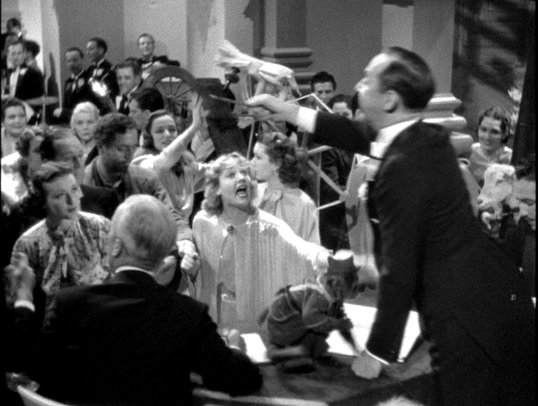
One of the joys of this scene is seeing the other things people found during the scavenger hunt. Love the monkey.

One of the joys of this scene is seeing the other things people found during the scavenger hunt. Love the monkey.

Godfrey, however, is far less amused.

Godfrey, however, is far less amused.

The next morning finds Godfrey in the Bullock mansion, prepared to start his duties as a butler.  He turns out to be a surprisingly adept butler but there’s only one problem.  It turns out that everyone was drunk last night and, as a result, nobody remembers Irene hiring Godfrey.  As Godfrey reintroduced himself to the family, he gets to once again know the Bullocks.

For instance, patriarch Alexander Bullock (Eugene Pallette) is a well-meaning man but he’s incapable of controlling his eccentric family or their excessive spending.  He faces each day with the weary resignation that his household is a disorganized mess and that he’s on the verge of losing his business.

Alexander’s wife, Angelica (Alice Brady), lives in her own world and confronts every problem with nonstop and delusional positivity.  She is very excited to have taken on a protegé, an artist named Carlo (Mischa Auer, who was justifiably nominated for an Oscar for his wonderfully odd performance).  Carlo is often surly and spoiled but he does do a pretty good impersonation of a gorilla.  Whenever the often dramatic Irene is declaring herself to be the most miserable rich girl in the world, Angelica insists that Carlo cheer everyone up by grunting and jumping around the room.
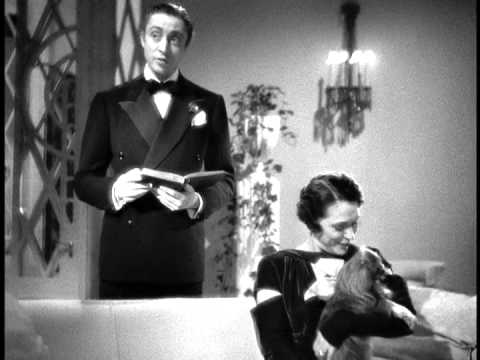
Mischa Auer as Carlo
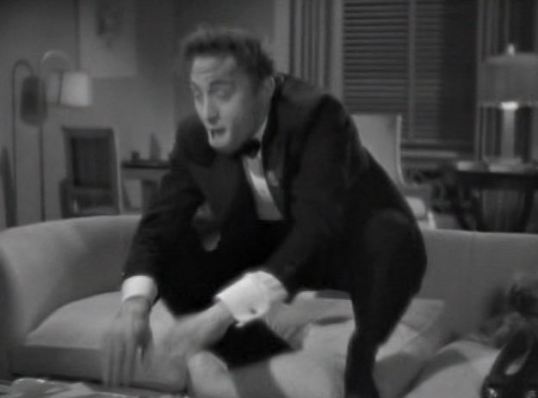
Mischa Auer as Carlo

Mischa Auer as a gorilla

Mischa Auer as a gorilla

(Apparently, the gorilla impersonation was something that Auer used to do at Hollywood parties.  The role of Carlo was specifically created with the idea of capturing Auer’s act on film.  As a result, Auer was one of the first actors to ever be nominated for Best Supporting Actor and he started a new career as a comedic character actor.)

Cornelia is selfish and materialistic.  Though she may not remember much about the scavenger hunt, she does remember Godfrey humiliating her.  From the minute she discovers that Godfrey is the new butler, she starts to conspire against him.  When her necklace disappears, everyone is sure that she hid it herself just to frame Godfrey.  The truth, of course, is a little bit more complicated.

And finally, there’s Irene.  Irene is spoiled but she’s not selfish.  She’s also not as ditzy as everyone assumes.  It’s just that she sees the world in her own unique way.  Almost as soon as Irene remembers that she hired Godrey, she decides that she’s in love with him.  She also decides that Godfrey is her protegé.  After all, if her mother can have a protegé, why can’t she!?
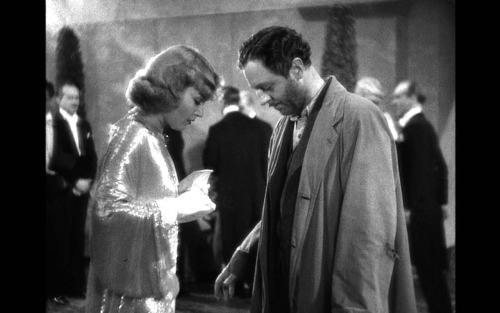
Carole Lombard and William Powell

Carole Lombard and William Powell

Carole Lombard was a masterful comedienne whose career was tragically cut short when she was killed in a plane crash in 1942.  Lombard is absolutely adorable in the role of Irene, a character to whom I very much related.

Of course, there is more to Godfrey and his past than he actually let on.   And, even after he becomes the new butler, Godfrey doesn’t forget where he was living just a few days before.  My Man Godfrey is a hilarious comedy but it’s also a comedy with a social conscience.
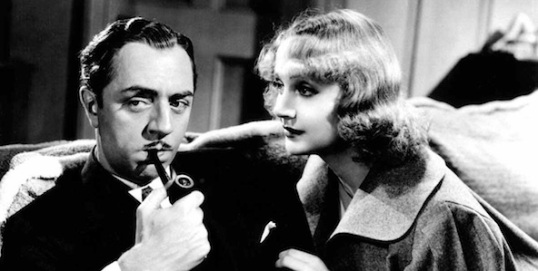
my-man-godfrey_592x299

I love this film.  It’s a screwball comedy in the best sense of the term, a film where all of the characters are eccentric while also remaining human.  William Powell and Carole Lombard were briefly married before they teamed up in My Man Godfrey and their chemistry is delightful to watch.  Finally, the supporting cast is memorable in the way that only a collection of great 1930s character actors can be.

My Man Godfrey is a great film.  It may not be from the 1940s but I’m glad it was included.
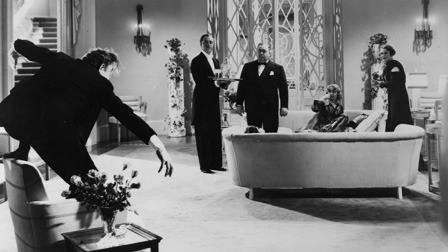
Godfreyw_bw_original

(By the way, just between you and me — I had a lot of fun watching this movie and writing this review.  It kind of reminded me why I started writing about movies in the first place.)
The Fabulous Forties #7: The Red House (dir by Delmer Daves)


40s

Last week, I started on my latest project — watching all 50 of the movies included in Mill Creek’s Fabulous Forties box set!  I started things off with Port of New York and then I was lucky enough to discover two excellent low-budget gems: The Black Book and Trapped.

And now, we come the 7th film in the Fabulous Forties box set: 1947’s The Red House.

Redhouseposter

The Red House takes place is one of those small and seemingly idyllic country towns that always seem to harbor so many dark secrets and past crimes.  Everyone in town is friendly, cheerful, and quick to greet the world with a smile.

Well, almost everyone.

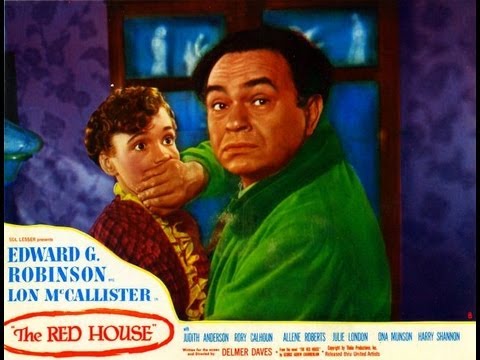
Pete Morgan (Edward G. Robinson) is the exception to the rule.  A farmer who moves with a pronounced limp, Pete lives on an isolated farm and refuses to have much to do with any of the other townspeople.  He lives with his wife, Ellen (Judith Anderson), and his niece, 17 year-old Meg (Allene Roberts).  Pete and Ellen are extremely overprotective of Meg.  Pete, especially, is always quick to tell her not to associate with any of boys in the town and not to enter the dark woods that sit next to the farm.  He tells her that there’s a red house hidden away in the woods and the house is haunted.  Going into the red house can only lead to death.

Despite Pete’s eccentricities, Meg is finally able to convince him to hire one of her classmates to help do chores around the farm.  Nath (Lon McAllister) is a good and hard worker and soon, even Pete starts to like him.  Meg, meanwhile, is falling in love with Nath.  However, Nath already has a girlfriend, the manipulative Tibby (Julie London), who cannot wait until they graduate high school so that she and Nath can leave town together.  When Nath starts to also develop feelings for Meg, Tibby responds by flirting with the local criminal, Teller (Rory Calhoun).

Though things seem to be getting better on the Morgan Farm, Nath eventually makes the mistake of admitting that, when he goes home, he takes a short cut through the old woods.  Pete angrily forbids Nath from entering the woods.  Of course, this has the opposite effect.  Soon, Nath and Meg are spending all day sneaking away into the woods so that they can look for the red house.

Once Pete learns of what they’re doing, he decides to hire Teller to keep them from even finding and entering the red house.  Needless to say, love, melodrama, murder, and tragedy all follow…

Despite the fact that the DVD suffered from a typically murky Mill Creek transfer, I enjoyed The Red House.  It’s one of those films that is just so over the top with all of the small town melodrama that you can’t help but enjoy it.  (If M. Night Shyamalan had been a 1940s filmmaker, he probably would have ended up directing The Red House.)  Nath and Meg were kind of boring but Julie London was a lot of fun as Tibby.  If I had ever starred in production of The Red House, I would want to play Tibby.

Plus, the film’s got Edward G. Robinson doing what he does best!  Robinson was an interesting actor, in that he could be both totally menacing and totally sympathetic at the same time.  He has some scary scenes as Pete but they’re also poignant because Robinson suggests that Pete hates his behavior just as much as Ellen and Meg.  Robimson was a powerhouse actor, the type who could elevate almost any film.

And that’s certainly what he does in The Red House!

red

Cleaning Out The DVR: Yankee Doodle Dandy (dir by Michael Curtiz)


Yankee_Doodle_Dandy_poster

So, today, I got off work so that I could vote in Texas’s Super Tuesday primary.  After I cast my vote (and don’t ask me who I voted for because it’s a secret ballot for a reason!), I came home and I turned on the TV and I discovered that, as a result of spending February recording countless films off of Lifetime and TCM, I only had 9 hours of space left on my DVR.  As a result, the DVR was threatening to erase my recordings of Bend It Like Beckham, Jesus Christ Superstar, American Anthem, an episode of The Bachelor from 2011, and the entire series of Saved By The Bell: The College Years.

“Acgk!” I exclaimed in terror.

So, I immediately sat down and started the process of cleaning out the DVR.  I started things out by watching Yankee Doodle Dandy, a film from 1942.

Yankee Doodle Dandy is a biopic of a songwriter, signer, and dancer named George M. Cohan.  I have to admit, that when the film started, I had absolutely no idea who George M. Cohan was.  Imagine my surprise as I watched the film and I discovered that Cohan had written all of the old-fashioned patriotic songs that are played by the Richardson Symphony Orchestra whenever I go to see the 4th of July fireworks show at Breckenridge Park.  He wrote You’re A Grand Old Flag, The Yankee Doodle Boy, and Over There.  Though I may not have heard of him, Cohan was an American institution during the first half of the 20th Century.  Even if I hadn’t read that on Wikipedia, I would have been able to guess from watching Yankee Doodle Dandy, which, at times, seems to be making a case for sainthood.

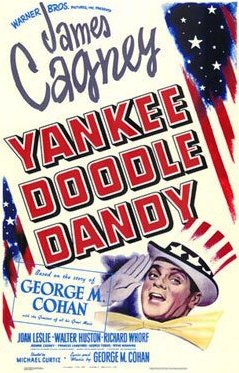
And that’s not meant to be a complaint!  74 years after it was originally released, Yankee Doodle Dandy is still a terrifically entertaining film.  It opens with George (played by James Cagney) accepting a Congressional Gold Medal from President Franklin D. Roosevelt.  (We only see Roosevelt from behind and needless to say, the President did not play himself.  Instead, Captain Jack Young sat in a chair while FDR’s voice was provided by impressionist Art Gilmore.)  Cohan proceeds to tell Roosevelt his life story, starting with his birth on the 4th of July.  Cohan tells how he was born into a showbiz family and a major theme of the film is how Cohan took care of his family even after becoming famous.

The other major theme is patriotism.  As portrayed in this biopic, Cohan is perhaps the most patriotic man who ever lived.  That may sound corny but Cagney pulls it off.  When we see him sitting at the piano and coming up with the lyrics for another song extolling the greatness of America, we never doubt his sincerity.  In fact, he’s so sincere that he makes us believe as well.  Watching Yankee Doodle Dandy, I found myself regretting that I have to live in such an overwhelmingly cynical time.  If George M. Cohan was alive today, he’d punch out anyone who called this country “Murica.”

Yankee Doodle Dandy is an amazingly positive film.  There are a few scenes where Cohan has to deal with a few Broadway types who are jealous of his talent and his confidence but, otherwise, it’s pretty much one triumph after another for Cohan.  Normally, of course, there’s nothing more annoying than listening to someone talk about how great his life is but fortunately, Cohan is played by James Cagney and Cagney gives one of the best performance of all time in the role.

Cagney, of course, is best remembered for playing gangsters but he got his start as a dancer.  In Yankee Doodle Dandy, Cagney is so energetic and so happy and such a complete and totally showman that you can’t help but get caught up in his story.  When he says that, as a result of his success, things have never been better, you don’t resent him for it.  Instead, you’re happy for him because he’s amazingly talented and deserve the best!

Seriously, watch him below:

James Cagney won the Oscar for Best Actor for his performance here.  Yankee Doodle Dandy was also nominated for best picture but lost to Mrs. Miniver.

I’m really glad that I watched Yankee Doodle Dandy today.  In this time of overwhelming negativity, it was just what I needed!

Lisa Reviews An Oscar Nominee: Sergeant York (dir by Howard Hawks)


Sergeant_York_1941_Poster

The 1941 film Sergeant York was the American Sniper of its day.  A biopic of Alvin York, one of the most decorated American soldiers of World War I, Sergeant York was not only a huge box office hit but it was a film that celebrated American patriotism in the type of unabashed fashion that you would never see in a film made today.  Though Sergeant York went into production at a time when the United States was officially pursuing a policy of international neutrality, it was released shortly before the Japanese attacked Pearl Harbor and, whether intentionally or not, Sergeant York served as a strong recruiting tool.  According to Wikipedia (and we all know that Wikipedia is never wrong), there were reports of young men going straight from the movie to the nearest military recruitment office.

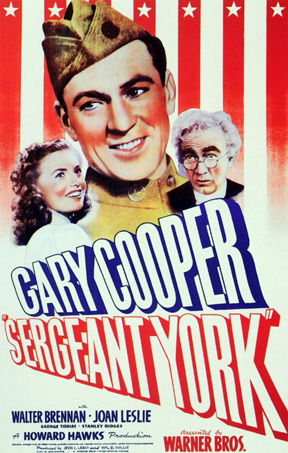
Clocking in at nearly two and a half hours (and running at least 40 minutes too long), Sergeant York is two films in one.  The second half of the film deals with the military career of Alvin York (Gary Cooper), a plain-spoken and honest Tennessee farmer who, because of his strong religious beliefs, unsuccessfully attempts to register as a conscientious objector.  Forced into the Army, York is, at first, dismissed as a simple-minded hillbilly.  (His fellow soldiers are amused to discover that York doesn’t know what a subway is.)  However, to the shock of his commanding officers, he proves himself to be an expert marksman.  As he explains it, being from the country means that he’s been shooting a rifle his entire life.

On the basis of his skills as a marksman, York is given a promotion but he still says that he refuses to kill.  It’s not until his superior officer reminds him of the sacrifices that past Americans have made that York starts to reconsider his position.  Then, a gust of wind opens York’s bible to a verse about giving unto Caesar what is Caesar’s and York realizes that he can go to war and, if need be, he can kill.

And it’s a good thing that he can!  Because World War I is heating up and York may be the only guy around with the strength and confidence to single-handedly defeat and capture over 170 German soldiers.

The army section of Sergeant York is predictable but well-done.  As you’d expect from a film directed by Howard Hawks, a lot of emphasis is put on how the soldiers work together.  York is portrayed not as being super human but instead as just an honest man who is exceptionally good at his job.  There’s nothing surprising about the second half of Sergeant York but Hawks keeps the action moving and Cooper gives a good performance.

To be honest, I preferred the first half of the film, which examined York’s life before he joined the Army.  When we first meet Alvin York, he drinks too much, he fights too much, and he’s totally irresponsible.  It’s not until he falls in love with Gracie Williams (Joan Leslie) that York starts to change his ways.  The scenes of York in the backwoods of Tennessee had a lively feel to them and it was enjoyable to see Cooper play a somewhat disreputable character.  Cooper seemed to be having fun playing a ne’er-do-well and, in the scenes before York finds God, his bad behavior was a lot of fun to watch.

Considering its success at the box office, it’s not surprising that Sergeant York was nominated for best picture of the year.  While Gary Cooper won the Oscar for best actor, the award for Best Picture went to How Green Was My Valley.