With the Cannes film festival underway in France, I’ve decided to spend the next few days watching and reviewing some of the films that previously won the Festival’s top prize. In 1952, what would eventually become the Palme d’Or was known as Grand Prix du Festival International du Film and it was actually awarded to two separate films. One of those films was Renato Castellani’s Two Cents Worth of Hope. The other was Orson Welles’s adaptation of Othello.
Oh, Othello. Where to begin, with this well-made Shakespearean adaptation that, by today’s standards, many would consider to be problematic?
Othello is one of Welles’s most important films, not just because of its quality but also because it was one of the first films of his European exile. It was also the first Welles’s production to last for over a year. In this case, it took three years to finish filming Othello. As Welles himself often pointed out, one of the film’s key sequences began in Morocco but ended in Rome. Working with a low budget, Welles would take roles just to have enough money to shoot another few feet of film. (Reportedly, his salary for The Third Man went right into Othello.) Pieces of scenes would be filmed years apart, often with the actors speaking to the camera as opposed to another performer. Actors regularly became unavailable and were replaced. And yet somehow, Welles managed to edit all of the seemingly random bits and pieces into a coherent and frequently powerful film. Over the years, the chaotic production of Othello would become the norm for Welles and he would become as known for the films he was forced to abandon as he was for the films that he had made. But, in 1952, Welles’s perseverance and his determination to bring his vision to the screen were still appreciated and the Cannes jury, headed by author Maurice Genevoix, saw fit to honor his achievement.
At the same time, this is also the film in which the white Orson Welles played the Moor of Venice. Of course, in 1951, it was still pretty much a tradition that every Shakespearean would eventually play Othello and that he would wear dark make-up while doing so. Welles opts for a light bronzer, one that makes him appear to have a deep tan. While it’s undeniably jarring to see Orson Welles playing a North African, it’s still not quite as jarring as seeing what Laurence Olivier did in his Oscar-nominated version of the play.
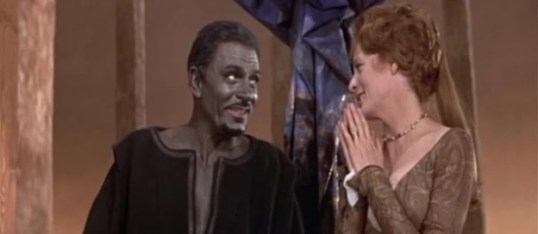
Laurence Olivier’s Othello
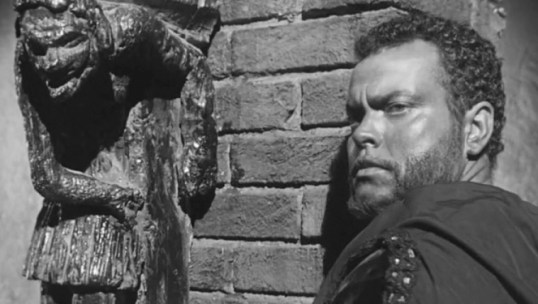
Orson Welles’s Othello
I have to admit that I held off on seeing this film precisely because I didn’t want to watch a film featuring Orson Welles, a director who I greatly admire, in blackface. Many people are probably never going to see this film for precisely that reason and that’s certainly understandable. In the end, it’s a decision that everyone will have to make for themselves. That said, having watched the film, I can now say that Orson Welles gives one of his best performances as Othello, playing him as a brilliant warrior who knows that, because of his background, he will never be fully accepted by the people of Venice. They’ll expect him to fight their battles for him but, when he marries the white Desdemona (Suzanne Cloutier), he is still expected to prove that he’s not some sort of savage. In fact, the only thing that prevents him from being brought up on charges is that Venice needs him to fight in another battle. Being a permanent outsider leaves Othello open to the manipulations of the evil Iago (Michael Mac Liammor), who pretends to be a friend but who instead views everyone around him with contempt and jealousy. Welles captures Othello’s anger but also his emotional vulnerability. As a permanent outsider, Othello is so used to being betrayed that it doesn’t take much from Iago to push him over the edge.
Welles directs the film like a film noir, filling the screen with menacing shadows and framing the film’s tragic finale like a horror film. He makes the film’s low-budget works to its advantage. As opposed to the grandeur that one normally associates with Shakespeare, there’s a seediness to the locations in Welles’s version of Othello. As Othello’s jealousy and paranoia grows, Venice itself appears to become more cluttered and cramped. It’s as if the viewer is seeing the location through Othello’s eyes, a once imposing city that, with each little secret or lie, edges closer to death. As both a director and an adapter of Shakespeare’s original text, Welles tells the entire story of Othello in less than 90 minutes, a pace that reflects Othello’s quick decent into irrational paranoia.
Admittedly, it’s not a perfect film. Mac Liammor was reportedly the best Irish stage actor of his time but his inexperience with film acting is obvious and it makes him a less than ideal Iago. Traditionally, Othello is usually dominated by whichever actor plays the role of Iago, as it’s Iago who pushes the story forward and narrates the action. However, Welles removes the moments when Iago narrates and speaks to the audience. Welles gives us an Othello that is clearly about the title character and this production is less interested in the reasons behind Iago’s betrayal than in what happens to Othello as a result. (Othello becomes yet another Welles film that is ultimately about the importance of friendship and loyalty.) Not surprisingly, with the film firmly centered on Welles’s performance, the rest of the cast struggles to make as strong of an impression. Only Suzanne Cloutier, cast as Desdemona, manages to give a performance that escapes from Welles’s shadow.
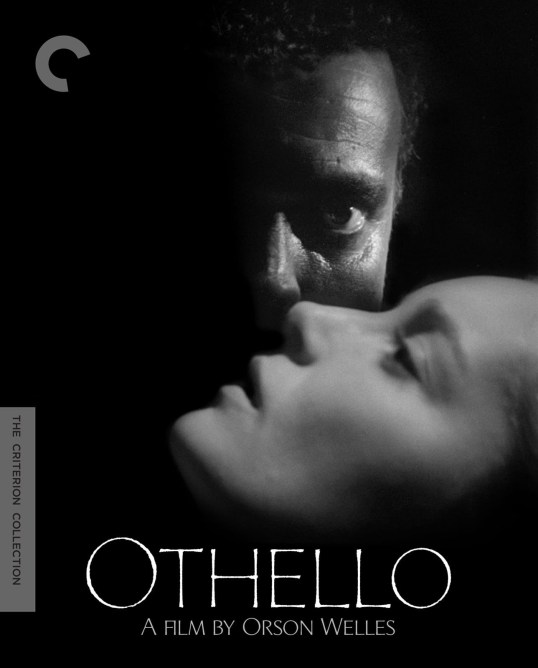
At Cannes, Othello defeated, among others, An American In Paris, Detective Story, Umberto D., and Viva Zapata. As often happened with Welles’s later films, it didn’t get much of an initial release in America but it has since been rediscovered by film connoisseurs. Needless to say, the Criterion release is the one to check out.
 Through the Shattered Lens