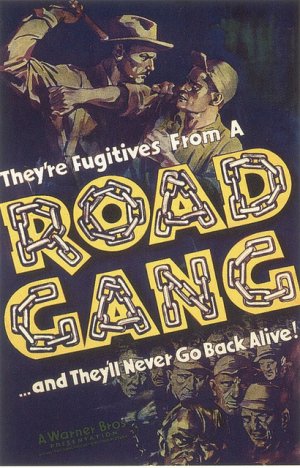
Lisa Cleans Out The DVR: Road Gang (dir by Louis King)


I was going to start this review with a quote from Gandhi: “A nation’s greatness is measured by how it treats its prisoners.”  That was something that I first heard from a perpetually stoned ex-seminarian who used to live in a trailer park in Lake Dallas.  I always figured that, being as stoned as he usually was, he probably knew what he was talking about but, upon doing research for this review, I have discovered that Gandhi actually didn’t say that.  What Gandhi said was, “A nation’s greatness is measured by how it treats its weakest members.”  Fortunately, it’s the same basic idea and, regardless of how you phrase it, it’s a quote that perfectly encapsulates the message of the 1936 film, Road Gang.

Road Gang tells the story of Jim (Donald Woods) and Bob (Carlyle Moore, Jr.).  Bob is fun-loving.  Jim is more serious and engaged to marry heiress Barbara Winston (Kay Linaker).  Jim and Bob live in an unnamed Southern state (though I’m going to assume that the state is supposed to be Georgia, just because).  Jim has just written an article that exposes the corruption of political boss, J.W. Moett (Joe King).  The article is so good that both Jim and Bob have been offered jobs in Chicago!  There’s a lot of corrupt political figures who can be exposed in Chicago!

However, while driving up north, Jim and Bob are arrested on trumped-up charges.  At first, Jim and Bob laugh off Moett’s desperation but, unfortunately, another criminal happens to be breaking out of jail at the same time that Jim and Bob arrives for booking.  That criminal kills the arresting officer and then forces Jim and Bob to drive him across the state.  Eventually, the police recapture the three of them.  However, the escaping criminal is killed and Jim and Bob are arrested as accessories.  Under the advice of their lawyer, Mr. Dudley (Edward Van Sloan), they plead guilty and accept a deal.  What they don’t know is that Dudley works for Moett and that, as a result of pleading guilty, they are going to be sentenced to five years in a prison camp.

Okay, so the film gets off to a pretty melodramatic start.  And, to be honest, the entire film is extremely melodramatic.  A lot of time is devoted to Barbara trying find evidence that Jim and Bob were set up, something that is made difficult by the fact that Barbara’s father, like Mr. Dudley, works for Moett.  Fast-paced and not-always-logical, this is a B-movie, in every sense of the term.

And yet, as melodramatic as it is, Road Gang is deadly serious when it comes to portraying the brutality of the prison camp.  From the minute that Bob and Jim arrive, they find themselves at the mercy of the corrupt warden and his sadistic guards.  The prisoners are largely used as slave labor and subjected to punishments that are often arbitrary and extreme.

Road Gang doesn’t flinch when it comes to portraying why prison often not only fails to rehabilitate but also helps to transform minor offenders into hardened criminals.  There’s a disturbing scene in which Jim, Bob, and the other prisoners are forced to listen as another prisoner is whipped.  The crack of the whip and his howls of agony explode across the soundtrack in a symphony of pain and sadism.  Jim and Bob have two very different reactions to being in prison.  One survives.  One allows himself to be killed rather than take one more day in confinement.

Road Gang is often compared to I Am A Fugitive From A Chain Gang.  Actually, beyond the theme of a fatally compromised justice system, there is no comparison.  The angry and fact-based I Am A Fugitive From A Chain Gang is a hundred times better and, quite frankly, Donald Woods was no Paul Muni.  However, Road Gang still has its moments of power.  Decades after it was made, the issues it raises continue to be relevant.  Do we send people to prison to rehabilitate them or to punish them and are the two goals mutually exclusive?  And how can we say that someone has “paid his debt to society” when, even after a prisoner serves his time, the stigma of having been imprisoned closes and locks most doors of opportunity?

Road Gang shows up occasionally on TCM.  There’s where I recorded it on January 23rd of this year.
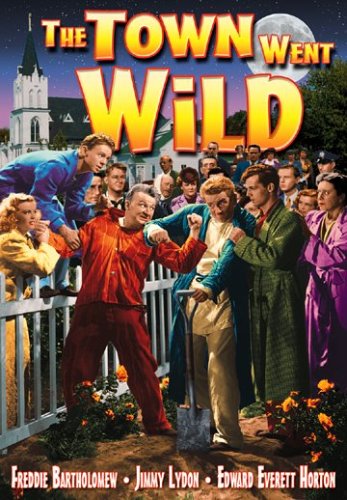
The Fabulous Forties #46: The Town Went Wild (dir by Ralph Murphy)


51BRWYTCMZL

The 46th film in Mill Creek’s Fabulous Forties box set was 1946’s The Town Went Wild!  Nice name, huh?

The name is actually a lot nicer than the movie, which is a bit incoherent.  Basically, David (Freddie Bartholomew) is a nice guy who has lived his entire life in the small town.  His best friend is Bob (Jimmy Lydon) and David is also in love with Bob’s sister, Carol (Jill Browning).  David is an engineer who has just been assigned to go work in Alaska.  Before he leaves, he is determined to marry Carol.

Unfortunately, Bob’s father (Edward Everett Horton) and Carol’s father (Tom Tully) hate each other.  They have been feuding for so long that they’re not even sure what they’re feuding about.  However, Carol and David are determined to get married so they decided to elope.  Getting a ride from their friend Mille (Roberta Smith), they go to the next town over and ask the justice of the peace to marry them,

However, before the justice of the peace can marry them, he needs them to publicly post their wedding plans in the local newspaper.  And before David can post those plans, he needs to get his birth certificate from the local registrar.  When David gets his birth certificate, he discovers something shocking.  There was a mix-up at the hosptial!  His Dad went home with the wrong baby.  David is actually … CAROL’S BROTHER!

So, what can they do?  How can David and Carol still get married despite apparently being related?  And will the fathers be able to set aside their feud long enough to help their children out?  The entire town wants to know!

I have to admit that I’m struggling a bit to come up with anything to say about The Town Went Wild.  The movie is a mess and David and Carol are such boring characters that they even make incest look dull.  Unfortunately, the version I saw of The Town Went Wild suffered from one of those infamously cheap Mill Creek transfers, complete with grainy picture, inconsistent sound, abrupt cuts, and the sneaky suspicion that certain scenes did not make the transfer from film to video.

With all that in mind, it’s hard to fairly judge The Town Went Wild but I can say that at least it provided good roles for Edward Everett Horton and Tom Tully.  If nothing else, these two character actors appeared to enjoy playing loud and frequently stupid rivals.  Otherwise, The Town Went Wild is one of those poverty row films that can safely be forgotten.

Cleaning Out The DVR #26: Little Women (dir by George Cukor)


(For those following at home, Lisa is attempting to clean out her DVR by watching and reviewing 38 films by this Friday.  Will she make it?  Keep following the site to find out!)

Little_Women_1933_poster

Based on the beloved classic by Louisa May Alcott, the 1933 film Little Women tells the story of the March sisters.  Growing up in Concord, Massachusetts during the Civil War, they wait — with their mother, Marmee (Spring Byington) — for their father to return from serving as a chaplain in the Union Army.  There are four sisters.  The oldest, Meg (Frances Dee) is a responsible and practical (which is a nice way of saying that someone is boring) seamstress.  The youngest, Beth (Joan Bennett) is beautiful but selfish.  Meanwhile, saintly Beth (Jean Parker) spends her time playing a severely out-of-tune piano.

And then there’s Jo (Katharine Hepburn).  Jo is just a year younger than Meg and … well, basically, she’s Katharine Hepburn.  She’s an independent-minded intellectual who dreams of being a writer and who isn’t interested in conforming to society’s expectations.  She’s head-strong and occasionally, she’s too stubborn for her own good.  But she’s also kind-hearted and loves her sisters, even if she does sometimes disagree with them.  We follow Jo as she rejects one potential suitor, poor earnest Laurie (Douglass Montgomery) and discovers another when she meets the older Prof. Behar (Paul Lukas).  We also watch as a family tragedy brings her and her sisters back together.

In fact, Katharine Hepburn is so perfect as Jo that it throws the rest of this adaptation out of balance.  So totally does Hepburn dominate this film that it’s hard not to feel that the other March sisters end up getting a short shrift.  To a certain extent, it does make sense.  Jo is the lead character and the story is largely told through her point of view.  But, for someone who enjoyed reading Alcott’s novel, it’s hard not to be disappointed.  I mean, Jo is great but some of us may have related more to one of the other March sisters.  Like Beth, for instance.

Another problem with this version of Little Women is that the March sisters are all supposed to be teenagers and yet, they’re played by actresses who were in their 20s.  For instance, 23 year-old Joan Bennett played Amy, who is supposed to be only 12 years old when we first see her.  By casting actresses who were already clearly adults, it makes t difficult for the film to work as a coming-of-age story.

(Personally, my favorite version of Little Women — and the first one that I ever saw — was the 1994 version that starred Winona Ryder as Jo.  Even though Ryder was clearly the film’s star, the other three March sisters were all given time to make an impression as well and, as a result, they felt like a real family.  Speaking as the youngest of four sisters, there was a lot about that movie to which I could relate.  Add to that, Christian Bale made for a far more interesting Laurie than Douglass Montgomery.)

With all that said, it bears repeating that Katharine Hepburn is absolutely perfect as Jo and, if you’re a Hepburn fan (and who isn’t), this is one of her essential films.  It helps that she was directed by George Cukor, the director who was responsible for some of Hepburn’s best performances.  The rest of the movie doesn’t quite live up to Hepburn’s performance but she was such a great talent that it almost doesn’t matter.

Little Women was nominated for best picture.  However, it lost to Cavalcade.