VGM Entry 62: Enix


VGM Entry 62: Enix
(Thanks to Tish at FFShrine for the banner)

Today Square might be remembered as the uncontested kings of Super Nintendo RPGs, but this is not an accurate assumption. As a young kid obsessed with anything approximating the genre, I anticipated every new Enix release with nearly equal glee. What I didn’t realize at the time was that Enix was a publisher. You won’t find games developed by them. While Square’s games emerged in house from the drawing board, Enix released titles developed by a wide variety of companies.

http://www.youtube.com/watch?v=Dk8BDJLEHew

Quintet was the leader of this pack. Quintet is a Japanese video game developer officially founded in April 1989. According to Wikipedia, the first game credited to them is Legacy of the Wizard (Nihon Falcom, 1987), an installment of the Dragon Slayer series. Hence a bit of a to-do is made about their origin, with “June 1987 / April 1989” listed as the ambiguous founding date. The source for their official founding date links to a nearly illegible magazine scan (in English), and I don’t want to give myself a headache trying to decipher it, so I’ll take the Wikipedia editor’s word on that one. (The fact that whoever edited the article noticed an ambiguity in the first place marks them as more attentive than the vast majority of game-related editors.)

But the article and its relevant links lead me to believe the issue isn’t as complex as it seems. Tomoyoshi Miyazaki, director and president of Quintet, was a Nihon Falcom employee (he was involved in developing the first three Ys titles), and it just so happens to be the case that Legacy of the Wizard was released in North America in April 1989. The only real confusion is that Wikipedia suggests that Quintet developed both the Famicom and the NES ports, and that the former was released in 1987. If both were released in 1989, or alternatively if Quintet only developed the NES release (if the division of labor between developer and publisher renders this thought unintelligible, my apologies), then there is no issue. And moreover, if Tomoyoshi Miyazaki was a Nihon Falcom employee, the ambiguity may capture a simple gap in time between Miyazaki beginning to call his development team Quintet and his registering the name as a corporate entity.

Whatever the case may be, Quintet were busy in 1993. Following ActRaiser in 1990 and Soul Blazer in 1992, they managed to pump out two games in a span of two months. This probably wasn’t a great idea in retrospect. Illusion of Gaia, composed by Yasuhiro Kawasaki, was musically pretty shallow (this might account for why I never bought the game after renting it as a kid), and as an installment in the unofficial Soul Blazer Trilogy it was a sad decline from the quality of Yukihide Takekawa’s Soul Blazer. In its subtler moments, 2:49 to 5:35 for instance, it boasts an atmospheric vibe vaguely reminiscent of Jeremy Soule’s Secret of Evermore two years later, but the rest is of poor quality.

http://www.youtube.com/watch?v=Mfr_C429oBY

ActRaiser 2 on the other hand had an outstanding score, and is a real testament to the diversity offered by Yuzo Koshiro. While I remain unmoved by his more popular Streets of Rage sound, as a classical composer he not only competes outside of the video game spectrum, but makes the Super Nintendo sound like a real symphony with unprecedented professionalism. Nobuo Uematsu is always quick to point out that he had no professional training, and my own musical inclinations lead me to treat such claims with an appreciative nod of respect, but where he did try to emulate an orchestra on the Super Nintendo he never came close to the level of Koshiro. (Indeed, “Dancing Mad”‘s charm is it’s quintessentially SNES sound within the orchestration.)

http://www.youtube.com/watch?v=6ukmCm8QBrI

Koshiro’s work in ActRaiser 2 in contrast might as well have been a live recording. Koshiro is, like Chris Hülsbeck, an artist I’ve I in many ways simply failed to appreciate, but not here. Quintet’s problem in this instance is that Koshiro’s stellar score was ActRaiser 2‘s only redeeming value. I mean, I never played it, but that fact is directly relevant to its commercial failure. In choosing to abandon the simulation side of the gameplay and go for a straight side-scroller they essentially ostracized their entire fanbase and entered a much more competitive field in which the Enix seal of approval meant jack.

http://www.youtube.com/watch?v=O3n_Qt6cgbs

Produce was a pretty obscure developer founded in 1990, probably most known for Super Adventure Island (Hudson Soft, 1992) and The 7th Saga. My most vivid memories of The 7th Saga are of the obnoxious pseudo-avoidable encounters that were for all practical purposes random but gave you the sensation of just being bad at avoiding them. Still, as with most Enix titles it was a refreshing change of pace from the Dragon Quest-patterned norm, and perhaps it had a good plot of which I was simply oblivious at the time (I doubt it though.)

What really strikes me though, listening to this video, is that it actually had a really great soundtrack. Norihiko Yamanuki doesn’t even have a vgmdb entry, and he’s surely one of the most obscure SNES composers to have actually accomplished something. There’s nothing really compositionally striking about the music of The 7th Saga, and it doesn’t really surprise me that I overlooked it as a kid. Yamanuki’s accomplishment here is more in the subtle qualities of the arrangement. The bubbly little tapping tones that prevail throughout this collection, most dominantly in the track at 1:00, really give the game a heartwarming sort of appeal; it’s quite pretty.

http://www.youtube.com/watch?v=wq4LGNGd5ik

Ogre Battle was probably the most successful real-time strategy game for the SNES, at least in the United States. It stemmed from a long lineage of similar titles in Japan, but few had found sufficient success for overseas ports. Quest, the developer, had worked on similar projects in the past, though Ogre Battle would be the first in their Ogre series. A game of few settings and themes–the entire plot unfolds within the combat setting, and there are no separate story scenes as in say, Final Fantasy TacticsOgre Battle demanded a whole bunch of tunes well suited for long, drawn-out conflict.

The game did, nevertheless, have a pretty extensive soundtrack. Masaharu Iwata did the bulk of the composition, contributing 24 tracks, while Hitoshi Sakimoto added 12 and Hayato Matsuo added 6 (based on the ost liner notes on vgmdb). If the music sounds a little similar to the score of Final Fantasy Tactics, that’s no coincidence. Masaharu Iwata and Hitoshi Sakimoto composed it too.
VGM Entry 61: The RPG generation


VGM Entry 61: The RPG generation
(Thanks to Tish at FFShrine for the banner)

The Super Nintendo RPG/Adventure legacy didn’t come over night. But ActRaiser (Enix, 1990), Final Fantasy IV (Square, 1991), and The Legend of Zelda: A Link to the Past (Nintendo, 1991) did not necessarily set the stage, either. RPGs had been huge in Japan for quite some time. The Super Nintendo provided both the capacity to carry them and the consistency to focus costs on a single product (imagine the amount of time and resources which must have went into porting PC RPGs to a half-dozen different systems). This didn’t inspire computer gaming companies to switch gears–Nihon Falcom continued to pump out their titles for the PC-9801 all the way up to 1996, slowly switching to Windows with only one Super Famicom title, Ys V: Ushinawareta Suna no Miyako Kefin (1995), to show for themselves in between. But other publishers saw RPGs as a more viable option now, and Capcom, Taito, and Nintendo hopped on the bandwagon while Square and Enix picked up the pace. (Konami held off producing RPGs until the Playstation era.)

The fact that these types of games did not start to appear in abundance on the SNES until 1992 might have been a simple consequence of developers spending most of 1991 making them. 1992 to 1995 were the glory days of SNES fantasy gaming, and perhaps the crowning era in the history of video game music.

http://www.youtube.com/watch?v=LB4CmTMOkFw

Capcom’s first big RPG was Breath of Fire (1993), credited to a long list of composers including Yasuaki Fujita (Mega Man 3), Mari Yamaguchi (Mega Man 5), Minae Fujii (Mega Man 4), Yoko Shimomura (Gargoyle’s Quest, Street Fighter II), and Tatsuya Nishimura. Thankfully track by track authorship is actually available, and we can see that Yasuaki ‘Bun Bun’ Fujita did the grand bulk of the composing, with Mari Yamaguchi contributing five songs and the other three chipping in a song each.

Here’s a track list for the compilation:

(0:00) The Dragon Warrior
(1:24) Fate
(2:54) Starting the Journey ~Breath of Fire~
(4:11) Deep Forest
(5:18) Battling
(6:02) Sand Palace
(7:07) Dejection
(8:05) Fishing

As a series, Breath of Fire was not really all that well noted for its contributions to video game music. I don’t want to blow off the rest of the games here and now before revisiting them, but I distinctly remember playing through most of them with the radio on (I never actually played Breath of Fire V). The original Breath of Fire was definitely more of an exception than than the rule. The soundtrack is peppered with memorable, moody numbers. It’s most famous song, at least in so far as it was carried on in future installments, is Mari Yamaguchi’s overworld theme, “Starting the Journey”. But it is Yasuaki Fujita’s bleaker contributions that really make the game stand out from the crowd. “Deep Forest” and “Dejection” could both easily pass for ending credits themes to some complex plotline defying the good versus evil stereotype–the sort of RPG we all crave but rarely find outside of the Suikoden series. They’re both delightfully dark and finite, screaming “it’s over, but did you really win?”

Of course neither of them are actually credits music, and Breath of Fire was never known for its plot. The series had an incredible knack for being simultaneously completely forgettable and quite fun to play–perhaps a consequence of actually challenging combat (at least, in comparison to the vast majority of turn-based RPGs.) When it came to music, the original was the only one that actually made a lasting impression on me when I played it.

http://www.youtube.com/watch?v=jhE7rAG6rvY

Lufia & the Fortress of Doom, composed by Yasunori Shiono, was another series starter in 1993. There were actually only two Lufia titles in the 90s, and I suspect the later handheld releases came as an afterthought. Taito were prolific producers with a history in the gaming industry dating all the way back to 1973, but they had always shied away from the RPG market. With the cooperation of newly-established developers Neverland Co., Lufia would be their first attempt.

As for the history of Neverland, something on Wikipedia is clearly wrong. It claims Lufia‘s developer was founded on May 7th, 1993, and it claims the game was released on June 25th, 1993. But while Neverland certainly must have had an earlier origin, Lufia does appear to be their first of very few titles. In that regard, the Lufia series was kind of unique. I won’t pretend to know what goes on behind the scenes in the gaming industry (my dream of directing RPGs has always been a total fantasy), but I have to imagine when a producer develops their own game there’s a fairly more intimate degree of interaction between the two sides. Square and Nintendo as of 1993 nearly always developed their own games. The wildcards in the world of non-PC RPGs almost always went through Enix (the most famous developers being Quintet and Chunsoft). Neverland-Taito then seems like a pretty unique pairing–an independent developer working with a producer that had never marketed an RPG.

Lufia & the Fortress of Doom was in every manner a rough draft–a sort of prototype for Lufia II: Rise of the Sinistrals, which was infinitely better and one of the best RPGs in the history of the SNES. Unlike Final Fantasy, Dragon Quest (from what I gather), Breath of Fire, Seiken Densetsu, Quintet’s unofficial ‘Soul Blazer Trilogy’, and Zelda really, the Lufia series was both plot-centric and cumulative, taking place in the same world with a continuous history and related/reoccurring characters. As if in collusion with the rest of the development team’s maturation, Yasunori Shiono’s compositions improved substantially in the second title, but we will get to that later.

http://www.youtube.com/watch?v=KDUS7OXiiJg

Good adventure/RPG music was not limited to the Super Nintendo. The Game Boy was a musical instrument par excellence, with by far the most aesthetically pleasing tones of any system on the market lacking diverse instrument sampling. (I hope that’s a suitable delineation for a technical subject of which I still know absolutely nothing.) The Legend of Zelda: Link’s Awakening is far and wide my favorite score in the Zelda series. It might have nothing on Ryuji Sasai’s work on Final Fantasy Legend III, but Link’s Awakening brings the Game Boy to life in a really beautiful way. Indeed, its only real fault is a failure to employ his three-dimensional stereo effects. The game’s crowning jewel, Tal Tal Heights, appears early in this compilation (0:30), but the whole score merits attention.

Koji Kondo surprisingly had nothing to do with it. Link’s Awakening was a joint effort between Kazumi Totaka, Minako Hamano, and Kozue Ishikawa, all of whom I’ve yet to mention. Kazumi Totaka actually had a pretty long history with Nintendo, providing music for the sort of games you might expect to hear Soyo Oka on (Mario Paint, Wave Race 64, most notably Animal Crossing, which I do hope I remember to feature if I ever get that far). Minako Hamano was responsible for roughly half of the Super Metroid soundtrack, though her name rapidly fades from the pages of history, and Kozue Ishikawa is a virtual unknown. But this motley crew managed to piece together one of the quintessential scores of the Game Boy, and in doing so earn themselves a place in video game music history.

October Music Series: 下村陽子 – Beware the Forest’s Mushrooms


http://www.youtube.com/watch?v=lbRJ733xiF4

Yoko Shimomura was a rising star when she composed the Super Mario RPG soundtrack in 1996, fresh out of Capcom and ready to embark on a higher profile career with Square. The whole soundtrack was exceptional, but one track in particular was so catchy that it’s been stuck in my head ever since, and it’s most certainly appropriate for a fall theme.

Within the game, the song plays to a forest maze–one of those looping maps that can have you wondering around forever if you don’t pay attention. ‘Forest music’ has always been among the best tracks in RPG scores, but I don’t know that anyone’s pulled one off as effectively as Yoko Shimomura. It’s not quite as dark and haunting as say, Koji Kondo’s “Forest” from A Link to the Past or Yasuaki ‘Bun Bun’ Fujita’s “Deep Forest” from Breath of Fire, nor as calm as Yasunori Mitsuda’s “Secret of the Forest” from Chrono Trigger, to name some contemporaries. It’s far more friendly and inviting, which really makes it all the more dangerous, because at the end of the day you’re still getting lost in a deep forest maze filled with monsters out to kill you. It draws you in, makes you want to keep on wandering, like a good proper evil enchanted forest ought to.

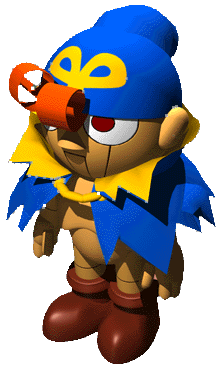
It’s also the theme song to Geno, a doll possessed by the spirit of one of the stars you’re out to rescue, who really creeped me out as a kid because I thought that orange thing on his hat was his nose for some reason.

VGM Entry 60: Splatterhouse


VGM Entry 60: Splatterhouse
(Thanks to Tish at FFShrine for the banner)

Today is October 1st, and Shattered Lens readers probably have a good idea of what that means.

http://www.youtube.com/watch?v=BPFh7W1yTz4

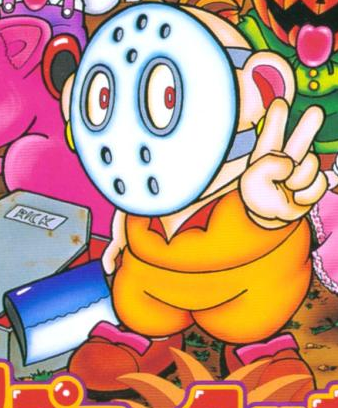
Namco’s Splatterhouse series first emerged in the arcades in 1988. As the advertisement poster used in this music video suggests, it was one of the first video games that really possessed the graphical capacity for some good old fashion gore. You play as Rick Taylor, a run of the mill college student who takes refuge from a thunderstorm in an old rickety mansion and inevitably finds himself demonically possessed, hacking and slashing his way through all sorts of hellspawn and ultimately butchering his girlfriend before defeating the mansion’s demon fetus-spawning womb and escaping. Quality stuff.

The game is accompanied by quite an impressive soundtrack.

http://www.youtube.com/watch?v=otH1qUc_kjw

When not taken to weird, incoherent noises such as on “Poltergeist”, the game has a knack for some rather pretty tunes that are only disturbing when placed in context. (The theme for Jennifer is one such instance; let’s not forget that the scene results in you chopping her head off.) I am not sure whether Yoshinori Kawamoto or Katsuro Tajima composed Splatterhouse. The former name crops up slightly more often on vgm websites, but trusting the majority consensus has lead me astray plenty of times before. Unfortunately, Namco have featured so seldom in my gaming music compilation that I am not really in a position to take an educated guess.

http://www.youtube.com/watch?v=Yf313hg_xW4

Splatterhouse is probably not thought of by most gamers as an arcade series. The original 1988 Splatterhouse only found obscure ports–to the PC Engine/TurboGrafx-16 in 1990 and the Fujitsu FM Towns in 1992. Its sequels made a bigger splash, becoming staples of the Sega Genesis/Mega Drive. Splatterhouse 2 and Splatterhouse 3 were released only seven months apart, in August 1992 and March 1993 respectively.

Both sequels were composed by Milky Eiko, and despite their wide acclaim, Milky’s rather outlandish pseudonym does not seem to have surfaced since. I could not find any other Eiko associated with Namco, and he must be regarded as both one of the last and one of the most famous game composers to be buried in complete anonymity, before composition credits became standard.

On an odd final note, there was actually another series game, Splatterhouse: Wanpaku Graffiti, released in 1989. It was an SD game, that is, super deformed, which generally refers in video games to over the top, excessively cute anime portrayals of familiar characters from earlier games. Released exclusively on the Famicom, Wanpaku Graffiti offered good clean serial murder for the whole family.

VGM Entry 59: Street Fighter II and SNES domination


VGM Entry 59: Street Fighter II and SNES domination
(Thanks to Tish at FFShrine for the banner)

An enormous disparity had emerged between the Super Nintendo and competing platforms by the early to mid-90s. The Sega Genesis/Mega Drive, released two years sooner, still didn’t have much to offer, and the arcade was fading fast. The former simply couldn’t compete with the SNES’s ability to simulate real instrumentation, and the latter, I suspect, was no longer funded the way it used to be. This lends itself to a number of comparisons, but in consideration of the fact that my available time for writing these articles is rapidly coming to an end, let’s just jump straight to the point.

http://www.youtube.com/watch?v=gR38veZ3JrM

The Street Fighter II series is a massive and confusing string of titles through which Capcom managed to milk a great deal of money releasing minor updates and new characters over a short period of time. The original Street Fighter II came out for the arcade in 1991. This was followed (in the arcade) by Street Fighter II: Champion Edition (April 1992), Street Fighter II: Hyper Fighting (December 1992), Super Street Fighter II: The New Challengers (October 1993), and Super Street Fighter II Turbo (March 1994).

If that were all, it would be fairly easy to sort out, but each of these games was given a different title based on region and platform. Street Fighter II Turbo for the SNES, for instance, was a port of Street Fighter II: Hyper Fighting, not Super Street Fighter II Turbo. Street Fighter II: Special Champion Edition for the Sega Genesis/Mega Drive was not a port of Street Fighter II: Champion Edition, but rather of Hyper Fighting. The additions made in the original Champion Edition were carried over into most future versions of the game and ports, such that the original Sega Master System Street Fighter II (released in Brazil, where there was inexplicably still an SMS market, in 1997) was actually Street Fighter II: Champion Edition.

I would love to sort all this in a nice coherent list, but it would take me all day, and as I said, my time for writing these articles is starting to run short. So let’s just look at the version currently playing: Super Street Fighter II: The New Challengers. This one was released for the Super Nintendo in 1994 as simply Super Street Fighter II. Skip ahead to 5:12 and you’ll hear a delicious little oriental arrangement reminiscent of Miki Higashino’s Yie Ar Kung-Fu. (Again, time restricts me from actually finding the name of the song.)

Wikipedia credits Isao Abe and Syun Nishigaki with composing the Super Street Fighter II soundtrack. This is a little confusing as well, since Isao Abe and Yoko Shimomura get credited for the original Street Fighter II and a lot of the music is the same, but whoever wrote it, you’ve now heard the arcade version of the song, and I think we can all agree that at least in the 80s sound quality (not necessarily composition and arrangement) was substantially better in the arcade than on any home system.

http://www.youtube.com/watch?v=fkEQyIDdA-I

The same song appears in the SNES Super Street Fighter II song compilation at 4:29, and I don’t think I need to point out how it’s better. Here’s a game released for a 1990 system, and the quality of sound is decisively better than Capcom’s 1993 arcade release. Forget about state of the art technology in the arcade; I think at this point companies were cutting costs, and high-end sound systems had to go.

http://www.youtube.com/watch?v=Uo9bgGbK_lA

Here’s another case in point. Shining Force (Sega, 1992) was a tactical RPG released for the Sega Genesis/Mega Drive. Composed by Masahiko Yoshimura, it is one of the most highly regarded soundtracks on the system. Aside from a ton of spin-off titles, Shining Force as a series only saw three installments, and each of these featured a different composer. Motoaki Takenouchi, for all his talents, didn’t do such a hot job with Shining Force II (Sega, 1993), and the third was released on the Saturn, so we’ll just focus on the original.

Masahiko Yoshimura did a really outstanding job here with the limited resources available to him, especially when the gameplay situation called for intensity. The tracks beginning at 1:47 and 2:34 especially impress me in this regard. Yoshimura’s militant snare carries the day, and there’s also something interesting going on in company with the bass. The deep piano tones on this second track play tricks on my ears, projecting a piano vibration onto the bass when I listen to the song as a whole which clearly isn’t there when I focus on the bass specifically. Both at the start of the 1:47 track and mid-way into the next, around 3:19, he musically employs a tone that sounds more like a jumping sound effect in order to simulate an instrument sample that probably wasn’t available on the system, and it works. You can catch some more of this in the track that kicks off at 7:23.

Packed with catchy songs creatively arranged to artificially simulate a higher degree of orchestration than the system allowed, Shining Force was a great success.

But what it took a lot of creativity to pull off on the Genesis the SNES made easy. Jun Ishikawa and Hirokazu Ando (both of Kirby series fame) composed Arcana (HAL Laboratory, 1992) the same year Shining Force came out, and the improvement in sound quality was staggering. RPGs to a large extent defined the SNES. I have no statistics to back this up, but I have to imagine more popular games outside of Japan fell into the RPG/adventure/tactics spectrum on the SNES than on any other system, to such an extent that NOA even incorporated an “Epic Center” column into Nintendo Power for two years (March 1995-November 1996).

An end date of late 1996 roughly coincides with the North American launch of the Nintendo 64, when Nintendo Power subscribers began to feel the effects of the cartridge gaming fallout. RPGs were big games, calling for big capacity, and the Playstation rapidly became developers’ new system of choice.

But this was 1992, and even little known, quickly forgotten titles like Arcana were blowing Sega and arcade gaming out of the water.

VGM Entry 55: Honorable mentions of ’92


VGM Entry 55: Honorable mentions of ’92
(Thanks to Tish at FFShrine for the banner)

No ‘best of’ compilation can ever satisfy everybody, and the difficulty of coming to agreement increases with the number of options available. With the average game soundtrack’s quality always on the rise, the task of singling out anything but the obvious best becomes sort of arbitrary after a while. I present these last few titles with the recognition that I have probably missed quite a number of arguably better works:

Super Mario Kart (Nintendo, 1992) would be the last major title passed off to Soyo Oka at Nintendo. Having scored Pilotwings in 1990 and Sim City in 1991, her distinct style briefly became a major voice of the Super Nintendo, but whether she should be counted among the best is very debatable. I will stand by the claim that Sim City was an outstanding and underrated work, but in general Soyo Oka was no Koji Kondo. Her inclusion isn’t obvious.

I played Super Mario Kart as much as any kid, and not a single song from it stuck in my memory over the years. The nostalgia here isn’t old familiar tunes. It’s an old familiar style. Soyo Oka had an extraordinarily distinct sound, and it’s her style of music, not any of the melodies, which lends such consistency down the line from Pilotwings to Super Mario Kart. I count this game among the best of 1992 because it does an excellent job of sounding like a Nintendo game for the SNES. It’s quite possible that Soyo Oka’s Nintendo career quickly diminished afterwards simply because they stopped producing this type of game. Her all-purpose sound worked great for simulations and racing, but after 1992 Nintendo came to focus much more heavily on character/plot-centric action and RPG titles. Star Fox, Super Metroid, Donkey Kong Country, these sort of games focused on franchise characters who required distinct theme songs.

Nintendo did not produce any more high-profile, well marketed games that could have actually fit Oka’s style until 1996, with Ken Griffey, Jr.’s Winning Run and Tetris Attack, but by then she had left the company.

I have only found two titles crediting Taro Kudo as composer, and that’s quite a shame, because both have found their way into my vgm series. Masanori Adachi’s partner on Super Castlevania IV, Kudo took on the task again the following year with Axelay (Konami, 1992). His mostly chill, relaxing tunes must have made a fairly substantial impact on the gameplay. Nothing frantic or unnerving here; the music carries a sense of confidence, and makes the game look a lot easier than it probably was.

Devilish (Hot-B, developed by Genki Co, 1992), known as Dark Omen in Japan, begins like some sort of Home Alone soundtrack, but before long it breaks out into more recognizable Genesis beats that will characterize a large portion of the game. Hitoshi Sakimoto managed to produce a very consistent and haunting selection of songs here that accurately reflect the settings of the game. These settings are themselves something of an anomaly. The game is basically an enhanced version of Breakout, but it’s set in an RPG world. You bounce into those rectangles in forests, deserts, airships, castles, the works.

About the only thing this bizarre mashup has against it is a plot. The main villain “turned the prince and princess into two stone paddles”? Really? … Really?

When I was a kid I for some reason always thought Kirby was an old, classic Nintendo character, perhaps because Kirby’s Adventure (Nintendo, 1993) was released for the NES despite the Super Nintendo having been around for three years. What inspired Nintendo to market a major franchise character on outdated and secondary systems is beyond me, but the little pink cream puff wouldn’t make his Super Nintendo debut until Kirby Super Star at the absurdly late date of March 1996. This may have been due in part to HAL Laboratory, not Nintendo, actually developing the games. But HAL Laboratory had released multiple Super Nintendo games by the end of 1991, so your guess is as good as mine. Kirby’s Dream Land (Nintendo, 1992) for the Game Boy was in fact the first game of the franchise, and it established a lot of the series’ iconic songs.

The other thing that caught me off guard is Jun Ishikawa composed it. I had been lead to believe it was the work of Hirokazu Ando. Ando did make an appearance on Kirby’s Adventure and many future installments, but the earliest original compositions appear to belong to Ishikawa. Ando and Ishikawa appear to have been HAL Laboratory’s main composers, collaborating together in many HAL titles both within the Kirby franchise and without, and perhaps this has created some of the confusion. Or perhaps Wikipedia is simply wrong. The bold claim in the Kirby’s Dream Land article that Jun Ishikawa was “the only composer for this game” (rather than just listing him as the composer and leaving it at that) is sourced to another game wiki site (Moby Games) which lists the credits in more or less the same unsourced manner that Wikipedia does, and makes no such explicit claim. Maybe Ishikawa wrote it all, or maybe he and Ando were in collaboration from the get-go, but either way Kirby’s Dream Land initiated a major Nintendo franchise series with catchy, highly regarded songs that ought not go unmentioned.

The last song I’d like to point out is the title theme to Agony (Psygnosis, 1992), composed by Tim Wright. Agony was a peculiar little shmup for the Amiga 500, fantasy themed to the extent of featuring a laser-blasting owl as the main hero. There is little room in your standard video game for a classical piano piece of this sort; it’s certainly not the type of thing you might associate with active gameplay. With the Commodore 64’s long history of loader music completely disassociated from the game however, and the Amiga’s much improved audio, this was the most probable platform for a work like Tim Wright’s to take shape.

VGM Entry 54: Final Fantasy V


VGM Entry 54: Final Fantasy V
(Thanks to Tish at FFShrine for the banner)

Square had a fresh set of games to offer in 1992, and I will turn to them next.

Final Fantasy Mystic Quest has amusing origins. After assessing the disparity in RPG sales between the Japanese and North American markets, Square concluded that Americans were just too dumb for Final Fantasy V, so they made the ultra-simplified Mystic Quest instead and commissioned Ryuji Sasai to compose a hard rock soundtrack for it.

Well, I don’t know if Sasai was actually specifically tasked to mix in heavy metal, but it would be funny if he was. And thankfully he did, because it’s really this game’s only redeeming quality. I wasn’t quite 10 years old when I played it, and I remember it boring the shit out of me.

Any stylistic similarities between Final Fantasy Mystic Quest and Final Fantasy Legend III are lost in the change of medium. The things that made Sasai a god among musicians on the Game Boy just weren’t options here. Most of the music is instead pretty generic. The title theme for instance, the first track in this mix, is appropriate and entirely forgettable. It’s in the combat sequences that Sasai really gave his all and salvaged the game from total despair. The regular battle music (2:03) could fly as a final boss theme in any other game, while the last castle (3:58) and final boss battle (8:36) hit even harder. But the real prize winner here is the regular boss battle music (6:39). This track just begs to be covered by a power metal band.

Yeah, it’s got nothing on Final Fantasy Legend III, but to a piss-poor attempt at a video game Sasai at least contributed some slight redeeming value. Then there’s Final Fantasy V.

As you listen through the Final Fantasy V soundtrack, one thought that might cross your mind is “Heh, this kind of sucks.” Yes, yes it does. Here is the track list for this compilation:

(0:00) Prelude
(1:08) Final Fantasy
(1:56) Dear Friends
(2:41) Ahead On Our Way
(3:35) Lenna’s Theme
(4:18) Battle Theme
(5:00) Royal Palace
(5:34) What?
(6:08) Home Sweet Home
(7:00) The Airship
(7:30) Four Warriors in the Dawn (Galuf’s Theme)
(8:03) Moogle’s Theme
(8:49) Go Go Boco!
(9:32) Fanfare

Quality is all relative. Compared to the average SNES game, Final Fantasy V might be stellar, but Nobuo Uematsu in 1992 ought to be held to a higher standard. To his credit, I think this was more of an experimentation than a creative flop. In that grey area between heavy NES restrictions and full orchestration, there was probably a lot of freedom to branch out from the styles that were perhaps expected of Uematsu. Máire Breatnach had recently arranged the Final Fantasy IV soundtrack into Celtic Moon, and Uematsu surely had some hand in that. I think perhaps he was going for something a little more folk oriented here and it just didn’t quite hit the mark. You can hear it in the Final Fantasy Main Theme (1:08). Trumpets and the feeling of a string orchestra are replaced by a simple harp at first, and as other instruments join in it never ascends into the illusion of an orchestra, remaining essentially a three-piece set.

But the use of a trumpet is more odd than rewarding in this instance, and the string tone measures out like chords on a keyboard, failing to create the illusion of the real deal. Songs like Royal Palace (5:00) are pleasant in concept, but the programmed loop nature of each track is just too apparent to make me feel like I’m listening to anything more than some MIDI imitation. There’s nothing remotely natural about the harp or synthy strings here; a real orchestra would never play this. It’s not that the music needed to feel orchestrated, but Uematsu employs the sort of instruments for which orchestration is expected. Home Sweet Home (6:08) is a good counter example. The strings that come in later still make too many hard stops to sound natural, but overall the arrangement manages to avoid counter-intuitive instrumentation, and it pays off.

Another good example, Harvest, doesn’t appear in this compilation. Here once again Uematsu avoids ‘orchestral’ instrumentation and lets his folk vibe play out uncontested. It’s one of the few instantly appealing tracks in the game, and I can’t help but think that had this instrumentation been the rule and not the exception, Final Fantasy V would have been a lot better off.

VGM Entry 52: Tim Follin’s Legacy


VGM Entry 52: Tim Follin’s Legacy
(Thanks to Tish at FFShrine for the banner)

The end of the NES era did not mark the end of the NES. Games would continue to appear on the system all the way up to February 1994, with Wario’s Woods (Nintendo) constituting the final licensed game for the system. Neil Baldwin was not the only classic chiptune artist to find refuge in the persistence of outdated systems. The underdog hero of my video game music series, Tim Follin, rode the third generation of gaming out to its end as well.

What’s more, the late transition of C64 chiptune artists to the NES brought out all kinds of amazing features on the system that were never realized during the system’s heyday. I did Tim Follin a terrible disservice by skipping over Silver Surfer (Arcadia Systems, 1990) for the Nintendo and Magic Johnson’s Basketball (Arcadia Systems, 1990) for the Commodore 64, having not really discovered either until it was too late to include them, but it’s not too late to touch on his 1991 masterpieces.

Treasure Master (American Softworks, December 1991) initially picks up right where Pictionary left off, and in this game you can really experience the climax of Follin’s NES pursuit, wherein groovy jam tracks took the place of progressive rock as a focal point. Just as Follin’s Commodore 64 works made a clean break from his original ZX Spectrum style, his NES compositions matured into a sound all of their own.

It’s not that prog elements were a thing of the past; Follin’s quintessential sound persists across every platform, and Treasure Master has its fair share. But on no two systems did he ever sound quite the same. He was ever and always a musician to place the system at the heart of the composition. It’s something I was criticizing other musicians for failing to do long before he was ever on my radar, and soundtracks like Treasure Master are vibrant proof of just how significant this sort of compositional mindset could be. This is the antithesis of Nobuo Uematsu’s eternally reinterpritable works; it is inconceivable in any other medium.

I don’t recall whether I actually made the observation before or simply thought it to myself, but I am inclined to believe that a lot of chiptune musicians struggled and faded away in the fourth generation because the lack of severe restrictions forced them to completely redefine their vision of what video game music should be. They were fundamentally musicians first and composers second, and the SNES, with its bountiful possibilities, simply could not function as an instrument. It was a means to an end, not an end itself, and that requires a whole different assortment of talents. Tim Follin struggled on the SNES, perhaps for the first time in his career. It’s no small triumph that he (and his brother Geoff, who likely contributed far more to the ‘Follin sound’ than I give him credit for) did ultimately overcome the challenge with Spider-Man and the X-Men in Arcade’s Revenge and Plok, which I will get to soon enough.

The majority of Tim Follin’s SNES works leave something to be desired however, and with the extraordinary exception of Ecco the Dolphin: Defender of the Future (Sega, 2000) for the Dreamcast, he would never really thrive as a video game composer again after the mid-90s. Suffice to say Tim Follin’s real glory days ended in 1991.

At least he went out with a bang. Gauntlet III (US Gold, 1991) was to be his final Commodore 64 title. Composed in collaboration with Geoff, it carried on in the spirit of Ghouls’n Ghosts.

A history of the development of Follin’s sound would make for an interesting mini-series all of its own. There’s certainly no linear progression to it, and I couldn’t pretend to establish one without ignoring quite a few games which defy conformity. (Even the suggestion that his NES soundtracks were inseparable from the system he wrote them for was a minor stretch if we consider similarities between Pictionary and Magic Johnson’s Basketball.) But the title theme to Gauntlet III most certainly follows from “Level 5” in Ghouls’n Ghosts, and trace signs of this thematic approach can, I think, be heard in the in-game theme from Black Lamp (Firebird, 1988) and the title theme from ChesterField: Challenge to Dark Gor (Vic Tokai, 1988). I make the observation to establish that this sound was emerging prior to Follin’s direct interaction with the original Ghouls’n Ghosts score by Tamayo Kawamoto. His outstanding cover of Level 2 aside, the C64 port shares little in common with the arcade music.

At any rate, that was only the title screen. Gauntlet III was one of those rare exceptions to the Commodore 64 rule of putting your best effort on the loader. To that credit goes the character select screen.

Was Tim Follin’s final C64 composition also his best? It’s definitely a contender. Gauntlet III lacked the quantity delivered in Ghouls’n Ghosts–I gather the actual gameplay was silent, though I’ve not been able to confirm this–but the quality is impeccable.

Tim Follin spent 1989 through 1991 breaking every mold and defying every standard ever set for what may well be considered the finest system in the history of video game music, and in so doing made his name inseparable from the final pages of the Commodore 64 legacy. Having simultaneously done the same thing for the Nintendo, and having single-handedly defined the ZX Spectrum as a system capable of a unique sound independent from both powerhouse competitors, he may well be rightly regarded as the most accomplished musician of the third generation era.

It’s a shame his time with the Amiga 500 was so brief. Underwhelming in comparison to the Ghouls’n Ghosts port, Tim and Geoff’s Amiga Gauntlet III music suffers merely from a lack of sound quality. I have been unable to find any copy of this song that delivers with the depth and clarity of Ghouls’n Ghosts, but I suspect this is more a consequence of a low bit rate in its modern conversion than a flaw in its original form. The bagpipes do seem to clash with the rest of the song from 1:40 on, but I’d rather not pass judgement until I’ve heard a higher quality recording. In any case, Follin was showing no signs of relenting on the Commodore Amiga, and it was surely decisions beyond his control at Software Creations that ultimately tied him into a Super Nintendo track from 1992 on.

VGM Entry 51: Neil Baldwin


VGM Entry 51: Neil Baldwin
(Thanks to Tish at FFShrine for the banner)

Who was Neil Baldwin? I have yet to even mention Neil Baldwin. In fact, I never even saw his name until quite recently, by a total accident of chain-clicking vaguely related youtube videos. It must be a gross oversight on my part. There’s no excuse for having missed Neil Baldwin.

I mean, his earliest works, like Shadow Skimmer (The Edge, 1987), might have been easily overlooked. They were fairly decent, but not groundbreaking in any sense, and in the glory days of Commodore 64 music ‘pretty good’ wasn’t going to stand out. Neil Baldwin was just learning the ropes in the late 80s, with the works of Rob Hubbard and Martin Galway serving as his main inspirations. His real legacy began when, much like Tim Follin, he brought the techniques of Commodore 64 composition to the NES.

http://www.youtube.com/watch?v=kp6T2YueKig

And much like Tim Follin, he put 90% of Nintendo composers to shame. Magician (Taxan), released for the NES in 1990, was the first game by British developers Eurocom. It was also Neil Baldwin’s first NES composition. It sounds more advanced than nearly anything else on the system.

What exactly distinguishes it–how Neil Baldwin (and Tim Follin) were capable of producing such better sound quality on the NES than indigenous composers with no Commodore 64 background–is technical and way beyond my understanding. But thankfully, those explanations have already been made. See, Baldwin did that one thing that we all wish every video game composer would do, and which hardly ever actually happens.

http://www.youtube.com/watch?v=vULnxUSM2I8

He went back and wrote about his own compositions in long, thorough detail, and provided mp3s of the lot of them.

http://dutycyclegenerator.com

How cool is that? It would be kind of silly for me to go about repeating everything that he says here, especially when I’ll never quite understand it unless I get my hands on the equipment and try to program some game music myself. So I’ll leave it for the original artist to explain.

This particular soundtrack is Ferrari Grand Prix Challenge, the NES port of F-1 Hero MD for the Genesis/Mega Drive, released by Acclaim in 1992. Neil Baldwin’s score for the NES port is an original composition, not a replica of the Genesis music. Yes, there was still some great NES music this late in the game.

Hero Quest and Erik The Viking both have pretty interesting stories. If you scroll down far enough on Baldwin’s site you can read them in full, but to sum it up briefly, both of these games were never officially released. Baldwin actually thought that the music to Hero Quest, written in 1991, had been lost, until he ran into vgm fans talking about it. A little investigation revealed that the author of the game, Chris Shrigley, had preserved a copy of it and released it independently long after the fact.

http://www.youtube.com/watch?v=_M7Lng2BbRI

Erik The Viking‘s story is the exact opposite. The actual game, which was fully completed in 1992 but, due to miscommunication between the developers and producer, never released, has been lost. Baldwin observes that it could quite possibly still exist somewhere, but it is certainly a lost artifact at the present. This time around, it was Baldwin that saved all of the original audio and released it independently years later.

Neil Baldwin has composed much else besides these five games, and his post-Commodore 64 work is consistently a cut above. I definitely recommend Erik The Viking first and foremost among his NES works. As for his later SNES compositions and beyond, I’ll definitely be keeping an eye out for them when I get there.

VGM Entry 49: The Game Boy in ’91


VGM Entry 49: The Game Boy in ’91
(Thanks to Tish at FFShrine for the banner)

How was the Game Boy doing? 1989 and 1990 were fairly dismal (remember that what I presented was the best out of close to one hundred titles), but things had to improve sooner or later. And Capcom released not one, but two Mega Man games for the system in 1991. Surely they would make the most of Game Boy sound and give their competitors something to strive for.

Well, no. I suppose not. I don’t know what Mega Man did with those scissors last time he whooped him, but this is about the most impotent rendition of Cut Man conceivable. The only track Makoto Tomozawa actually gets right in Mega Man: Dr. Wily’s Revenge is Fire Man, and that’s too little too late for redemption. Part of the problem might be that Capcom outsourced their Game Boy titles. Mega Man: Dr. Wily’s Revenge, released in July, was still generally well received.

The sequel Mega Man II, pumped out a mere five months later by a different developer than Dr. Wily’s Revenge, was more of a total botched job. The team supposedly had no familiarity with the game series when they got tasked with it. This doesn’t necessarily show in the music so much as in the gameplay. I’ve never played it, but it’s supposedly just a dumbed down and spliced port of Mega Man 2 and Mega Man 3.

Kenji Yamazaki, to be fair, did a moderately decent job of maintaining the general style of the series. Despite being an original score, his is more true to form than Makoto Tomozawa’s attempt to arrange songs from the original Mega Man. But it still leaves a lot to be desired. If the tracks at 3:18 and 7:31 feel like they could be Mega Man classics, the track at 1:28 kind of makes me want to die.

How Capcom missed the bandwagon after Gargoyle’s Quest is beyond me, because Konami sure didn’t. I couldn’t find any composition credits for F-1 Spirit (known as World Circuit Series in North America and The Spirit of F-1 in Europe), but the music kicks ass. The decision to keep that running motor sound effect in the background throughout the game was certainly questionable, but I’m not going to say they’d have been a little better off without it. It’s not an obvious nuisance, adding an extra gritty feel to an already really chippy soundtrack. I think the excellent selection of percussion tones does the job well enough on its own, but hey, if they want to keep it as noisy as possible I’m not going to complain. The Game Boy was good at that. The tunes are perpetually catchy, the drumming is loud and intense, and the constant distortion of the sound effect keeps everything good and heavy even when the main melody occasionally chills out.

Sports games have a long history of terrible soundtracks, but Konami really nailed it this time. And it wouldn’t be their greatest accomplishment in 1991 either.

This game has a funny name. I mean, it’s not a port of Castlevania II: Simon’s Quest. Castlevania II: Belmont’s Revenge is an entirely different game. There’s no obvious explanation for why Konami chose to go this route. Why not call it Castlevania: The Adventure II? The Japanese titles straighten this out, sort of. Castlevania: The Adventure was Legend of Dracula there, whereas the original 1986 Castlevania was Devil’s Castle Dracula. So there was no ambiguity in naming it The Legend of Dracula II. This was actually the only title in the series that made any sense at all.

See, the game Haunted Castle was also called Devil’s Castle Dracula. Oh, and so was the game Vampire Killer. And you know Castlevania IV? Yeah, that was also called Devil’s Castle Dracula. And while our The Adventure was Legend of Dracula, our Simon’s Quest was Devil’s Castle Legend. It’s kind of like how they confusingly called the North American N64 Castlevania installment Castlevania instead of, you know, Castlevania 64. Except they really still haven’t straightened things out forty-some titles later.

But whatever. I wish I could post every single track from Castlevania II: Belmont’s Revenge for you, because there isn’t a downer in the mix. You can find a complete collection on youtube, compliments again of explod2A03. Hidehiro Funauchi didn’t just perfect the Game Boy sound on this one; he nearly surpassed every game in the series while doing so. If you put all the songs of the early Castlevania titles in the same medium I suppose Castlevania II: Belmont’s Revenge might not come out on top. The melodies aren’t quite as catchy, and the songs are a bit more repetitive in general. But I do believe it makes more effective use of its system’s capabilities than Castlevania IV or any of the NES titles. The whole album is in constant motion, even on some of the softer songs, and while the back and forth speaker-hopping doesn’t quite work through headphones–the contrast is just too severe–it greatly enhances the effect out my speakers.

“Evil Gods” is my favorite song in the game. It’s deliciously distorted, embracing as its main drive the sort of tones that many Game Boy musicians had gone out of their way to avoid up to that time. The sound is really massive, more so I think than even a lot of major Commodore 64 works. Hidehiro Funauchi figured out how to make the Game Boy sound amazing, and it had a lot more to do with choosing the right sounds than with writing a catchy melody.

http://www.youtube.com/watch?v=MQdmmglXU9g

Yeah, 1991 was definitely the year that Game Boy music came into full bloom. Ultimately the prize goes to Ryoji Yoshitomi for his masterpiece Metroid II: Return of Samus. It is everything that the original Metroid didn’t quite manage to be. Metroid tried really hard to feel like an ambient and natural element of the game. It tried to bring the planet to life through sound, it just… didn’t.

Metroid II starts out like a Hitchcock nightmare, and the chaotic random blips which soon join in don’t exactly soothe the soul either. By the one minute mark I’m thoroughly unnerved, and then something really pretty happens. What’s going on here? Well, I think this is Ryoji Yoshitomi nailing the whole point of the game. Here you are on SR388, the Metroid home planet, sent to exterminate their species. Sure, the place is creepy as hell, but it’s also a living organism. You want to breathe life into the planet through the music? This is how you do it. Using sound effects of the ground shaking as the drum beat was a pretty sweet final touch.

Most of the music in Metroid II is more upbeat than the introduction. The track beginning around 2:05 is one of the most memorable I’ve heard on the Game Boy, and it’s so astonishingly well attuned to the system that it really couldn’t have sounded any better on the SNES or beyond. The bass and drums feel like they’re a part of the earth below you, not some tune playing in the background. Sure, sci-fi and chiptunes go hand in hand, but plenty of other musicians missed the mark. And what about that mesmerizing number at 4:08, eh? It’s pretty much post-rock, and I think I could contently listen to it for hours on end if I could get my hands on the ost.

Not every track in the game is great. The one at 3:26 is nothing to brag about, and the ending theme is a stereotypical and irrelevant jingle, albeit pretty. But I’m sold. Yoshitomi’s soundtrack lives and breathes in rhythm with the planet it’s set upon. It accomplishes exactly what the original Metroid soundtrack set out to, and I think, alongside Yoshitomi’s creative genius, the beautiful and unique tones of the Game Boy made it happen.