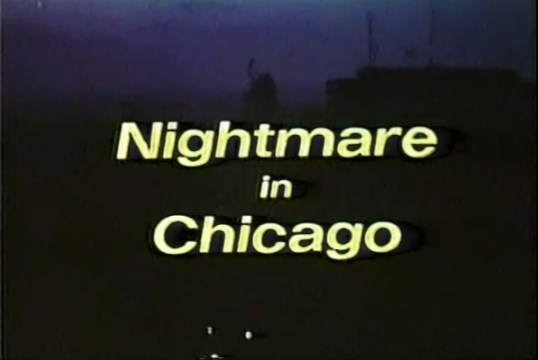
Taking place over the course of one very long day and night in December, this 1964 made-for-television movie opens with the discovery of a murdered woman in Indiana. She is the latest victim of a killer that the press has nicknamed “Georgie Porgie.”
Georgie Porgie, who has killed five blondes in the Midwest, is actually a nondescript man named Myron Ellis (Philip Abbott). Myron is middle-aged, short, and fairly normal-looking. That, along with the fact that he’s always moving, is one reason why he has yet to be captured. The only thing that really stands out about Myron is that, due to a medical condition, he is extremely sensitive to light and always wears dark glasses, even at night. When Myron isn’t murdering someone or stealing a car, he’s haunted by the voice of his dead sister.
Because he is a nomadic killer, the authorities in Chicago are worried that Myron is coming to their town next and it turns out that they’re correct. Myron is already in Chicago and he’s looking for his next victim. In a rather disturbing scene, he strangles a woman that he meets at a strip club, managing to do so without any of the many people around them even noticing. Myron wanders up and down the streets of Chicago, looking for his next victim. With his polite manners and his bland appearance, no one suspects that the polite man on the street corner is actually a murderer.
Police Commissioner Lombardo (Ted Knight) and Detectives McVea (Robert Ridgley) and Brockman (Charles McGraw) decide that the best way to catch the killer would be to set up a dragnet on the highway, stopping cars and shining flashlights at the drivers to see who has the weakest eyes. The only problem is that there is also a nuclear missile convoy scheduled to move through the city at the same time. With the highways congested and the killer not above wrecking his own car to throw the police off his trail, Lombardo tries to both capture the killer and make sure nothing happens to the convoy.
Nightmare In Chicago is a short and efficient thriller. It’s well-acted and rather serious in its approach. Especially when compared to more recent films with similar plots, Nightmare In Chicago deserves some credit for not trying to turn its serial killer into some sort of diabolical mad genius. Myron, like all serial killers in real life, is a maladjusted and rather stupid person who has only gotten away with his crimes due to pure luck. He’s not a Hannibal Lecter-style supergenius. Instead, he’s just a creep who has many, many issues. The film also does a good job of capturing the manic energy and eventual exhaustion of pulling an all-nighter. It’s an effective little film with a memorably sordid story.
For modern audiences, probably the most interesting thing about Nightmare in Chicago is that it was directed by Robert Altman and was, in fact, his second non-documentary film after The Delinquents. At the time he made this film, Altman was largely working in television. Nightmare In Chicago was one of the first made-for-TV movies and it was a ratings and critical success. Seen today, it’s easy to spot Altman’s trademark attention to detail in the film. While it’s far more straight-forward than the majority of his feature films, Nightmare in Chicago still displays the talent that eventually led to Robert Altman become one of Americas most important filmmakers.
 Through the Shattered Lens