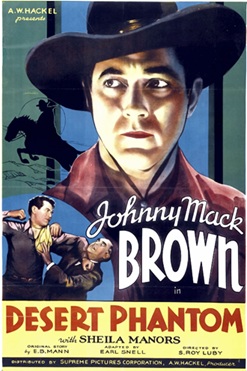
 In a frontier town, rancher Jean Halloran (Sheila Bromley) has a big problem. Someone is shooting and killing all of her ranch hands and sending her notes in which he tells her to give up her ranch and leave town. When an ammunition salesman and trick shooter named Billy Donavon (Johnny Mack Brown), Jean hires him to serve as a bodyguard and to track down the mysterious Phantom. Billy, however, has a secret of his own.
Desert Phantom is a remake of an old Harry Carey film. I don’t know why Poverty Row did remakes since all of their films pretty much had the same plot regardless. A stranger comes into town and gets involved with a female rancher and a bad guy who is trying to hide his actual identity. In this one, Nelson McDowell gets to supply the comic relief as a befuddled veterinarian while familiar faces like Ted Adams and Karl Hackett are there to keep us guessing about how the Phantom could actually be. If you’ve watched enough of these movies, though, you’ll always be able to guess who the bad guy is.
This isn’t the best of Johnny Mack Brown’s movies. The Phantom’s story seems like it could have been interesting but that would have meant taking more risks than most of the Poverty Row studios were willing to do. Johnny Mack Brown is as convincing a cowboy as always and is the film’s saving grace. Brown was a western star precisely because he could make even something like Desert Phantom watchable.
 Through the Shattered Lens