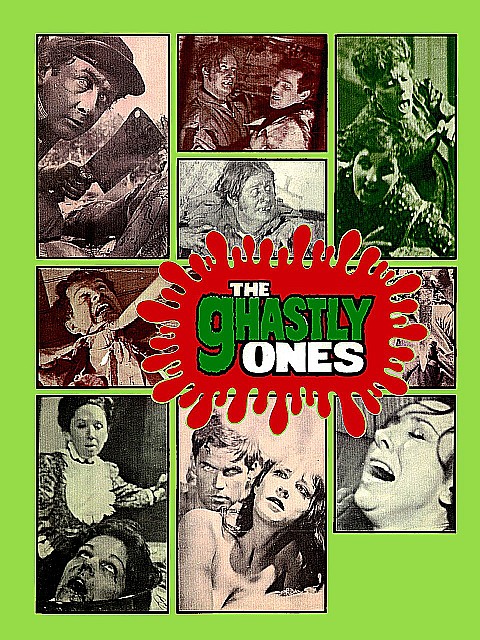
The TSL’s Horror Grindhouse: The Ghastly Ones (dir by Andy Milligan)


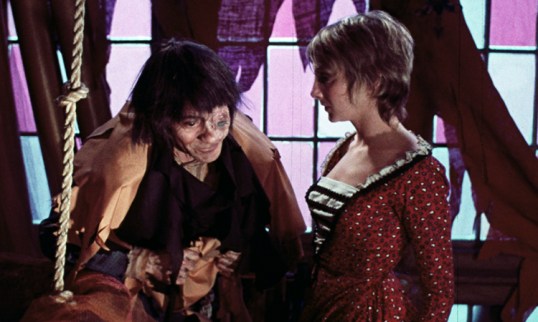
A young couple — both of whom are dressed in clothes that appear to come from the 1890s — enjoys a romantic and sunny excursion to an isolated island.  Unfortunately, their day is ruined when they’re discovered by a buck-toothed hunchback named Colin (played by Hal Borske).  Death and dismemberment follows.

Somewhere in New York, three sisters are informed that their father has died but that neither they nor their husbands can receive a cent of their inheritance until they fulfill one very specific requirement.  According to their father’s impossibly elderly attorney (played by Neil Flanagan, who is made up to look like an old witch from a community theater production of MacBeth), the sisters and their husbands must spend three nights in their father’s mansion.  Of course, the sisters agree.

Upon arriving at the mansion, they discover that the mansion is being looked after by two maids and a hunchbacked, buck-toothed handyman named …. COLIN!  Within a few minutes of meeting everyone, Colin eats a live rabbit while everyone watches.  Later the remains of the rabbit shows up in one of the sister’s bed, along with a note that reads, “Blessed are the meek for they shall inherit!”

Speaking for myself, I would probably leave as soon as I saw the handyman eating a live rabbit.  I mean, none of the sisters appear to be struggling financially but then again, greed is a powerful force.  Instead, everyone settles in for their three-night stay, which leads to 1968-style sex scenes and a lot of footage of people sitting around and talking about nothing.  For a low-budget grindhouse film, this is an extremely talky movie.

Anyway, eventually people start dying.  Someone gets pitchforked.  Another person is found hanging by his ankles.  There’s a rather bloody disembowelment and someone else loses their head.  Bloody X’es are left on doorways.  Who is doing the killing?  Hmmm …. well, Colin is the obvious suspect since we already saw him kill two people for absolutely no reason.  But, it turns out that Colin has a little help.  That’s right!  The Ghastly Ones comes with a twist ending that you’ll see from miles away.

So, what exactly is The Ghastly Ones?  It’s an extremely low-budget film, full of unlikable people dying in various grotesque ways.  It’s an oddly moralistic film, with everyone dying because their greed prevents them from doing the sensible thing and leaving the house.  It’s also apparently a period piece, with everyone dressed like they belong in the 1890s even though you can clearly hear the sound of cars in the background of a few scenes.

In short, this is another Andy Milligan film!  Filmed on Staten Island and featuring a largely amateur cast (though one of the husbands is played by Richard Romanus, who went on to appear in Martin Scorsese’s Mean Streets and has since had a respectable career as a character actor), The Ghastly Ones is just as bad and weirdly hypnotic as you would expect any Andy Milligan film to be.  Milligan even makes a cameo of sorts in the film.  Listen closely and you can occasionally hear him off-camera, feeding the actors their lines and, at one point, telling one of the sisters to “roll over.”

It’s a terrible movie and yet, it’s also strangely fascinating.  I think that’s because Milligan’s ineptness was matched only by his anger and that anger (along with a lot of pressimism) courses through the entire film.  Every frame of the film drips with Milligan’s sincere disdain for the greedy and selfish characters who appear throughout the movie and, as you watch, it becomes obvious that Milligan had more sympathy for Colin than for any of his victims.  (Of course, two of Colin’s victims were just two innocent people in love who were trying to have a nice picnic so perhaps it’s for the best not to dwell too much on what that might mean.)  Milligan directs this story with an intensity that doesn’t quite make up for the lack of talent involved but, at the very least, it does keep things vaguely interesting.  “Who are the Ghastly Ones?”  Andy Milligan seems to be asking.  “We all are.”

By the way, between this and Guru, The Mad Monk, I have now watched two Andy Milligan films in one week.  Pray for me.

The TSL’s Horror Grindhouse: Guru, The Mad Monk (dir by Andy Milligan)


The 1970 film Guru, the Mad Monk opens with a woman being dragged, by two men, down a New York sidewalk.  In the background, you can clearly hear the sounds of Manhattan morning traffic as people head to work or school, presumably barely noticing that a movie is being made one block over.

Now, normally, that might not be a problem.  In fact, it’s the kind of things that you tend to expect from an independent film made in the early 70s.  Cinema verite was all the rage back then and many films from that period would incorporate documentary techniques, shooting on location and making use of actual bystanders and the sound of actual traffic.  However, Guru, the Mad Monk is supposed to be taking place on the isolated (and fictional) prison island of Mortavia.  Even more importantly, it’s supposed to be taking place in 1480.  Now, obviously, all historical films require a certain suspension of disbelief.  I mean, we know that no cinematic version of the 15th Century is going to be a 100% accurate and we really should be happy about that because the the 1400s were a pretty disgusting time to be alive.  I mean, we don’t need to see people tossing a chamber pot out of their bedroom window in order to accept that a film is taking place in a certain time period.  However, what we do need is for there not to be two scenes that feature the sounds of cars driving by the film’s set.  One half expects some random person to wander into the shot and hail a taxi.

Guru, the Mad Monk was directed by Andy Milligan, who is a legendary name as far as grindhouse filmmaking is concerned.  Milligan was an off-off broadway playwright-turned-exploitation filmmaker who didn’t let a lack of money and/or discernible talent prevent him from directing an estimated 29 films.  Milligan’s films are distinguished by angry (if usually incoherent) storylines, flamboyant performances from a stock company made up of local Staten Island actors, cheap gore effects, and poor sound quality.  One reason why you especially notice the sound quality is because a typical Milligan film is surprisingly talky.  It makes sense when you consider that Milligan developed his artistic vision while working in theater but, as a director, Milligan never seemed to figure out how to break free from the inherent stageyness of his scripts.

And yet, there’s also an odd and, at times, rather dream-like intensity to most of Milligan’s films.  Some of that is undoubtedly due to the fact that a typical Milligan film lacks any sort of intentional humor.  For instance, Guru features a supporting character named, believe it or not, Igor.  And yes, Igor (played by Jack Spencer)) is a hunchback.  And typically, you would think any filmmaker including a hunchback named Igor in a horror film made after 1940 would have to be having a little bit of fun with the cliches of the genre.  But no, Guru, The Mad Monk was obviously meant to be a very serious film and very much a reflection of the negative worldview that seemed to permeate all of Milligan’s films.  Guru, The Mad Monk is a dark film where almost everyone is corrupt and guilty of something and, watching the film, you get the feeling that its darkness is coming straight for Milligan’s heart.

Notice the white scooter in the background as these 15 century clergymen hold a meeting in Guru, The Mad Monk.

As for what the film’s about …. well, that’s hard to say.  The plot is rather difficult to follow.  Father Guru (played, in flamboyantly evil style, by Neil Flanagan) is the governor of the prison island of Mortavia.  (St. Peter’s, an Episcopal Church in Manhattan, stands in for the prison.)  Guru is usually quick to execute his prisoners so that his mistress, Lady Olga (Jacqueline Webb), can drink their blood.  It’s hard to say whether Lady Olga is supposed to be a real vampire or not.  When we first meet her, she just comes across as being a Lady Bathory-type but then there’s another scene where she appear to be wearing fake fangs and declares herself to be the “Soul of Darkness” so who knows for sure?

In between all of the eye gougings and beheadings that one would typically expect to find in a Milligan film, there’s also a love story as jailer Carl (Paul Lieber) falls in love with the latest prisoner, Nadja (Susan Israel).  Nadja is due to be executed but Guru agrees to spare her life if Carl will dig up some bodies and sell them to a nearby university.  Carl agrees but it soon turns out that he made a mistake trusting Father Guru.  It all leads to the expected bloodbath, along with Guru raving about the joys of living a life where “I preach one thing but continue to believe another!”

Clocking in at just 57 minutes, it’s a weird film.  Typically, I tend to defend films like this because, regardless of their flaws, they at least represent the director’s unique vision of the world.  That’s always been my defense when it’s come to Ed Wood, for instance.  But, when it comes to Milligan …. eh.  I mean, from a historical perspective, anyone who is interested in classic grindhouse and independent filmmaking has to see at least one Andy Milligan film.  And it can be said that you’ll never mistake an Andy Milligan film for anyone else’s.  But, at the same time, I have to admit that watching Guru was the longest 57 minutes of my life.

So, no …. unless you’re on some sort of Andy Milligan kick, I don’t really recommend Guru, The Mad Monk.

Sorry, Igor.