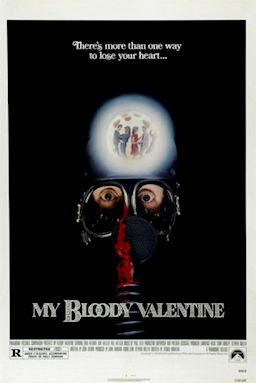
Horror Film Review: My Bloody Valentine (dir by George Mihalka)


Poor Mabel.

In the 1981 slasher film, My Bloody Valentine, Mabel (played by Patricia Hamilton) is the sweet old woman who has convinced the mayor of Valentine Bluffs to reinstate the annual Valentine’s Day dance.  The dance had been a tradition, up until the great mine explosion of 1960.  Harry Warden was the only miner to survive the explosion, which everyone agreed wouldn’t have happened if the two mine supervisors hadn’t left their post to attend the dance.  (Why two middle-aged men were so eager to attend a teenage dance party is a question that is never really explored.)  Harry went mad in the mine and resorted to eating the other miners to survive.  AGCK!  The next year, Harry killed the two supervisors and was promptly sent off to mental asylum.  Meanwhile, the annual dance was canceled because I guess it was easier to blame the dance than the mining company or the corrupt union bosses.

Mabel, however, has brought the dance back and it’s probably not a minute too soon because the town of Valentine Bluffs is one of the most depressing towns I’ve ever seen.  The sky is permanenlyt overcast.  Everyone spends all day down in the mine, getting covered in soot and trying not to die.  At night, they go to the bar and get drunk and argue with each other.  If the men need to talk about their feelings, they have a drink at the local junkyard.  Among the slashers films that came out in the early 80s, My Bloody Valentine is unique for taking place in an authentically blue collar milieu.  These aren’t upper class teenagers who are about to be targeted by a demented killer.  These are tough men who work hard all day and who are apparently really into Valentine’s Day dances.

Unfortunately, we all know that it’s impossible to move on from a decades-old murder.  No sooner has the Valentine’s Day Dance been announced than some old drunk starts telling everyone that they’re doomed.  People start to get strange and bloody packages in the mail.  A man dressed up like a miner kills Mabel and stuffs her into a washing machine, which seems like an overreaction on the part of The Miner.  It does, however, make one thing very clear.  If even sweet old Mabel can die, then anyone can die.

After Mabel’s death, the mayor and the sheriff announce that the dance is off but those miners are really into Valentine’s Day so they decide to throw a party anyway.  A few of them go down into the mine, which is not necessarily what I would want to do at a party but whatever.  I just don’t like soot.  Unfortunately, our brave heroes go down into the mine at the same time that the Miner shows up at the party and starts killing people.

The assumption, of course, is that the Miner is Harry Warden but most member of the audiences will have seen enough slasher movies to know better.  There’s two obvious suspects.  There’s Axel (Neil Affleck), who has a temper and knows how to use a pickax.  And then there’s TJ (Paul Kelman), who also has a temper and knows how to use a pickax.  Axel and TJ are both in love with Sarah (Lori Hallier) but only one will get to ask her to be his “bloody valentine.”

Among horror fans, My Bloody Valentine is notorious for having been heavily edited to get an R-rating.  Supposedly, cuts were made to every single death scene and, even with the cuts, this is still a notably gruesome film.  The scene involving the showerhead impalement is especially macabre, even if it has obviously been edited.  The Miner is not one of those talkative, quippy, fun-loving murderers that eventually became a staple of the genre.  Instead, he’s notably cruel.  The murders he commits feel personal and calculated.  He’s not one of those movie slashers who just kills anyone unlucky enough to discover Camp Crystal Lake.  Instead, he has a plan.  In the end, the Miner is one of the more frightening of the killers to come out of the early 80s slasher boom.

My Bloody Valentine works far better than it has any right to.  The mine is a notably creepy location and the film does a good job of creating an atmosphere where you really do believe that anyone could die at any minute.  The film plays out like a nightmarish urban legend come to life and it provides an example of the giallo-inspired thrillers that slasher films used to be.  Despite being a Valentine’s Day film, it’s one that your really should watch for Halloween.

When you’re watching either this film or the 2009 remake, be sure to offer up a prayer to Mabel.  With her love of Valentine’s Day, she made it all possible.
Neon Dream #9: Air – Alone in Kyoto


Sofia Coppola’s Lost in Translation left a strange impression on me. In a way I can only really compare to Casablanca, it burrowed into my memory like an actual personal experience. I don’t review movies, and I am ill equipped to explain what made it such a special film for me, but the bond that Bob Harris (Bill Murray) and Charlotte (Scarlett Johansson) forge over a few days in Tokyo is something I’ll always carry with me and look back on fondly. That’s pretty weird, but I’m not complaining.

Music was essential to Lost in Translation, embedded into scenes as a part of what Bob and Charlotte actually experience. The hotel lounge has a live jazz band. “The State We’re In” by The Chemical Brothers plays in the club they visit. Phoenix’s “Too Young” pumps over the stereo when they go to a friend’s apartment. A woman dances to Peaches’ “Fuck the Pain Away” at the strip club. The actors aren’t just seen singing karaoke; they perform it at length. Coppola was pretty clever about extending this integration to the more traditionally situated background music. Happy End’s “Kaze wo Atsumete” enhances the feeling that Bob and Charlotte are winding down from an exhausting night, but it drifts faintly into the hallway, as if playing from the karaoke room. Charlotte is wearing headphones when we first hear Air’s “Alone in Kyoto”. The Jesus and Mary Chain’s “Just Like Honey” kicks off as Bob enters his cab. The encore of “Kaze wo Atsumete” in the credits could easily be playing in Bob’s head. Almost every song in the movie functions within the environment, not just as a peripheral enhancement.

Garden State tried something like this a year later, though I don’t recall the extent of it beyond the awkward Shins sequence. The effect was a sort of garish, in-your-face endorsement of director Zach Braff’s favorite tunes. It didn’t really cut it for me, in spite of the soundtrack’s impressive cast. In Lost in Translation, Coppola was a lot more attentive to creating continuity between songs and bringing musicians on board with the film’s atmosphere. She didn’t stop at using “Sometimes” by My Bloody Valentine; she dug founder Kevin Shields out of relative obscurity to compose four original pieces. A lot of the other artists formed a pre-existing community of sorts, suited to engage the project as art rather than a quick paycheck. Soundtrack supervisor Brian Reitzell performed drums for Air on their 2001 album 10 000 Hz Legend. Both Air and Roger Joseph Manning Jr, a fellow studio musician on that album, contribute original music to Lost in Translation. Phoenix previously performed with Air, and Sofia Coppola ultimately married their singer. While their contribution was recycled (“Too Young” appears in the context of young adults who would have been familiar with obscure but up and coming artists; using Phoenix’s first single made sense), the band was still involved in Coppola’s social sphere of musicians.

“Alone in Kyoto” plays as Charlotte travels through the classic side of Japan, visiting shrines and observing ancient customs. While that could possibly put it at odds with my theme, Air’s approach keeps the feeling modern, casting tradition as a subtle, delicate element of the present rather than as a form of escapism. It also occurs in a sequence without character interaction, permitting a pure sense of exploration. Within Lost in Translation‘s soundtrack, “Alone in Kyoto” reaches closest to that Japanese dream that still permeated a lot of American subcultures in 2003. The movie itself brought many of us the closest we would ever come to actually living that dream.

6 Trailers for Valentine’s Day Weekend


Happy St. Valentine's Day

I’m running a little bit late on getting this Valentine’s weekend edition of Lisa Marie’s Favorite Grindhouse and Exploitation Trailers up and running and for that, I apologize.  Last night, around midnight, I found myself at Target waiting for them to start selling the latest Twilight movie…well, let’s just not go into it, okay?  Instead, here’s 6 trailers for your Valentine’s weekend.

1) Valentine (2001)

Oh.  My.  God.  This is such a bad movie!  Seriously terrible.  However, it is Valentine’s Day weekend…

2) My Bloody Valentine (1981)

The original. 

3) My Bloody Valentine 3D (2009)

The remake, which is a lot better than Avatar.

4) Emmanuelle (1974)

Valentine’s weekend is all about either celebrating romance or being alone and bitter.  I’ve been told that Emmanuelle can be used for both of those purposes.  “This movie will be shown only in special theaters.”

5) Emanuelle and the Last Cannibals (1977)

Not surprisingly, Italian director Joe D’Amato put his own individual spin on Emmanuelle (or Emanuelle as he spelled it, in order to get around copyright laws).  This is probably one of the more explicit trailers I’ve ever posted so keep that in mind before you watch it. 

6) Superfly (1972)

This trailer isn’t connected to Valentine’s Day at all but it’s got a lot of style.

Finally, let me just say, regardless of whether you’re in love, in lust, or mired in lonely bitterness, Happy Valentine’s Day!

Happy Valentine's Day!