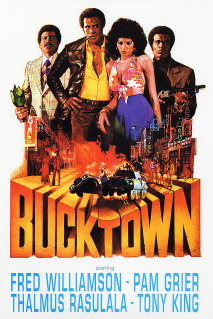
The TSL’s Grindhouse: Bucktown (dir by Arthur Marks)


Welcome to the town of Buchanan!

It’s a small Southern town, popularly known as Bucktown.  It’s a town where you can literally get anything, as long as you know who to pay off.  Upon arriving, don’t be surprised if a little kid approaches you and asks you what you’re looking for.  He can get it for you.  That kid had connections!

The population of Buchanan is almost entirely African-American but all of the cops are white.  Under the leadership of the redneck police chief (Art Lund), the cops have turned Buchanan into their own private kingdom.  If you want to do anything in Buchanan, you have to be ready to pay the cops for protection.  Refuse and you’ll get arrested.  Continue to refuse and you’ll probably end up getting shot.

Obviously, someone needs to clean up Buchanan?  But who!?

How about Duke Johnson (Fred Williamson)?  Duke’s brother owned the hottest nightclub in Bucktown, Club Alabama.  Or, at least he did until he announced he wasn’t going to pay anymore protection and he ended up getting gunned down by the cops.  When Duke arrives in town, he thinks that he’s just going to stay long enough to attend the funeral and sell his brother’s bar.  However, when Duke find out that he has to wait 60 days until he can sell the bar, he decides to stick around.  Not only does he move in with his brother’s former lover, Aretha (Pam Grier), but also reopens the Club Alabama.

Soon, the cops are coming around and demanding their share.  However, they quickly discover that no one tells Duke Johnson what to do.  Like all good action heroes, Duke has friends all over the country.  He places a call to Roy (Thalmus Rasulala) and soon, Roy, TJ (Tony King), and Hambone (Carl Weathers) show up in Bucktown.  They quickly wipe out the corrupt police force.  The local citizens are so happy that they make Roy the new police chief and his men the new police force.

Unfortunately, that turns out to be a mistake.  Apparently, giving some totally random dude complete and total authority to enforce the law in whatever he sees fit isn’t always the best way to handle things.  Roy and his men quickly become just as corrupt as the old redneck policemen.  The only thing protecting Duke is his friendship with Roy but even that is endangered when T.J. decides that he wants Aretha for himself.  T.J. decides to turn Roy and Duke against each other.  It all eventually leads to an epic fist fight, with the winner earning the right to remain in Bucktown…

(Of course, you may be wondering why anyone would want to remain in Bucktown as the place is kind of a dump, regardless of who’s in charge.)

Released in 1975, Bucktown is a pretty basic action film but I liked it because it appealed to all of my anti-authoritarian impulses.  There have been so many movies about what it takes to clean up a town but there haven’t been many made about what actually happens after all of the corrupt cops and greedy businessmen have been kicked out.  Thalmus Rusulala was great as the charismatic but dangerous Roy and Tony King, a favorite of Italian exploitation fans everywhere, was an effective villain.  Pam Grier doesn’t get to do much but she does the best with what she’s provided.  Of course, the entire film is dominated by Fred Williamson, who may not have been a great actor but who had an undeniable screen presence.  Williamson struts through the film like the hero of stylish Spaghetti western.

Bucktown is an entertaining 70s action film.  Though it doesn’t deeply explore any of the issues that it raises, it still deserves some credit for raising them.  If nothing else, it’s a film that shows why Fred Williamson retains a cult following to this day.
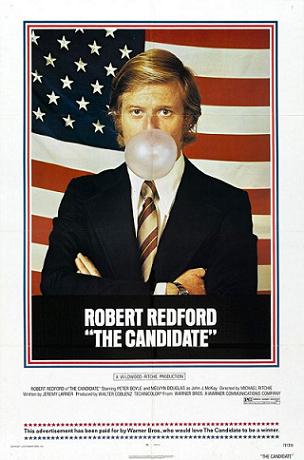
Shattered Politics #30: The Candidate (dir by Michael Ritchie)


Candidateposter

“What do we do now?” — Democratic senate candidate Bill McKay (Robert Redford) in The Candidate (1972)

When I reviewed Advise & Consent, I mentioned that if anyone could prevent billionaire Tom Steyer from winning the Democratic nomination to run in the 2016 California U.S. Senate election, it would be Betty White.  Well, earlier today, Tom Steyer announced that he would NOT be a candidate.  You can guess what that means.  Betty White has obviously already started to set up her campaign organization in California and, realizing that there was no way that he could possibly beat her, Tom Steyer obviously decided to step aside.

So, congratulations to Betty White!  (I would probably never vote for her but I don’t live in California so it doesn’t matter.)  As future U.S. Senator Betty White prepares for the next phase of her career, it would probably be a good idea for her to watch a few movies about what it takes to win political office in the United States.

For example: 1972’s The Candidate.

The Candidate would especially be a good pick for the nascent Betty White senate campaign because the film is actually about a senate election in California!  California’s  U.S. Sen. Crocker Jarmon (Don Porter) is a Republican who everyone assumes cannot be defeated for reelection.  Democratic strategist Marvin Lucas (a heavily bearded Peter Boyle) is tasked with finding a sacrificial candidate.

The one that Marvin comes up with is Bill McKay (Robert Redford, before his face got all leathery), a 34 year-old lawyer who also happens to be the estranged son of former Governor John J. McKay (Melvyn Douglas, whose wife Helen ran for one of California’s senate seats in 1950).  As opposed to his pragmatic and ruthless father, Bill is idealistic and the only reason that he agrees to run for the Senate is because Marvin promises him that he’ll be able to say whatever he wants.  Marvin assures Bill that Jarmon cannot be beaten but if Bill runs a credible campaign, he’ll be able to run for another office in the future.

However, Jarmon turns out to be a weaker candidate than everyone assumed.  As the charismatic Bill starts to close the gap between himself and Jarmon, he also starts to lose control of his campaign.  He soon finds himself moderating his positions and worrying more about alienating potential voters than stating his true opinions.  (In one of the film’s best scenes, Bill scornfully mutters his standard and generic campaign speech to himself, obviously disgusted with the vapid words that he has to utter in order to be elected.)  The film ends on a properly downbeat note, one that reminds you that the film was made in the 70s but also remains just as relevant and thought-provoking in 2015.

Written by a former political speech writer and directed, in a semi-documentary style, by Michael Ritchie, The Candidate is an excellent film that answer the question as to why all political campaigns and politicians seem to be the same.  The Candidate is full of small details that give the film an air of authenticity even when a familiar face like Robert Redford is on screen.

Whenever I watch The Candidate, I find myself wondering what happened to Bill McKay after the film’s iconic final scene.  Did he ever regain his idealism or did he continue on the path to just becoming another politician.  As much as we’d all like to think that the former is true, it’s actually probably the latter.

That just seems to be the way that things go.

Hopefully, Betty White will learn from Bill McKay’s example.

http://www.youtube.com/watch?v=thSY0g22j8Y