Love On The Shattered Lens: Charming Sinners (dir by Robert Milton and Dorothy Arzner)


Based on a play by Somerset Maugham, 1929’s Charming Sinners takes place amongst the very rich.

Kathryn Miles (Ruth Chatterton) is married to Robert Miles (Clive Brook).  Robert is wealthy and a respected businessman and, through her marriage, Kathryn is also wealthy and …. well, she’s not quite respected.  The fact of the matter is that everyone is gossiping about the fact that Robert is cheating on Kathryn.  Kathryn denies that Robert is being unfaithful but she knows that he is.  She also knows that Robert is cheating with her best friend, Anne-Marie Whitley (Mary Nolan).  Even when Anne-Marie’s husband, George (Montagu Love), comes to suspect that Anne-Marie is cheating with Robert, Kathryn tells George that it isn’t true and defends her cad of a husband.

Why is Kathryn doing this?  As Kathryn explains it, she doesn’t feel that marriage necessarily means that you have to love someone.  Kathryn married Robert for the money and the status and, as long as she has that, she’s willing to overlook Robert’s dalliances.  Admitting that Robert is cheating would obligate her to go through a divorce and potentially lose everything that she has.  If this film had been released just a few years later than it was, the Production Code would have insisted that Kathryn suffer for her less-than-reverent attitude towards the institution of marriage.  Since this is a pre-code film, Kathryn is portrayed as being strong and determined.  What the Production Code would have deemed a drama, the pre-code era considered to be a comedy.

Still, Kathryn does get revenge on her husband by openly flirting with a former lover, Karl Kraley (William Powell, handsome and suave as ever).  Kathryn also makes some money on her own, proving to her husband that she could be a success even if she hadn’t married him.  Kathryn informs Robert that she is going to be living her own life, even if they are married.  And if Kathryn wants to take a lover, that’s her decision.

And good for Kathryn!  Seriously, Robert is so smug and sure of himself that it’s deeply satisfying to watch as Kathryn reveals that Robert was never as clever as he thought it was.  Though the film does not end with the dramatic divorce that some might expect, it does end with Kathryn taking control of her own life and making her own decisions about how she’s going to live it.  That type of ending is rare enough today.  One can only imagine how audiences in 1929 reacted to it.

But is the film itself any good, you may be asking.  It’s an early sound picture and while the cast all proves their ability to handle dialogue, the largely stationary camera often makes the film feel like a filmed play (which is largely what it was).  Like many pre-code films, the emphasis here is on how the rich have better clothes and better homes than the majority of the people watching the movie.  That’s not a problem for me.  I like looking at nice clothes and wonderfully decorated houses.  Some others may dismiss this film as just being about the problems of the rich but my personal opinion is that everyone has problems.  Wouldn’t you rather have problems as a wealthy person than a poor one?  The most important thing is that the film features two of the best actors of Hollywood’s early Golden Age, Ruth Chatteron and William Powell, and they both give excellent and charming performances.

Charming Sinners is a bit of time capsule and probably not for everyone.  If you’re not interested in the film’s era, it probably won’t hold your attention.  But, to a fashionable history nerd like me, Charming Sinners definitely had its charms.
Lisa Reviews An Oscar Winner: The Life of Emile Zola (dir by William Dieterle)


The Life of Emile Zola, the winner of the 1936 Oscar for Best Picture of the Year, opens with two French artists living in a drafty apartment.

Emile Zola (Paul Muni) is destined to become one of France’s most popular and important writers.  Paul Cezanne (Vladimir Sokoloff) will eventually become one of the most important artists of the post-impressionist movement.  But for now, they’re just two struggling artists who have sworn that they will never sell out their principles.  They are poor but they’re happy.  That changes for Zola after he meets a prostitute named Nana (Erin O’Brien-Moore) and he uses her life story as the inspiration for a novel.  The book is controversial and its frank content scandalizes France.  The public censor comes close to banning it.  But it also becomes a best seller.  It’s the book everyone secretly owns but claims to have never read.

Zola writes several more books, all about the conditions of the working class in France.  Eventually, he becomes what he claimed he would never be, a wealthy man living in a mansion and having little contact with the poor and oppressed.  Cezanne sees Zola one last time, calling him out for having sold his talent for money.  Cezanne explains that, on general principle, he can no longer be Zola’s friend.

Meanwhile, a quiet and rather meek family man named Captain Alfred Dreyfus (Joseph Schildkraut) has been arrested and accused of being a spy for Germany.  There’s little evidence that Dreyfus is a spy.  Indeed, most of the evidence seems to point to a Major Walsin-Esterhazy (Robert Barrat).  But, because Dreyfus is considered to be an outsider, he is convicted in a show trial and exiled to Devil’s Island.

(In real life, it’s generally agreed that Dreyfus was a victim of anti-Semitism.  As the only Jewish member of the army’s General Staff, Dreyfus was viewed with suspicion by his colleagues even before anyone knew that there was a German spy.  The Life of Emile Zola doesn’t specifically state that Dreyfus was a victim of anti-Semitism, with the exception of a brief moment when one of his accusers looks at his personnel file and says, “He’s not one of us,” while pointing at the word “Jew.”  Otherwise, the fact that Dreyfuss was Jewish is never mentioned in the film.  It’s as if the film is going out of its way to avoid offending the very people that the movie is criticizing.)

After speaking to Dreyfus’s wife (played by Gale Sondergaard, who would later become the victim of a show trial herself when she was blacklisted as a suspected communist), Zola decides to take up Dreyfus’s case.  He publishes an open letter — J’Accuse — in which he states that Dreyfus was not given a fair trial and that Dreyfus is innocent of the charges against him.  Zola finds himself in court, accused of libel.  Zola uses his trial to give Dreyfus the hearing that he never received.  While the army boos his every utterance, the people of France rally to his side.

The Life of Emile Zola is an early example of the type of prestige production that today is often referred to as being an “Oscar picture.”  It tells a true story.  As a film that condemns the treatment of Alfred Dreyfus but avoids stating the obvious reason why Dreyfus was targeted in the first place, it’s political without being radical.  And it features a performance from the most acclaimed actor of the era, Paul Muni.  Muni gives a powerful performance as Zola, holding the viewer’s attention even during the lengthy trial scenes that take up most the second half of the film.  That said, the true star of the film is Joseph Schildkraut, who plays Dreyfus as being a kind and trusting soul who finds himself caught up in a Kafkaesque nightmare.  At one point, Dreyfus is given a gun and told that there’s one way that he can avoid being put on trial for treason.  Schildkraut played the scene so well that I wanted to cheer when he refused to surrender.

The Life of Emile Zola is a big and, at times, self-consciously important production.  It was clearly designed to win a bunch of Oscars and it certainly managed to do that.  Compared to some of the other films nominated that year — The Awful Truth, Dead End, A Star is Born, Lost Horizon, Stage Door, In Old Chicago — The Life of Emile Zola can seem a bit stodgy.  However,  the performances of Muni and Schildkraut continue to make the film worth watching.

Cleaning Out The DVR, Again #37: All This And Heaven Too (dir by Anatole Litvak)


(Lisa is currently in the process of trying to clean out her DVR by watching and reviewing all 40 of the movies that she recorded from the start of March to the end of June.  She’s trying to get it all done by the end of July 11th!  Will she make it!?  Keep visiting the site to find out!)

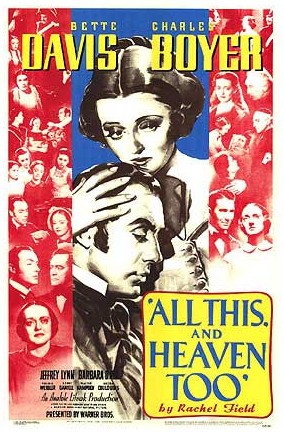
All_this_heaven_movieposter

The 37th film on my DVR was the 1940 film, All This, And Heaven Too.  It originally aired on June 21st on TCM.

All This, and Heaven Too is one of the many melodramatic historical romances in which Bette Davis appeared in the late 30s and early 40s.  These films usually featured Bette as a strong-willed woman who was often condemned for not conforming to the rules of society.  Typically, she would end up falling in love with a man who society said she could not have.  Bette almost always seemed to end up alone, which I guess was the way women who thought for themselves were punished back then.

In this one, Bette plays Henriette Deluzy, a French woman who ends up in America in the 1850s.  When she shows up to start teaching at a private, all-girls school, her students immediately start gossiping about her.  It seems that Henriette was at the center of some sort of European scandal and everyone is speculating about what happened.  Finally, at the start of class, Henriette tells her students that she’s going to tell them the true story of what happened back in France.

It turns out that Henriette was a governess.  She took care of the four children of the Duc de Praslin (Charles Boyer) and his wife, the Duchesse (Barbara O’Neil).  The Duchesse was mentally unstable and soon came to suspect that her husband had fallen in love with Henriette.  Though she may have been insane, it turned out that the Duchesse was correct.  When the Duchesse fired Henriette and then lied to her husband about it, the Duc flew into a rage and murdered his wife.

Under the laws of the time, the Duc could only be judged by his fellow noblemen.  He was told that if he simply confessed and said that Henriette was the one who drove him to commit the murder, he would be set free.  (As opposed to the characters that Bette Davis played in The Letter and The Little Foxes, Henriette was totally innocent.)  Would the Duc confess and allow Henriette to be blamed or would he deny his love for her and sacrifice his life as a result?

All This, And Heaven Too is a rather slow movie and it’s hard not to be disappointed that Henriette is such a boring character.  She’s so innocent and victimized that the role almost seems like a waste of Bette Davis’s talents.  A big production that featured lavish (though black-and-white) recreations of 19th Century France, All This, And Heaven Too was probably a big deal for contemporary audiences and, if you’re a Bette Davis or Charles Boyer completist, you might enjoy it.  But otherwise, it’s really nothing special.

All This, And Heaven Too was among the 10 films nominated for Best Picture of 1940.  However, it lost to Rebecca.

Cleaning Out The DVR #23: The Adventures of Robin Hood (dir by Michael Curtiz)


(For those following at home, Lisa is attempting to clean out her DVR by watching and reviewing 38 films by this Friday.  Will she make it?  Keep following the site to find out!)

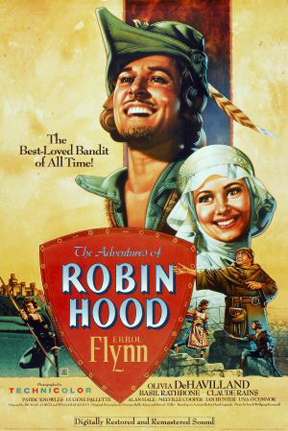
Robin_hood_movieposter

Flamboyant.  Athletic.  Joyous.  Determined.  Handsome.  Outspoken.  Bigger than life.  Revolutionary.  Anarchist.  Sexy.  Libertarian.  Is there any doubt why Errol Flynn remains the definitive Robin Hood?

And. for that matter, is there any doubt why the 1938 film The Adventures of Robin Hood remains not only the definitive Robin Hood film but also one of the most influential action films in history?

The Adventures of Robin Hood tells the story that we’re all familiar with.  The King of England, Richard The Lionhearted (Ian Hunter), is captured while returning from the Crusades.  His brother, King John (Claude Rains, in full autocratic villain mode), usurps the throne while Richard is gone and immediately raises taxes.  He claims that he’s only doing this to raise the money to set Richard free.  Of course, the real reason is that John is a greedy tyrant.

The only nobleman with the courage to openly oppose John is Sir Robin of Locksely (Errol Flynn).  Sir Robin protects his fellow citizens from John’s main henchman, Sir Guy of Gisbourne (Basil Rathbone, also in full autocratic villain mode).  In fact, Robin is so brave that, on multiple occasions, he even enters Sir Guy’s castle so that he can specifically tell King John and Sir Guy that he has no use for their laws.  This, of course, always leads to Robin having to make a dramatic escape while arrows flies and swords are unsheathed all around.

And through it all, Robin Hood keeps smiling and laughing.  He’s a wonderfully cheerful revolutionary.  He may be fighting a war against a ruthless and unstoppable enemy and he may be the most wanted man in England but Robin is determined to have fun.  One need only compare Robin to his humorless foes to see the difference between freedom and bureaucracy.

(We could use Errol Flynn’s Robin Hood today, though I suspect our government would just blow him up with a drone and then issue a statement about how, by stealing money from the rich and giving it to the poor, Robin was keeping the government from being able to rebuild bridges and repair roads.)

When Robin isn’t exposing the foolishness of organized government, he’s hanging out in Sherwood Forest.  He’s recruiting valuable allies like Friar Tuck (Eugene Pallette) and Little John (Alan Hale, Sr.)  He’s playing constant pranks and promoting revolution and, to his credit, he’s a lot more fun to listen to than that guy from V For Vendetta.  He’s also romancing Maid Marian (Olivia de Havilland) and good for him.  Two beautiful people deserve to be together.

Even better, he’s doing it in glorious Technicolor!  There’s a lot of great things about The Adventures of Robin Hood.  The action scenes are exciting.  The music is thrilling.  The film is perfectly cast.  Errol Flynn may not have been a great actor but he was a great Robin Hood.  But what I really love about the film is just the look of it.  We tend to take color for granted so it’s interesting to watch a film like The Adventures of Robin Hood, one that was made at a time when color film was something of a novelty.  For those of us who spend a lot of time talking about how much we love old school black-and-white, The Adventures of Robin Hood is a film that says, “Hey, color can be great too!”

But what I mostly love about The Adventures of Robin Hood is just the pure joy of the film.  Just compare this Robin Hood to the grimly tedious version played by Russell Crowe.

(True, nobody in The Adventures of Robin Hood shouts, “I declare him to be …. AN OUTLAAAAAAAAAAAAWWWWWWWW!”  Actually, now that I think about it, Ridley Scott’s Robin Hood would have worked much better if Oscar Isaac and Russell Crowe had switched roles.)

The Adventures of Robin Hood was nominated for best picture and it probably should have won.  However, the Oscar went to Frank Capra’s You Can’t Take It With You.