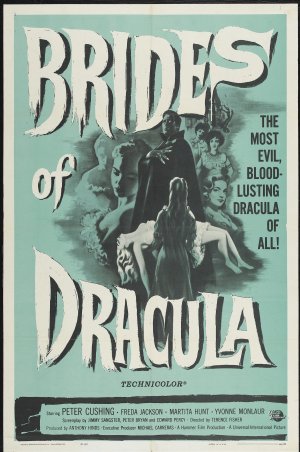
 So, imagine this. Two years have passed since your film company released a low-budget film called Horror of Dracula. To the surprise of many, the film became an international hit that not only revived interest in the character of Dracula but also made a star out of an imposing and opinionated actor named Christopher Lee. Naturally, being a smart film mogul, you want to make a sequel to Horror of Dracula. Both director Terrence Fisher and screenwriter Jimmy Sangster have agreed to return to make a second part of the franchise. Now, all you have to do is recruit your star…
…and Christopher Lee doesn’t want to do the film!
There are conflicting reports on just how much Christopher Lee disliked the Hammer Dracula films. Lee, himself, has been inconsistent on the subject, occasionally claiming that he hated all of them and then other times saying that he only disliked the sequels. One thing that does remain consistent is that Lee reportedly feared being typecast as Dracula and, as a result, he initially declined to be a part of any sequel.
Nowadays, they’d probably just recast the role with Nicolas Cage. But this was the late 50s/early 60s and, instead of recasting, Hammer just made a Dracula film without Dracula. Yes, the film may have been called The Brides of Dracula but, beyond being mentioned in the film’s prologue, Dracula never makes an appearance. For that matter, there really aren’t any brides of Dracula either. There are three female vampires but none of them are turned into vampires by Dracula. Instead, the vampire in question is Baron Meinster (David Peel, who does a pretty good job in the role but who, needless to say, is no Christopher Lee).
Dracula does not return for The Brides of Dracula but his nemesis Prof. Van Helsing (Peter Cushing) does. Cushing was so well-cast as Van Helsing and brought such a sense of righteous fury to the role that his presence goes a long way towards making up for the absence of Christopher Lee. When you look at and listen to Cushing’s Van Helsing, you’re left with little doubt that this is a man who has dedicated his life to destroying vampires and that he’s quite good at it.
And it’s a good thing that Van Helsing shows up because, regardless of whether Dracula is directly involved or not, Transylvania has some issues. The Brides of Dracula opens with a French school teacher named Marianne (Yvonne Monlaur) finding herself stranded at an old castle. The owner of the castle — Baroness Meinster (Martita Hunt) — allows Marianne to spend the night but asks her to please refrain from releasing her son, Baron Meinster, from the chains that hold him prisoner. Naturally, Marianne does exactly the opposite. She steals a key and sets the Baron free.
Of course, the Baron is a vampire and soon he’s feeding on the inhabitants of a nearby village. The Baron has also decided that Marianne should be his bride. Will Prof. Van Helsing be able to save Marianne’s soul and defeat a second vampire? You’ll have to watch the movie to find out!
And you certainly should. Once you get over the fact that Brides of Dracula does not feature Lee’s iconic Dracula, the film itself is surprisingly entertaining, filled with all of the gothic touches, creepy scenery, evil villains, bloody throats, and heaving cleavage that you would expect from a Hammer film. Peel, Hunt, and Monlaur are all well-cast and best of all, Peter Cushing is Dr. Van Helsing!
In short, it’s not bad for a Dracula film that doesn’t actually feature Dracula.

 Through the Shattered Lens