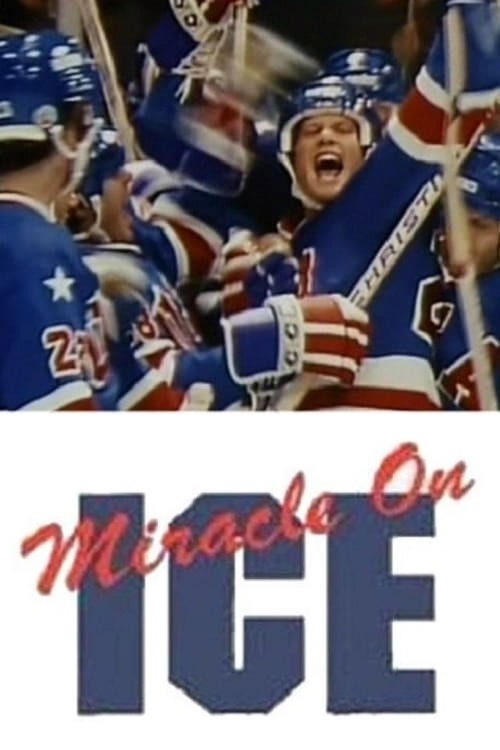
Miracle On Ice (1981, directed by Steven Hilliard Stern)


On February 22nd, 1980, the U.S. Olympic Hockey team pulled off one of the greatest upsets in sports history when they defeated the Soviet team during the Winter Olympics.  At a time when America was struggling under Jimmy Carter and the Soviet Union appeared to be winning the propaganda war, a group of unheralded college students brought the U.S. together in celebration as they defeated the Soviets and then went on to defeat Finland for the gold medal.

Everyone knows that the Miracle On Ice, as it was called, served as the basis of the Disney film Miracle, with Kurt Russell playing coach Herb Brooks.  What is now forgotten is that the story was first recreated in 1981, with a made-for-tv movie called Miracle On Ice.  Who played Herb Brooks in that movie?

Karl Malden.

Keep in mind, Herb Brooks was 42 years-old when the U.S. team defeated the Soviets and he was a former player himself.  Malden was 69 when he starred in Miracle On Ice and didn’t look like he had ever worn skates in his life.  Malden is convincingly grumpy and hard-nosed as Brooks but he’s still very miscast and the movie misses the point that one of the reasons why Brooks could coach the young American team was because he was still relatively young himself.  The actors playing the members of the team are better cast, with Andrew Stevens playing team leader Mike Eruzione and Steve Guttenberg cast as goalie Jim Craig.  A lot of time is devoted to Craig’s financial difficulties and his fear that remaining an amateur for the Olympics, instead of going pro, will continue to make life difficult for his family.  On the one hand, it is messed up that the U.S., at the time, did not allow its Olympians to turn professional.  On the other hand, the fact all of the players were considered to be “amateurs’ made their victory over the Soviets all the more special.

It takes a while for Miracle on Ice to get to the main event.  There’s a lot of scenes of Brooks dealing with everyone’s skepticism and Eurozione trying to keep the players from giving up in the face of the Soviet Union’s previous domination of the game.  Once the movie does finally reach the Winter Olympics, it relies on actual footage from the game, which is actually pretty cool.  Watching the real footage, you can still feel the growing excitement in both the stadium and the broadcast booth as people started to realize that the American team was going to pull it off and defeat the Soviets.  It’s impossible not to be inspired by the Soviet Union getting humiliated by a bunch of American college players.  The Soviets may have had the performance enhancing drugs but the Americans had the spirit!

Of the two films about America’s victory, Miracle is definitely the one to see but Miracle On Ice still pays tribute to a great moment.
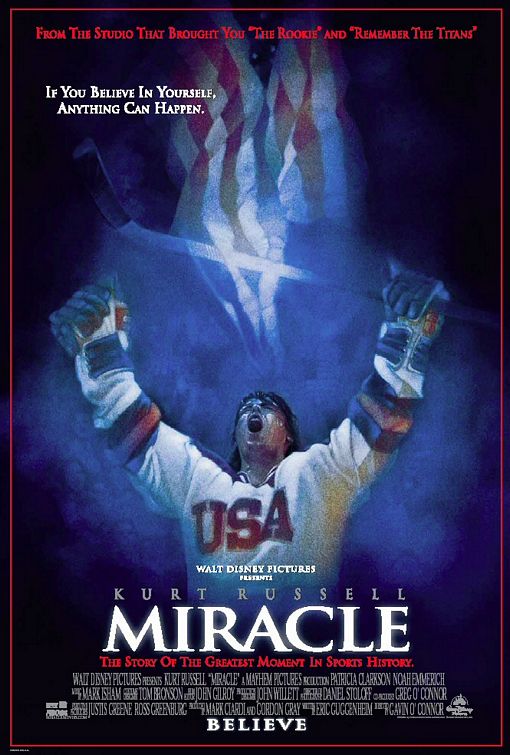
A Moment in Time: Miracle


Today, with my mother who couldn’t recall the film, I watched Miracle.

For those of you who don’t know, this film follows the rise of the 1980 USA Olympic hockey team as they prepare themselves for the inevitable clash against the unstoppable juggernaut of the USSR. Facing down the fact that the Soviets haven’t been defeated by the Americans since 1960, and that they’ve won three straight Olympic gold medals, the USA’s team of collegiate athletes nonetheless is looking at their own shot at the gold. I cannot recommend this film highly enough; it rests comfortable atop the pinnacle of sports movies ever made, and it tells a story that has all but been forgotten… at least, until mentioned.

Today, it’s commonplace to hear people talk about the greatest moment in sports history. The greatest call in the game. The greatest game ever played. The greatest goal ever scored. But, at least, for denizens of the United States, that honour is one that will never be taken from the 1980 Olympic squad.

Miracle‘s most endearing attribute is that it’s about a real story. And it’s a story that thrills people who salute the stars and stripes even in 2011, or it should. It’s a better story than that of the Marshall football team. It’s a greater story than any recounting of a sport on these shores. It’s a story that could not happen without another Cold War – the story of a team of beleaguered underdogs (whom we love so well) battling against the unstoppable Soviet Union, in a time before the internal failings of the Soviets were known. This was a match that meant more than anything possibly can in sports today, no matter what team you root for, or what your age happens to be.

For me, personally, Miracle follows events that transpired years before I was born. My memories as a young man are not of the implacable Soviet Union hanging like a dark cloud over half the world, but rather of their collapsing economy, unsustainable with the lack of infrastructure that had secretly crippled them for forty years. Of negotiations and compromise that saw the Berlin Wall torn down, and a tenuous alliance between the Russian Federation and the United States be born. I have never lived an era in which NATO seemed to hang as an aegis between my life and nuclear oblivion, or where the threat of communism seemed like one which would march across the globe and take from me everything I held dear.

But I still feel the chills across my skin, the goosebumps rising, during Miracle’s climactic moments – the semi-finals between the USA and the USSR. Unlike most other sports movies, where the true draw is the characters and the drama, and a scripted sporting event can never mean as much, the semi-finals game in Miracle is sung to the script of history. It was a real game, where nobody on earth knew the result before it was written. Al Michaels reprises his role as play-by-play announcer, dubbing over his own dialog from the original broadcast, and our actors re-enact the twists and turns of this amazing contest on the ice.

I write about it for three reasons. Each of them single lines from the film, and each of them uttered from the roughly 20-straight minutes of hockey that we are treated to as viewers at the end of the film. Kurt Russell delivers for us perhaps the greatest performance of his career, in what is debateably the greatest film of his career, and what is probably the greatest sports film of all time.

“They just benched the best goaltender in the world,” he assures his team after a first period in which the USA dared to tie the score and the Soviets pulled their goaltender, Vladislav Tretiak, in a game where everyone present knew they were lucky to just be trailing by one going into the break.

“He doesn’t know what to do,” Kurt Russell, as the real-life character Herb Brooks, assures us as he sees Soviet coach Viktor Tiknohov barking terse commands at his team halfway into the final period. Against all odds, the USA’s team is still in this game, as the crowd at Lake Placid New York tirelessly chants “U-S-A!”, waving American flags, their energy carrying that USA collegiate team against a squad that, while “amateur” themselves, were easily considered to be the best hockey team in the world.

Finally, as time begins to expire, the digital redubs that Al Michaels recorded of his play-by-play switch back to the original telecast. We hear an Al Michaels thirty years younger screaming into his mic, as the puck is cleared toward center ice, putting the victory literally out of the reach of the USSR, “Do you believe in miracles!?” he pauses an instant, as the time truly does expire, and then screams “Yes!”

And history goes wild.