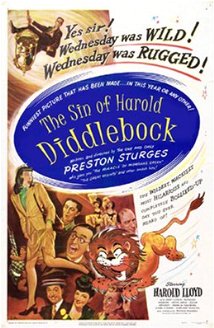
The Fabulous Forties #43: The Sin of Harold Diddlebock (dir by Preston Sturges)


Film1947-TheSinOfHaroldDiddlebock

The 42nd film in Mill Creek’s Fabulous Forties box set was a 1947 comedy called The Sin of Harold Diddlebock.

As a classic film lover, I really wish that The Sin of Harold Diddlebock was better than it actually is.  The film was a collaboration between two of the biggest names in cinematic comedy history: director/writer Preston Sturges and legendary actor Harold Lloyd.  In fact, this was the first film that Sturges directed after leaving the studio system so that he could make bring his unique brand of satire to life without having to deal with interference.  He managed to convince Harold Lloyd to come out of retirement to star in the movie and the film even works as a quasi-sequel to one of Lloyd’s most beloved silent comedies, The Freshman.  In a perfect world, The Sin of Harold Diddlebock would have been a comedy masterpiece that would have perfectly shown off the talents of both men.

Unfortunately, that’s really not the case.  The Sin of Harold Diddlebock is consistently amusing but it’s never quite as funny as you want it to be.  This is one of those films that sounds like it should be hilarious but, when you actually watch it, you see that the film is oddly paced and Lloyd never seems to be fully invested in his role.  I suppose the natural inclination would be to blame this on interference from the notoriously eccentric Howard Hughes, who co-produced the film with Sturges.  After Harold Diddlebock failed at the box office, Hughes withdrew it and spent three years personally reediting the film before re-releasing it under the title Mad Wednesday.  However, by most reports, Hughes wasn’t really the problem.  If Wikipedia is to be believed (and God do I hate starting any sentence with that phrase), Lloyd and Sturges did not have a good working relationship.  As sad as that is, it’s also understandable.  Geniuses rarely work well together.

The Sin of Harold Diddlebock does get off to a good start, seamlessly incorporating the last reel of The Freshmen with footage shot for Harold Diddlebock.  (Somewhat sweetly, the film starts with a title card informing us that the what we are about to see was taken from The Freshman.)  After college freshman Harold Diddlebock scores the winning touchdown in a football game, impressed advertising executive J.E. Waggleberry (Raymond Walburn) offers Harold a job.  However, Harold wants to finish college so Waggleberry tells Harold to look him up in four years.

Four years later, recently graduated Harold goes to Waggleberry for a job and discovers that J.E. Waggleberry has totally forgotten him.  Harold ends up working in the mailroom but is told that, as long as he is ambitious and smart, he will easily move up in the company.  22 years later, Harold is still working in the mailroom.  He is secretly in love with Miss Otis (Frances Ramsden).  Of course, he was also in love with each of Miss Otis’s six older sisters, all of whom worked at the company before the current Miss Otis.  Harold bought an engagement ring when the oldest Otis sister was with company.  Years later, he’s still carrying it with him and dreams of giving it to the current Miss Otis.

However, that might be difficult because Harold has just been fired.  J.E. Waggleberry feels that Harold’s unambitious attitude is setting a bad example.  As severance, Harold is given a watch and $2,946.12.

The normally quiet and reserved Harold reacts to losing his job by doing something very unusual for him.  He goes to a bar and, with the help of a con man (Jimmy Conlin) and a bartender (Edgar Kennedy), he gets drunk.  The bartender even creates a special drink called the Diddlebock.  Harold drinks it and wakes up two days later, wearing a huge cowboy hat and owning a bankrupt circus…

And it only gets stranger from there….

While The Sin of Harold Diddlebock doesn’t quite work, I appreciated the fact that it not only created its own surreal world but that it just kept getting stranger and stranger as the film progressed.  It was Harold Lloyd’s final film and there’s even a scene where he and a lion end up on the edge of a skyscraper that’s almost as good as the famous comedic set pieces from his silent classics.  It’s a pity that the film doesn’t really come together but I’d still recommend seeing it just for history’s sake.

The Fabulous Forties #42: The Strange Love of Martha Ivers (dir by Lewis Milestone)


StrangeLoveofMartha

The 41st film in Mill Creek’s Fabulous Forties box set was the 1946 film noir, The Strange Love of Martha Ivers.  While The Strange Love of Martha Ivers is definitely a superior example of noir and features Barbara Stanwyck in one of her best femme fatale roles, the film is best remembered for being the film debut of a Hollywood icon.

In December of this year, Kirk Douglas will turn 100 years old.  He is one of the few stars of the Golden Age of Hollywood left.  (Olivia De Havilland is another.  She’ll be turning 100 on the 1st of July.)  Though he’s had his share of health issues over the past few years, it is somehow not surprising that Kirk Douglas is going to make it to a hundred.  In fact, it probably wouldn’t be surprising if he lasted for another hundred after that.  Regardless of how old or young he may have been at any point in his career, Kirk Douglas has always epitomized virile masculinity.  Whenever you see Kirk Douglas in a film, you know that you might not like or trust his character but you definitely want him around if things start to get tough.  That remains true whether you’re watching Kirk in The Bad And The Beautiful or in Holocaust 2000.

That’s why it’s interesting to see Kirk cast very much against type in his very first film.  In The Strange Love of Martha Ivers, Kirk Douglas plays Walter O’Neil.  Walter is the district attorney of a Pennsylvania mining town called Iverstown.  He is married to Martha Ivers (Barbara Stanwyck), the niece of the widow of the man who founded Iverstown.  Walter owes almost all of his success to the influence of the Ivers family and he knows it.  He’s also in love with Martha but she doesn’t love him.  And he knows that as well.  Walter deals with his insecurity by drinking.

Walter and Martha have a secret.  Seventeen years ago, Walter witnessed Martha murder her abusive aunt.  (The aunt is played by Judith Anderson, the creepy housekeeper from Rebecca.)  Walter helped Martha to cover up the crime, lying that he saw a burglar beat the aunt to death.  As a result of their lies, an innocent man was executed for the murder.

Now, many years later, Sam Masterson (Van Heflin) has returned to Iverstown.  Sam was a friend to both Martha and Walter when they were younger.  Sam came from the poor section of town and ran away shortly after the death of Martha’s aunt.  Walter has always suspected that Martha truly loves Sam.  When Sam — now a drifter and a gambler — shows up in town, Walter fears that he knows the truth about the aunt’s death.  Walter is scared that Sam is going to blackmail him.  Even worse, he’s scared that Sam is going to steal Martha away from him.

Walter has reason to be worried.  Having met a troubled young woman named Toni (Lizabeth Scott), Sam believe he is no longer in love with Martha.  However, Martha does claim to love Sam and Sam finds himself being drawn back to her.  In fact, Martha loves Sam enough to suggest that maybe he should murder Walter…

The Strange Love of Martha Ivers is an entertaining melodrama, one that features great performances from Heflin, Stanwyck, and Scott.  However, in the end, it’s mostly interesting because Kirk Douglas is not only making his debut in a totally atypical role but he also does a fantastic job.  If The Strange Love of Martha Ivers had been made in the 50s, Kirk probably would have been cast as Sam but he’s unexpectedly perfect in the role of the angry, self-loathing, and ultimately tragic Walter.

You watch The Strange Love of Martha Ivers and, even with Kirk Douglas cast against type, you can’t help but think, “No wonder he made it to a hundred!”

martha-ivers


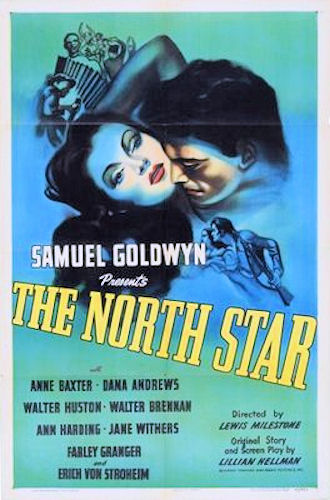
The Fabulous Forties #41: The North Star (dir by Lewis Milestone)


The North Star

The 40th film — wait a minute, I’m finally up to number 40!?  That means that there’s only ten more movies left to review!  And then I’ll be able to move on!  It’s always exiting for me whenever I’m doing a review series and I realize that I’m nearly done.

Anyway, where was I?

Oh yeah — the 40th film in Mill Creek’s Fabulous Forties box set was the 1943 war epic, The North Star.  This is one of the many war films to be included in the Fabulous Forties box set and I have to admit that they all kind of blend together for me.  Since these films were actually made at a time when America was at war, there really wasn’t much room for nuance.  Instead, every film follows pretty much the same formula: the Nazis invade, a combination of soldiers and villagers set aside their individual concerns and/or differences and team up to defeat the Nazis, there’s a big battle, a few good people sacrifice their lives, the Nazis are defeated, and the allies promise to keep fighting.

It’s a pretty predictable formula but that’s okay because it was all in the service of fighting the Nazis.  Could I legitimately point out that the villains in these movies are always kind of two-dimensional?  Sure, I could.  But you know what?  IT DOESN’T MATTER BECAUSE THEY’RE NAZIS!  Could I point out that the heroes are often idealized?  Sure, but again it doesn’t matter.  Why doesn’t it matter?  BECAUSE THEY’RE FIGHTING NAZIS!

That’s one reason why, even as our attitude towards war changes, World War II films will always be popular.  World War II was literally good vs evil.

Anyway, The North Star was a big studio tribute to America’s then ally, the Soviet Union.  When a farm in the Ukraine is occupied by the Nazis, the peasants and the farmers refuse to surrender.  They disappear into the surrounding hills and conduct guerilla warfare against the invading army.  It’s all pretty predictable but it’s also executed fairly well.  It doesn’t shy away from showing the brutality of war.  There’s a haunting scene in which we see the bodies of all of the villagers — including several children — who have been killed in a battle.

The Nazis are represented by Erich Von Stroheim.  Von Stroheim plays a German doctor who continually claims that he personally does not believe in the Nazi ideology and that he’s just following orders.  When wounded Nazi soldiers need blood transfusions, he takes the blood from the children of the village.  His rival, a Russian doctor, is played by all-American Walter Huston and indeed, all the Russians are played by American stars, the better to create a “we’re all in this together” type of spirit.  When Huston tells Von Stroheim that he is even worse than the committed Nazis because he recognized evil and chose to do nothing, he’s speaking for all of us.

Unfortunately, before the Nazis invade, The North Star devotes a lot of time to showing how idyllic life is in the communist collective and these scenes are so idealized that they totally ring false.  Everyone is so busy singing folk songs and talking about how happy they are being a part of a collective (as opposed to being an individual with concerns that are not shared by the other members of the collective) that it’s kind of unbearable.  Not surprisingly, The North Star was written by Lillian Hellman, who wrote some great melodramas (like The Little Foxes) but who was always at her most tedious when she was at her most overly political.

(Watching the opening of The North Star, I was reminded that I would be totally useless in a collectivist society.)

So, I have to admit, that I was rather annoyed with the villagers at first.  But then the Nazis invaded and I realized that we’re all in it together!  As I said earlier, you can forgive your heroes almost anything when they’re fighting Nazis.

The North Star is an above average war film and a below average piece of political propaganda.  See it as a double feature with The Last Chance.

The Fabulous Forties #40: Smash-Up, The Story of a Woman (dir by Stuart Heisler)


Smash-Up_(1947)

The 39th film in the Fabulous Forties box set was 1947’s Smash-Up, the Story of a Woman.  I have to say it was a little bit strange going from watching the hilarious and life-affirming My Man Godfrey to watching the very serious and rather depressing Smash-Up.

Smash-Up is pure, tear-jerking Hollywood melodrama.  When the film starts, Angie Evans (Susan Hayward) is in a hospital, with her face totally covered in bandages.  Just by looking at her, we already know that her story is not going to be a happy one.

Flash back time!  Angie was a nightclub singer and a pretty good one at that.  The audiences loved her and she loved performing but she loved one thing more.  (See how overwrought my prose was there?  That’s a reflection of Smash-Up’s style.)  She loved Ken Conway (Lee Bowman, who may be related to me but probably isn’t).  Ken was a singer himself, though he was nowhere near as successful as Angie.  However, after Ken and Angie married, Angie put her career on hold while Ken went on to become a huge success.

Angie was already a drinker before she met Ken.  Having a few drinks before going out on stage helped to calm her nerves.  It helped her to relax and become the performer that the audiences loved.  However, once Ken became a star and Angie found herself continually alone in their home, she started to drink because it was the only thing that made her happy.  Whenever she started to regret giving up her career, she drank.  When she was worried that Ken was having an affair with his secretary (Marsha Hunt), Angie drank.  Ken’s best friend and songwriter, Steve (Eddie Albert), could see that Angie was losing control.  However, Ken refused to accept that his wife had a drinking problem.  Accepting that Angie was drinking to be happy would mean accepting that she wasn’t happy in the first place.

Trapped in the middle of all this was their daughter, Angel (Sharyn Payne).  When Ken, finally admitting that his wife could not control her drinking, demanded custody of Angel, Angie was determined to get back her daughter.

But, even though she wanted to, Angie could not stop drinking.  Or smoking.  And the smoking, the drinking, and the kidnapping did not make for a particularly good combination.

According to Wikipedia, Smash-Up was a failure at the box office and I can actually see why.  1940s American cinema can basically be divided between the earnest, patriotic, and optimistic films that were released during World War II and the dark and pessimistic films that came out after the war ended and the world realized just how evil and dangerous human beings could be.  Smash-Up is one of those dark films.  It’s not a happy film, nor is it at all subtle.  In fact, as much as I love a good melodrama, Smash-Up occasionally seems like a bit much.  Absolutely every bad thing that could happen does happen and it’s typical of the approach of Hollywood in the 40s that, for all the trouble Angie suffers as a result of her drinking, the film still has to find an excuse to send her to hospital with her face in bandages.  The film is often very empathetic in its treatment of Angie but, in the 1940s, mistakes still had to be punished.

Fortunately, Susan Hayward gives a great performance in the role of Angie, capturing the aching sadness that leads her to drink in the first place.  She saves the entire film and, quite justifiably, she received a nomination for best actress for her performance here.  She didn’t win but she still made Smash-Up worth seeing.

The Fabulous Forties #39: My Man Godfrey (dir by Gregory La Cava)


My_man_godfrey

The 38th film in Mill Creek’s Fabulous Forties box set was My Man Godfrey, which is strange considering that My Man Godfrey is not a 40s film.  The back of the box insists that My Man Godfrey was made in 1946 but it was actually made in 1936.  Errors like this aren’t uncommon when it comes to Mill Creek but, even beyond that simple mistake, My Man Godfrey is clearly not a product of the earnest and pro-American 1940s.  My Man Godfrey may be a screwball comedy but it’s a comedy that is very much a product of the far more cynical 1930s.  It’s a comedy that could only have come out during the Great Depression, at a time when FDR was promoting his New Deal and yet many Americans were still out-of-work and struggling to make ends meet, forgotten by a country determined to buy into a feel good narrative regardless of any evidence to the contrary.

But no matter!  My Man Godfrey might not technically belong in the Fabulous Forties box set but I’m still glad that it was there because it is an absolutely fantastic film.

The Godfrey of the title is played by the always charming and always funny William Powell.  When we first see him, he’s living in a garbage dump with several other men who have lost their money, homes, and family.  These are men who spend their time wondering when and if things are ever going to get better.  While the rest of the country insists that happy days are here again, these men know it’s simply not true.  They are truly the forgotten men.

Fortunately, there’s also a scavenger hunt going on!

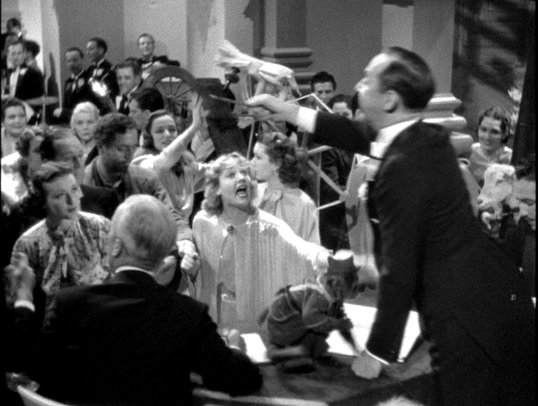
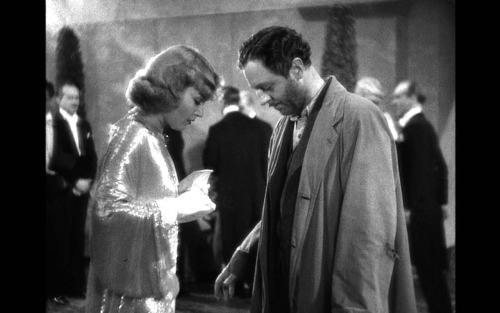
For charity, a group of rich people are running around the city and collecting various oddities.  And among those oddities — “a forgotten man!”  When wealthy and snobbish Cornelia Bullock (Gail Patrick) stops off at the dump, she offers Godfrey five dollars to come with her and be her “forgotten man.”  Offended, Godfrey reprimands her and a shocked Cornelia stumbles back and falls into an ash pile.  Cornelia’s younger sister, the flighty Irene (Carole Lombard), sees this and laughs.  Mostly to get back at Cornelia, Godfrey agrees to be Irene’s forgotten man.

When Irene takes Godfrey to the Waldorf-Astoria Hotel so that the game’s organizers can declare him to be an authentic forgotten man, Godfrey is disgusted by the silly and wealthy people that he sees around him.  After he is authenticated, Godfrey proceeds to loudly denounce everyone in the hotel.  Every one is scandalized, except for Irene.  Irene asks Godfrey if he would like to come home with her and be her family’s new butler.  Reluctant but broke, Godfrey agrees.

One of the joys of this scene is seeing the other things people found during the scavenger hunt. Love the monkey.

One of the joys of this scene is seeing the other things people found during the scavenger hunt. Love the monkey.

Godfrey, however, is far less amused.

Godfrey, however, is far less amused.

The next morning finds Godfrey in the Bullock mansion, prepared to start his duties as a butler.  He turns out to be a surprisingly adept butler but there’s only one problem.  It turns out that everyone was drunk last night and, as a result, nobody remembers Irene hiring Godfrey.  As Godfrey reintroduced himself to the family, he gets to once again know the Bullocks.

For instance, patriarch Alexander Bullock (Eugene Pallette) is a well-meaning man but he’s incapable of controlling his eccentric family or their excessive spending.  He faces each day with the weary resignation that his household is a disorganized mess and that he’s on the verge of losing his business.

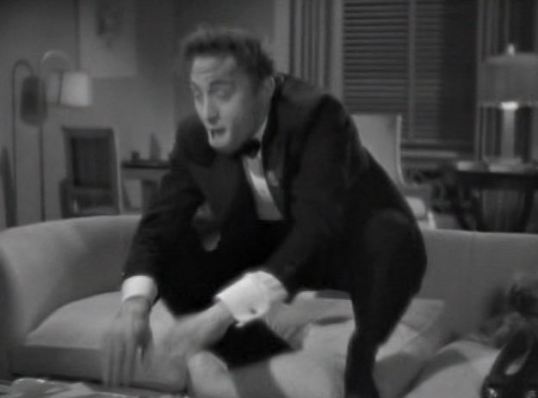
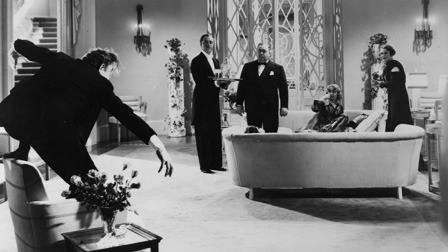
Alexander’s wife, Angelica (Alice Brady), lives in her own world and confronts every problem with nonstop and delusional positivity.  She is very excited to have taken on a protegé, an artist named Carlo (Mischa Auer, who was justifiably nominated for an Oscar for his wonderfully odd performance).  Carlo is often surly and spoiled but he does do a pretty good impersonation of a gorilla.  Whenever the often dramatic Irene is declaring herself to be the most miserable rich girl in the world, Angelica insists that Carlo cheer everyone up by grunting and jumping around the room.

Mischa Auer as Carlo

Mischa Auer as Carlo

Mischa Auer as a gorilla

Mischa Auer as a gorilla

(Apparently, the gorilla impersonation was something that Auer used to do at Hollywood parties.  The role of Carlo was specifically created with the idea of capturing Auer’s act on film.  As a result, Auer was one of the first actors to ever be nominated for Best Supporting Actor and he started a new career as a comedic character actor.)

Cornelia is selfish and materialistic.  Though she may not remember much about the scavenger hunt, she does remember Godfrey humiliating her.  From the minute she discovers that Godfrey is the new butler, she starts to conspire against him.  When her necklace disappears, everyone is sure that she hid it herself just to frame Godfrey.  The truth, of course, is a little bit more complicated.

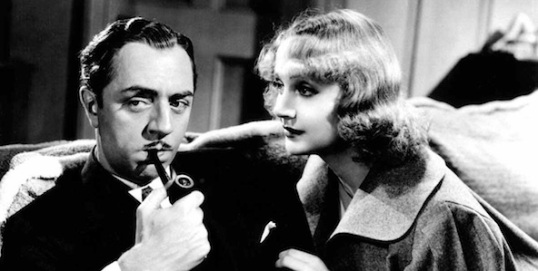
And finally, there’s Irene.  Irene is spoiled but she’s not selfish.  She’s also not as ditzy as everyone assumes.  It’s just that she sees the world in her own unique way.  Almost as soon as Irene remembers that she hired Godrey, she decides that she’s in love with him.  She also decides that Godfrey is her protegé.  After all, if her mother can have a protegé, why can’t she!?

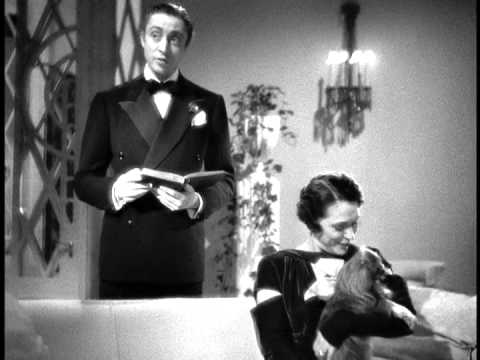
Carole Lombard and William Powell

Carole Lombard and William Powell

Carole Lombard was a masterful comedienne whose career was tragically cut short when she was killed in a plane crash in 1942.  Lombard is absolutely adorable in the role of Irene, a character to whom I very much related.

Of course, there is more to Godfrey and his past than he actually let on.   And, even after he becomes the new butler, Godfrey doesn’t forget where he was living just a few days before.  My Man Godfrey is a hilarious comedy but it’s also a comedy with a social conscience.

my-man-godfrey_592x299

I love this film.  It’s a screwball comedy in the best sense of the term, a film where all of the characters are eccentric while also remaining human.  William Powell and Carole Lombard were briefly married before they teamed up in My Man Godfrey and their chemistry is delightful to watch.  Finally, the supporting cast is memorable in the way that only a collection of great 1930s character actors can be.

My Man Godfrey is a great film.  It may not be from the 1940s but I’m glad it was included.

Godfreyw_bw_original

(By the way, just between you and me — I had a lot of fun watching this movie and writing this review.  It kind of reminded me why I started writing about movies in the first place.)

The Fabulous Forties #38: The Devil Bat (dir by Jean Yarbrough)


1940_devil_bat_012

The 37th film in Mill Creek’s Fabulous Forties box set was 1940’s The Devil Bat, which Gary Loggins reviewed on this site back in October.  Since, for the most part, I agree with Gary’s review, I’m going to recommend that you go read it and then I’ll just add a few thoughts of my own.

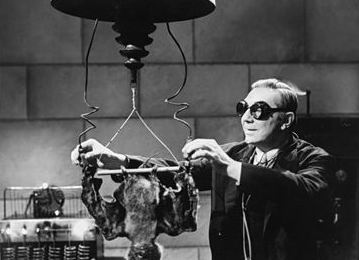
The Devil Bat is usually described as being one of the films that Bela Lugosi made during his decline, even though he made it just a year after appearing in a supporting role in the Oscar-nominated Ninotchka.  Lugosi plays Dr. Paul Carruthers, a small-town chemist who uses radiation to create a gigantic bat that he unleashes on everyone who he feels has wronged him.  The bat targets anyone who makes the mistake of wearing an aftershave lotion that Carruthers has created.

I would argue that there is a hint of genius to be found within The Devil Bat.

First off, there’s the fact that the giant bat is so clearly fake that it actually becomes rather charming.  Wisely, the film makes no effort to convince you that the bat is real.  Whenever that big, fake bat is lowered in on a bunch of often-visible wires, it works as almost a Brechtian alienation device.  In much the same way that Godard used jump cuts in Breathless, Devil Bat uses that big, fake bat to remind the audience that they are watching a film.  As a result, the audience has no choice but to think about the conventions of the horror genre and how their own world view has been shaped by watching movies like Devil Bat.

The other hint of genius is the satirical masterstroke of casting Bela Lugosi as a small town chemist.  Lugosi remains Lugosi, regardless of what role he plays.  When the film’s characters accept, without even a second glance, that Bela Lugosi, with his thick accent and his theatrical acting style, is a humble suburbanite, the film becomes a perhaps inadvertent satire of American conformity.

Needless to say, Lugosi was always a far better actor than he has ever been given credit for being.  In The Devil Bat, he plays Dr. Carruthers with a weary sense of resignation.  Carruthers never becomes a standard evil villain.  Instead, he’s a man who has been so beaten down by life that he now see no other option beyond using a giant bat to kill those who he feels has betrayed him.  Much as he would in Ed Wood’s Bride of the Monster, Lugosi brings an almost redemptive sadness to his mad scientist.

The end result is that poor, misunderstood and underestimated Bela elevates the entire film.

db

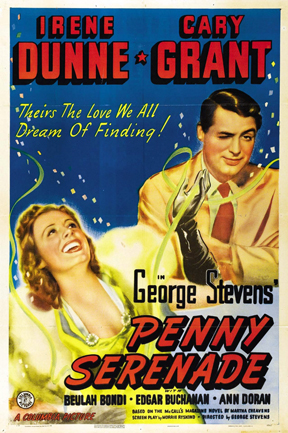
The Fabulous Forties #37: Penny Serenade (dir by George Stevens)


Penny_Serenade_1941_Poster

How many tears can be jerked by one tear jerker?

How melodramatic can one melodrama get?

These are the type of questions that I found myself considering as I watched the 36th film in Mill Creek’s Fabulous Forties box set, 1941’s Penny Serenade.

Penny Serenade opens with Julie (Irene Dunne) announcing that she’s planning on leaving her husband, Roger (Cary Grant).  Fortunately, before Julie goes through with her plan, she listens to a song called You Were Meant For Me.  Perhaps not coincidentally, the song is included on an album called The Story Of A Happy Marriage.  As she stares at the spinning vinyl, Julie starts to have flashbacks!

No, not flashbacks of the LSD kind.  (Though, interestingly enough, Cary Grant was reportedly a big fan of LSD…)  Instead, she has flashbacks of her marriage to Roger.  We see how she first met Roger while she was working in a music store.  Roger stopped by the store to tell her that a record was skipping and it was love at first sight.  However, Roger had no interest in getting married.  Or, at the least, he didn’t until Julie opened up a fortune cookie and read the fortune: “You get your wish — a baby!”

Julie continues to stare at the spinning record and we discover that eventually, she and Roger did get married.  Julie did get pregnant but, as the result of an earthquake, she lost the baby.  (Curse you, fortune cookie!  CURSE YOU!)  Meanwhile, Roger took over a small town newspaper and revealed himself to have absolutely no idea how to handle money.

Because of the earthquake, Julie will never be able to have a child.  (DAMN YOU, FORTUNE COOKIE!  DAMN YOU FOR YOUR LIES!)  However, they can still adopt!  She writes to Miss Oliver (Beulah Bondi), the head of the local orphanage.  Julie demands to be given a baby with “blue eyes and curly hair.”  Fortunately, Miss Oliver apparently has a surplus of curly-haired, blue-eyed babies but she’s still reluctant to approve the adoption.  After all, Julie is such a terrible housekeeper!  However, she is impressed by how much both Julie and Roger want a baby so Miss Oliver puts aside her concerns and allows them to have a baby for two years.

At the end of the two years, Roger and Julie have to go to an adoption hearing.  Unfortunately, the paper has gone out of business, the family has absolutely no money, and the fortune cookie has stopped giving advice.  Fortunately, Roger is Cary Grant and who can say no to Cary Grant?  Roger promises the judge that he’ll always love and take care of the baby…

But that’s not all!  The movie is not over yet.  And even as Roger makes his plea, we can’t help but think about the fact that this movie is being told in flashback and that present day Julie is still planning on leaving Roger.  Now, I’m not going to spoil the movie by going into why or revealing what happens in the end.  I’ll just say that it involves more tragedy and more melodrama.  In fact, it includes so much tragedy and so much melodrama, that it starts to get a little exhausting.  How much bad stuff can happen to Cary Grant!?

And the record just keeps spinning…because what goes up must come down, spinning wheel got to go round…

Over the course of his long career, Cary Grant only received two Oscar nominations.  Penny Serenade was his first nomination and, as a fan of Cary Grant’s comedies, it saddens me to say that Cary’s nominated performance really wasn’t that good.  Watching this film, you can tell that Cary felt that this was his chance to prove himself as a dramatic actor and, as a result, he acts the Hell out of every scene.  Of course, Cary’s undying popularity comes from the fact that he rarely seemed to be acting.  His charm was in how natural he was.  In Penny Serenade, he never seems natural.  He’s trying too hard and it’s just odd to see Cary Grant trying too hard.

If you want to see Cary Grant at his best, check out The Awful Truth.  Or maybe The Philadelphia Story.  Those are two great films that prove that Cary Grant was a great actor.  Even a rare misfire of a performance can’t change that fact.

Until next time…

Ride a painted pony, let the spinnin’ wheel spin. … Ride a painted pony, let the spinnin’ wheel turn.

The Fabulous Forties #36: Dishonored Lady (dir by Robert Stevenson)


40s

15 to go!

That’s what I find myself thinking as I begin this review of the 35th film in Mill Creek’s Fabulous Forties box set.  I’ve only got 15 more of these reviews to go and then I will be finished with the Fabulous Forties.

Oh, don’t get me wrong.  Over the past two months, I’ve seen some very good movies from the 1940s — The Black Book, The Last Chance, Trapped, and a few others.  However, I have also had to sit through things like Jungle Man, Freckles Comes Home, and Lil Abner.  The Fabulous Forties has been an uneven collection, even by the standards of Mill Creek.  However, the important thing is that I’m getting to discover films that I probably would otherwise have never known about.  I love watching movies, even ones that don’t quite work.

Fortunately, the 35th film in the Fabulous Forties does work.

Dishonored_Lady_poster

The 1947 film Dishonored Lady stars the beautiful Hedy Lamarr as Madeline Damien.  Madeline would appear to have it all.  She’s wealthy, she’s socially well-connected, she lives in Manhattan, and she has a glamorous job as the fashion editor of a slick magazine called Boulevard.

So, if Madeline’s life is so perfect, why does she end up crashing her car outside of the house of psychiatrist Richard Caleb (Morris Carnovsky)?  Madeline says it was just an accident but Dr. Caleb immediately understands that she wrecked her car as part of a suicide attempt.  He takes Madeline as a patient and we quickly learn that Madeline is actually on the verge of a nervous breakdown.  When she’s not working, she’s usually drinking.  When she’s not drinking or working, she’s having sex with almost every man she meets.

(Or, as the film primly insists, “making love” to every man she meets.)

And what’s remarkable is that, for a 1947 film, Dishonored Lady is rather sympathetic to Madeline.  While it portrays her lifestyle as being self-destructive, it doesn’t condemn her.  It doesn’t attempt to argue that her problems are a fitting punishment for her decisions, as opposed to so many other 1940s films.  Even when Dr. Caleb’s counseling leads to Madeline quitting her job, the film refrains from criticizing Madeline for wanting to have a career.  Instead, it simply suggests that Boulevard is a toxic environment, almost entirely because of the sleazy men that Madeline has to deal with on a daily basis.

Madeline ends up renting a small apartment and rediscovering her love for painting.  Speaking of love, she also falls in love with her neighbor, Dr. David Cousins (Dennis O’Keefe).  At first, she doesn’t tell David anything about her past but, when she’s falsely accused of murder, she has no choice but to tell him everything.  Will David stand by her or will he prove to be yet another disappointment?  And will Madeline be able to prove her innocence even while her past in put on trial?

I really liked Dishonored Lady.  It’s a surprisingly intelligent film and Hedy Lamarr gives a great performance in the role of Madeline.  Dishonored Lady proved to be a pleasant surprise and you can watch it below!

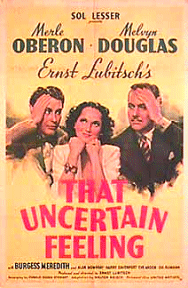
The Fabulous Forties #35: That Uncertain Feeling (dir by Ernst Lubitsch)


That_Uncertain_Feeling

The 35th film in Mill Creek’s Fabulous Forties box set was — wait a minute?  I’m on my 35th Fabulous Forties review?  Let’s see — there’s 50 films in the box set so that means that I only have 15 more of these to write and I’ll be done!  And then I can move onto the Nifty Fifties, the Sensation Sixties, the Swinging Seventies, and the Excellent Eighties!  YAY!

Anyway, where was I?

Oh yeah, the 35th film.

First released in 1941, That Uncertain Feeling is a movie about sophisticated people doing silly things.  Socialite Jill Baker (Merle Oberon) gets the hiccups whenever she gets nervous or irritated.  Her trendy friends suggest that she try the new big thing: seeing a psychoanalyst!  At first, Jill is reluctant but eventually, she gives in to the pressures of high society and she goes to visit Dr. Vengard (Alan Mowbray).  Dr. Vengard tells her that her hiccups are a result of her marriage to Larry (Melvyn Douglas) and suggests that the best way to cure them would be to get a divorce.

At first, Jill is horrified at the suggestion.  Whatever will people think if she gets a divorce!?  However, Larry is kind of a condescending jerk.  (Or, at least, he comes across as being a jerk when viewed by 2016 standards.  By 1941 standards, I imagine he’s supposed to be quite reasonable.)  And Jill happens to meet another one of Vengard’s patients, an outspoken pianist named Alexander Sebastian (Burgess Meredith).

Soon, Jill is not only contemplating getting a divorce from Larry but perhaps marrying the eccentric Sebastian as well!  When Larry realizes that Jill is dissatisfied with their marriage and that she is attracted to Sebastian, he gives her a divorce.  He even pretends to be an abusive husband so that she can file for divorce on grounds of cruelty.  (It’s funnier than it sounds.)  Jill and Sebastian get engaged but, once Larry starts to date again, Jill realizes that she’s not quite over her ex…

I was really excited when I saw that The Uncertain Feeling was an Ernst Lubitsch film.  Lubitsch directed some of my favorite Golden Age comedies, films like Ninotchka and Heaven Can Wait.  But That Uncertain Feeling is not quite up to the standard of the other Lubitsch films that I’ve seen.  As played by Burgess Meredith, Sebastian never comes across as being a realistic rival to Larry.  The character is so cartoonishly eccentric that it becomes impossible to see what Jill sees in him.  At the same time, Larry comes across as being such a chauvinist that it’s far easier to understand why Jill would divorce him than why she would ever want to take him back.  The end result is a rare Lubitsch misfire.

However, as long as we’re talking about Lubitsch, make sure to see The Smiling Lieutenant if you get the chance.  Now, that’s a good Lubitsch film…

(And be sure to follow it up with The Love Parade...)

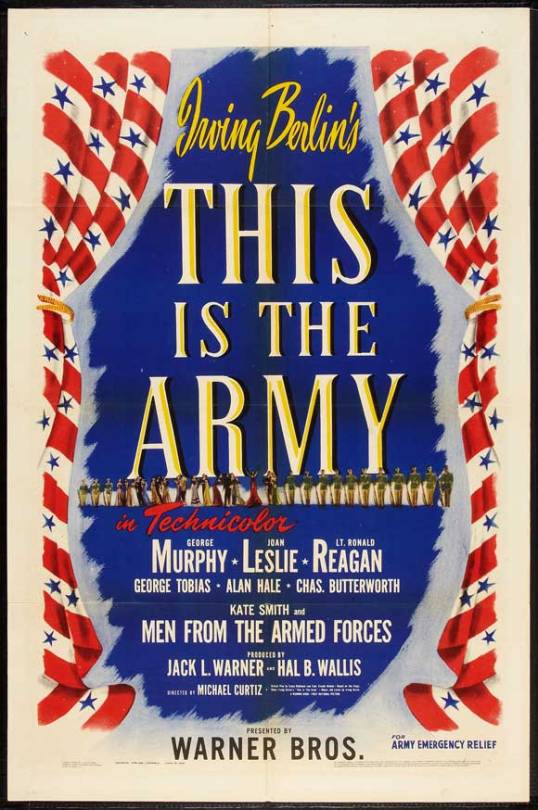
The Fabulous Forties #34: This Is The Army (dir by Michael Curtiz)


Titapos

The 34th film in Mill Creek’s Fabulous Forties box set is the 1943 musical, This is The Army.

This Is The Army is based on a Broadway musical that was specifically conceived and written by Irving Berlin as a way to boost wartime morale.  The show, which was a collection of patriotic songs and comedic skits, was performed by members of the U.S. Army.  The film version starts with dancer Jerry Jones (George Murphy) being drafted at the start of World War I and putting together an all-army revue called Yip Yip Yaphank.  (Interestingly enough, this was also the name of a real-life show that Irving Berlin put together during World War I.)  The show is a big hit and, when the soldiers in the cast receive their orders to head to France, they literally march off the stage and out the theater.  It’s actually a pretty rousing scene but it’s almost immediately followed by a very sad one, in which we learn that only three members of the cast survived the war.  Jerry Jones is shot in the leg and when he returns home, the former dancer now walks with a cane.

Twenty-five years later, another world war has broken out.  Jerry’s son, Johnny (Ronald Reagan), has joined the army.  Johnny is ordered to put together another revue, in the style of Yip Yip Yaphank.  At first, Johnny is reluctant but orders are orders.  Soon, Johnny and the cast of This Is The Army are touring the U.S. and even performing in front of President Roosevelt (played by Jack Young, though, from a historical perspective, wouldn’t it be neat if President Roosevelt had appeared as himself in a film with Ronald Reagan?).  Along the way, Eileen (Joan Leslie) tries to convince Johnny to marry her even though Johnny wants to wait until the war is over.

It’s really not much of a plot but then again, the film is about showcasing the musical performances.  The soldiers sing.  The soldiers dance.  The soldiers tell jokes and imitate people who were famous in 1943.  There are several scenes that attempt to wring laughs from soldiers dressed up like women.  What’s interesting is that, at a time when the army was still segregated, the performances in This Is The Army feature both white and black soldiers.  Irving Berlin apparently demanded that black soldiers be allowed to appear in both the stage show and the film and, as a result, the unit that performed This Is The Army was, for a time, the only integrated unit in the U.S. Army.

Of course, that makes it even odder that there’s an extended sequence in which white soldiers perform while wearing blackface and standing on a set that’s been designed to resemble a pre-Civil War plantation.  It’s a scene that pops out of nowhere and then it keeps going and going and going and I could only stare at the screen in shocked horror as it played out.  It’s an odd contradiction that the same Irving Berlin who demanded that black soldiers be honored on stage and screen was also apparently the same Irving Berlin was put a minstrel show sketch into the middle of This Is The Army. 

Interestingly enough, George Murphy later retired from acting and was elected to the U.S. Senate in 1964.  Murphy’s success inspired his co-star, Ronald Reagan, to run for governor.  If Murphy had never been a senator, Reagan would probably never have been a president.  Both Reagan and Murphy give likable performances in This Is The Army and it’s easy to see how that likability, while it may not have often translated into great acting, did eventually lead to political success.

This Is The Army is a time capsule film, one that is mostly interesting as a view into the psyche of 1940s America.  The humor is often corny and the storyline is predictable but there’s also a very sad subtext to the film.  Since both the film and the stage show were performed by actual enlisted men, you watch with the knowledge that some of the men singing and joking on stage won’t return from the war.  Often times, during the performances, we see random people in the audience crying as they realize the same thing.  Even in an otherwise light-hearted film, the sobering realities of life during wartime are right beneath the surface.