(With the Oscars scheduled to be awarded on March 4th, I have decided to review at least one Oscar-nominated film a day. These films could be nominees or they could be winners. They could be from this year’s Oscars or they could be a previous year’s nominee! We’ll see how things play out. Today, I take a look at the 1941 best picture nominee, Hold Back the Dawn!)
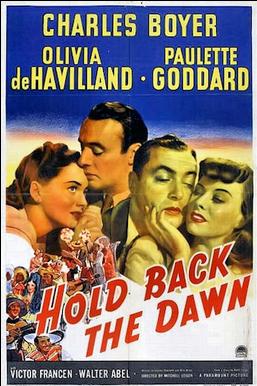
Hold Back The Dawn is a historically important film for many reasons.
First off, this was the last film to be written by Billy Wilder before he launched his own legendary directorial career and, with its mix of sharp comedy and tearful melodrama, Hold Back The Dawn definitely feels like a Wilder film. Wilder, himself, claimed that he was never happy with the way his script was adapted. For instance, Wilder wrote a scene in which Charles Boyer, playing a Romanian who is stranded in a Mexican border town, was meant to deliver a monologue to a cockroach. Boyer felt that the scene was ridiculous and the film’s director, Mitchell Leisen, never filmed it. Wilder was so incensed that he declared that he would never again allow any of his scripts to be filmed by anyone other than himself.
Hold Back The Dawn also played a part in one of the most legendary feuds in Hollywood history, though there are some who claim that it was more the product of an overzealous pr agent’s imagination than anything else. For her role as the shy school teacher with whom Boyer falls in love, Olivia de Havilland was nominated for Best Actress and was considered to be one of the front-runners for the reward. (If nothing else, it was felt that giving her the Oscar would make up for not giving it to her when she was nominated for Gone With The Wind.) However, that same year, Joan Fontaine was nominated for her role in Hitchock’s Suspicion and many felt that, after losing the previous year for her performance in Rebecca, Fontaine was owed an Oscar as well. An Oscar night, Joan Fontaine beat Olivia de Havilland. What complicated matters it that, beyond issues of professional jealousy, de Havilland and Fontaine were sisters. For years, there were stories that de Havilland had never gotten over losing her Oscar to Fontaine and that, as a result, the two sisters had little to do with each other. (The truth, as is always the case with siblings, appears to have been a lot more complicated. de Havilland herself said it was less about the Oscars and more about just not having much in common with her sister.)
Beyond all that, however, Hold Back The Dawn is a charming dramedy that holds up remarkably well. Boyer is Georges Iscoveu, a Romanian gigolo who has spent eight years living in a Mexican hotel, waiting to be allowed to enter the U.S. Olivia de Havilland is Emmy Brown, an unmarried teacher who has nearly given up on ever finding love. At first, Georges just wants to trick Emmy into marrying him so that he can legally enter the United States. However, he soon finds himself truly falling in love with her. Unfortunately, his partner-in-crime — Anita (Paulette Goddard) — is also in love with Georges and is not at all prepared to lose him to Emmy. I know it all sounds very melodramatic but Wilder frames his story with a meeting between Georges and a Hollywood producer, a move the assures us that Hold Back The Dawn is content to be pure entertainment and we really should just sit back, not get too caught up on the specifics of the plot, and enjoy ourselves. Charles Boyer is all befuddled charm as Georges while de Havilland is both poignantly likable as Emmy. For me, as good as they are, the best performance came from Paulette Goddard, who is sharp-tongued and wonderfully cynical as Anita. All three performers are helped by a wonderful script. Even if Boyer never does talk to a cockroach, Wilder’s dialogue is still sharp and witty. This is a film that is as much fun to listen to as it is to look at.
Hold Back The Dawn was nominated for best picture but lost to How Green Was My Valley.
This tribute Olivia de Havilland in Hold Back The Dawn was put together by Monique Classique for Olivia’s 100th birthday.


 Through the Shattered Lens