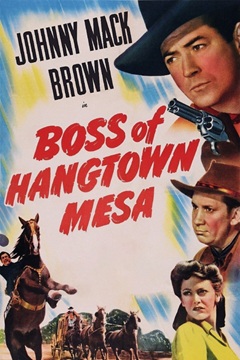
 The telegraph company has come to the frontier town of Hangtown Mesa and soon, the citizens will be connected to the rest of the world. The wealthy men who run the town don’t want that to happen because then people might discover how corrupt they are. They hire a gunman known as the Utah Kid (Hugh Prosser, not looking much like a kid) to come to town and kill the owner of the telegraph line, John Wilkins (Henry Hall). The Utah Kid steals the clothes of engineer Steve Collins (Johnny Mack Brown) and frames him for Wilkins’s murder. With the help Betty Wilkins (Helen Deverell) and traveling medicine man Dr. J. Willington Dingle (Fuzzy Knight), Steve sets out to clear his name.
This is a pretty good Johnny Mack Brown western. The plot isn’t half-bad as far as Poverty Row westerns are concerned and director Joseph H. Lewis keeps things lively. Lewis not only gets good performances from his cast but he also makes Hangtown Mesa seem like an actual, growing frontier town. Lewis even manages to create some suspense as The Utah Kid and Steve Collins switch identities. Comparing Lewis’s westerns to the ones directed by Sam Newfield shows how much difference a good director can make, even within the confines of a poverty row production. Even Fuzzy Knight is used well!
Boss of Hangtown Mesa is one of the better Johnny Mack Brown westerns, featuring a good story and an interesting idea behind it as it shows how far the bad guys will go to keep their own private fiefdom from connecting with the rest of the world. Brown is convincing, whether he’s riding a horse or holding a gun. He’s playing an educated man here, an engineer, but Brown is still a cowboy through-and-through.

 Through the Shattered Lens