Film Review: Unseen (dir by Yoko Okumura)


Up in Michigan, Emily (Midori Francis) is a doctor who has been kidnapped by her psychotic ex-boyfriend, Charlie (Michael Patrick Lane).  Charlie takes her to a cabin in the woods, where he ties her up and brags about the revenge that he’s going to take on her.  Emily manages to break free and temporarily incapacitate Charlie but, in the process, she breaks her glasses.  Nearly blind, Emily stumbles out into the wilderness.  Despite not knowing where she is and not being able to see more than a few inches in front of her, Emily has to find her way back to civilization before Charlie finds her.

Down in Florida, Sam (Jolene Purdy) arrives for another day of work at a gas station where she spends most of her time dealing with a broken Slurpee machine.  From the start, it’s not a good day, with a rich woman named Carol (Missi Pyle) demanding a refund just because she accidentally put the cheapest brand of fuel into her BMW.  Sam finds herself looking down at the card that she has from the suicide prevention hotline and we immediately know that Sam is not happy with her life.  Then, suddenly, her phone rings.

Emily and Sam don’t know each other but when Emily tries to use her phone to call for help, Sam is the one who ends up getting the call.  Once Sam realizes that Emily is being stalked by her murderous ex, Sam agrees to become Emily’s eyes through video call.  Sam guides Emily through the woods, keeping her informed of whether or not Charlie is nearby.  Along the way, they talk about their different lives and how they came to be in their current situations.  Sam gives Emily the strength to keep fighting for her survival while Emily gives Sam a reason to keep on living.  And while Emily is having to constantly deal with Charlie and his attempts to re-capture her, Sam has to deal with things like exploding slushee machines, a dying phone battery, and eventually Carol and an apparently insane (and heavily armed) man who appears to be her husband.

Unseen is a bit of a disjointed film.  The scenes in Michigan are very serious and very intense, with Emily suffering serious injury as she flees from Charlie.  At one point, Emily begs Sam to call her mom so that Emily can say goodbye to her and it’s a genuinely emotional scene.  At the same time, the scenes in Florida are often broadly comedic, with Sam sliding across the floor and, at one point, locking herself behind bullet-proof glass while Carol and her husband, who is dressed like a yacht captain, scream at her to come out.  The tonal shifts between the two locations can be a bit jarring but the film is still effective, largely due to the sincerity of the performances of Midori Francis and Jolene Purdy.  Their friendship feels real and it’s hard not to get a little misty-eyed at the film’s final moments.

Unseen deserves a lot of credit for only being 76 minutes long.  It tells its story quickly and without any unnecessary padding.  This is a film that does not waste any time getting to the point and, in this time when even the simplest of genre films will often run for more than two hours, it’s hard not appreciate the nicely paced efficiency of Unseen.
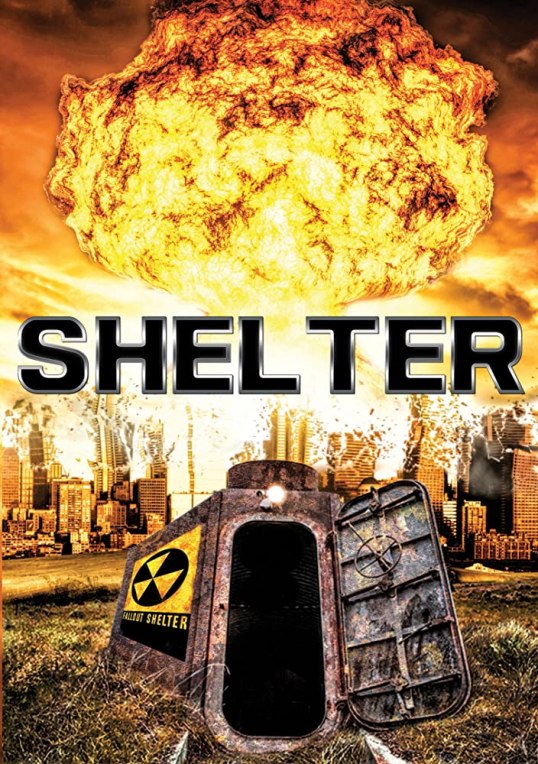
Film Review: Shelter (dir by Wrion Bowling and Adam C. Caudill)


The 2012 film, Shelter, opens in an ominous and sterile-looking room.  There are bunk beds.  There are shelves that appear to be full of supplies.  There’s a table where people could possibly sit down and talk or play cards.  There’s a shower stall, with a shower curtain providing a little bit of privacy.

There are also several people in the room.  One woman is asking what they’re going to do.  In the shower, another woman is crying.  We can tell by looking at the inhabitants of the room that they’ve been in the room for a while and that they’re all losing whatever grip they once had on sanity.

And really, even though we don’t know what’s going on, we can all relate.  We can probably relate better in 2020 than audiences could in 2012.  Most of us have, in one way or another, been sheltered in place since at least March and — surprise!  — it turns out that all of those “We’re all in this together” commercials didn’t make anyone feel any better about the idea of not even being able to go outside without having to first put on a mask.  It’s not just the feeling of claustrophobia or humanity’s natural inclination to resent being ordered around.  It’s also that it’s hard to be happy when you don’t have the freedom to live your own life.  When someone is continually told that what they want isn’t important and that their fate is in the hands of some unseen regulator, who can blame them for going a little crazy?  That certainly would appear to be the situation in which the characters in Shelter have found themselves.

The film flashes back to the day that five strangers first found themselves locked away in the shelter.  They entered the room because an alarm went off.  None of them knew what the room was but, shortly after entering, they heard an explosion and felt the ground shake.  On a monitor, they saw a bright flash of light apparently vaporize the city above them.  They also found a note that explained that the room was designed to provide safety from a nuclear attack.  According to the note, they had enough food to last for several years.  Of course, the note also stated that the shelter was built and stocked with two inhabitants in mind, as opposed to five.

We follow the five survivors as they get to know each other and as they adjust to life in the shelter.  It doesn’t take long for them to settle into their new routine.  There’s really nothing else for them to do but accept the situation.  The room is locked and the doors are not going to open until a computerized system determines that it’s safe for the inhabitants to leave.  They’re stuck together so they might as well play cards and just wait it out.

Of course, things don’t work that smoothly.  The hours turn into days and the days turn into months and soon, petty annoyances become major disagreements.  Some of the survivors seem to be content with the idea of staying in the shelter forever while others think about escape.  Some start to wonder if there’s even actually been a war….

Shelter is a good thriller about human nature and just how much isolation and claustrophobia someone can take before they snap.  The characters are all well-defined and well-acted and the film made good use of its low-budget, with that sterile bunker ultimately becoming as much of a character as the people trapped inside of it.  The film ends with a twist that, while not completely unexpected, was still satisfying nonetheless.

Shelter‘s on Prime so watch it the next time you’re feeling trapped.