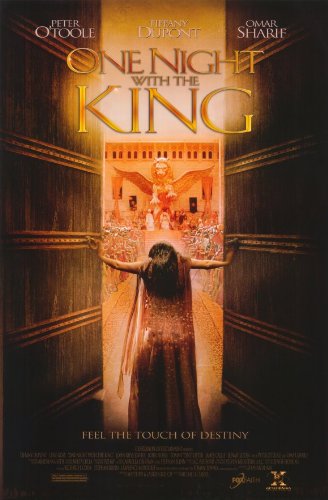
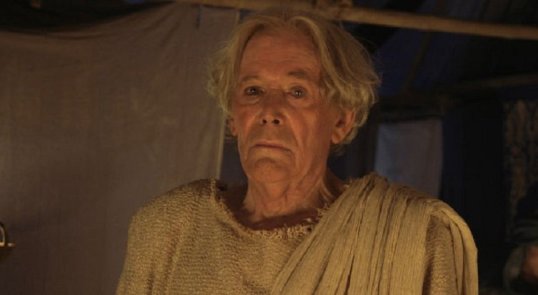
The 2006 Biblical film, One Night With The King, opens with God ordering King Saul to conquer and execute all of the Amalekites and their livestock. However, as so often happened whenever God ordered him to do something, Saul manages to screw everything up. He does conquer the Amalekites but he decides to keep their best livestock for himself and he also declines to execute the Amalekite king or his pregnant wife. The prophet Samuel (played by an uncomfortably frail-looking Peter O’Toole) shows up and tells Saul that he’s screwed up for the last time. Samuel goes off to execute the Amalekite king. However, the queen escapes into the desert.
And that’s the last we see of her. It’s also the last we see of O’Toole who, despite being top billed, has about a minute of screen time.
Jump forward several hundred years. We are now in the city of Susa, Persia. It’s the center of the known world. We know this because characters tend to say stuff like, “We are living in the center of the known world.” Xerxes (Luke Goss) is the king of Persia, a somewhat uncouth man who is obviously used to getting everything that he wants. Xerxes is plotting on marching off to war. However, his current wife is opposed to the war and refuses to attend Xerxes’s pre-war banquet. Scandal! Xerxes’s advisor, Prince Memucan (Omar Sharif, who co-starred with Peter O’Toole in Lawrence of Arabia), suggests that perhaps Xerxes should get a new wife.
Every female virgin in the city is brought to Xerxes’s palace so that, under the watchful eye of the king’s eunuch, Hegai (Tommy Lister, Jr.), they can compete for the chance to become queen. Among the women is the beautiful Hadassah (Tiffany Dupont), who is the niece of one of the king’s scribes, Mordecai (John Rhys-Davies). Hadassah does not tell the king that she’s related to Mordecai and instead says that her name is Esther. With the help of Hegai, Hadassah soon emerges as the favorite to become the new queen.
Meanwhile, an evil man named Haman (Boo! Haman! Boo!) has shown up on the scene. Haman (played by James Callas) is a descendant of the Amalekites that Saul failed to destroy. (Dammit, Saul!) A greedy astrologer, Haman (Boo!) has been appointed to the position of vizier by Xerxes. Haman (hiss!) demands that all of the king’s servants bow before him. However, because he has a pagan symbol sewn onto his clothes, Mordecai refuses to do so. Driven by hate (Boo!), Haman makes plans to execute not only Mordecai but every other Jew in Persia. With the king unaware of Haman’s intentions, only Hadassah can stop his plans but to do so, she’ll have to risk seeing the king unsummoned….
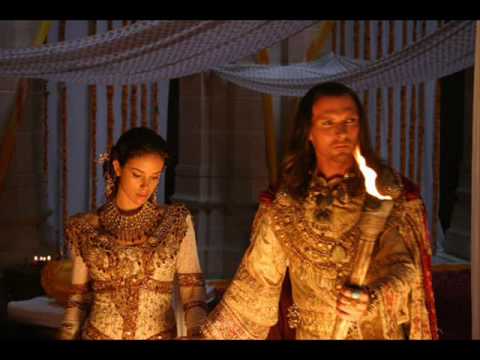
The story of Esther, Mordecai, the king, and the moment that Haman (Boo!) discovers that karma is a bitch has always been one of my favorites so I’ve always enjoyed One Night With The King whenever I’ve watched it. Don’t get me wrong. It has its flaws. Though the film does a pretty good job of recreating the past on a low budget, it’s still one of those films that’s full of awkward exposition, cringe-worthy dialogue, and more than a few inconsistent performances. (Sharif and O’Toole, for instance, both go through the motions, doing just enough to pick up a paycheck.) At the same time, Luke Goss is properly rough-around-the-edges as the king and Tiffany DuPont is well-cast as Hadassah. Tommy Lister, Jr. appears to be having a lot of fun in the role of the world’s most unlikely eunuch and, as a result, he’s entertaining to watch. Visually, it’s a pretty film and the costumes are to die for, as they should be in any film about a royal romance. And, even if the story is at times awkwardly told, it still reaches a deeply satisfying conclusion.
James Callas is convincingly evil and properly detestable as Haman (Boo! Haman! Boo!). Haman is an archetype of evil, the ant-Semite whose evil legacy has continued to haunt the world in the centuries since he met his own fate. Though the film at times spends too much time playing up the romance between the king and Hadassah (which, while nice to watch, is not the point of the source material), One Night With The King does include enough scenes of Haman (hiss!) ranting to make clear the link between Haman and the anti-Semitism of the Nazis and those modern day hate mongers who try to hide their bigotry behind claims that they are “only criticizing Israel.” Haman’s evil makes his final fate all the more satisfying but the film leaves no doubt that, unless the world remains vigilant, there will always be new Hamans threatening to come to power. That’s an important enough message to make up for many of the film’s missteps.
One Night With The King is a flawed, low-budget film. But I like it.


 Through the Shattered Lens