October Positivity: Thy Neighbor (dir by George A. Johnson)


2017’s Thy Neighbor led me to spend way too much time thinking about neighborhood hot tub etiquette.

Amber Reynolds (Jessica Koloian) is the wife of pastor Zach Reynolds (Nathan Clarkson).  Zach used to be fat.  Zach used to pick fights and carry a gun.  However, Zach lost a ton of weight, wrote a book about how he got thin and conquered his anger issues, and is now something of a celebrity.  He’s been invited to be the new pastor at the local megachurch and, upon moving into their new home, Amber makes it a point to bake cookies for all of her new neighbors.  One of the neighbors (Dave Payton) — who is simply called The Neighbor for the majority of the film — doesn’t care much for church but he sure does like those cookies.  Zach thinks that the Neighbor is creepy and he doesn’t want Amber having anything to do with him.  Amber thinks that the Neighbor needs someone to talk to so she invites him to come relax in the hot tub with her.

Seriously….

My neighbors across the street have a hot tub and I’ve pretty much got an open invitation to use it whenever I want.  Many a night, we’ve all relaxed in the hot tub and talked about whatever we felt like talking about at the time.  But I’m also extremely close to my neighbors.  I have a lot in common with my neighbors, as we all graduated from the same college and we tend to have similar cultural and political outlooks.  They’re friends, along with being neighbors and it also helps that we all look in our swimsuits.  And even so, they still got to know me a little before they said, “Hey, feel free to come use our hot tub whenever you feel like it.”  My point is that I have a hard time buying that anyone, regardless of how nice they are or how much they want to help their husband win points around the neighborhood, would invite a total stranger to strip down and join them in the hot tub.  That’s especially true when you’re the mother of a young son and your husband is away from the house and when the stranger in question is kind of creepy and bizarrely aggressive in the way that he talks to people.

Zach is not amused to return home and find the Neighbor in the hot tub.  After the Neighbor leaves, Amber argues that Zach needs to make an effort to reach out to everyone, even creepy people like The Neighbor.  As for The Neighbor, he starts trying to break up Zach and Amber’s marriage by trying to get Zach to lose his temper and trying to convince Amber that Zach is having an affair with a church secretary….

This is not a typical faith-based film.  It’s a thriller, one that conveys its message with a minimum amount of preaching and which features a trio of strong performances from Koloian, Clarkson, and Payton.  The film argues that everyone should be treated with kindness while, at the same time, acknowledging that some people are very, very annoying.  The Neighbor is a total creep but he’s also someone who appears to have spent a good deal of his life being victimized.  Unusually for a film of this sort, Thy Neighbor ends on a rather dark and melancholy note, again acknowledging that things are not always as easy as the movies would have us believe.  Amber is determined to be kind while Zach cannot let go of his suspicions.  In the end, it’s obvious that it’ll take more than a few hours in the hot tub to fix these broken souls.
 

Music Video of the Day: Bluer than Blue by Michael Johnson (1978, directed by ????)


On August 1st, 1980, MTV premiered and played a total of 116 music videos over a 24 hour period.  The 18th video that they played was for Michael Johnson’s Bluer than Blue, which features the singer singing about a failing relationship in a blue-tinged house.

This was an early music video, made three years before MTV even premiered so it looks fairly primitive to modern eyes.  It’s still a step up from the performance clips that were used for most music videos during the late 70s.  It actually has a narrative, albeit a simple one.

Enjoy!

The First Videos Shown on MTV:

  1. Video Killed the Radio Star by the Buggles
  2. You Better Run by Pat Benatar
  3. She Won’t Dance With Me by Rod Stewart
  4. You Better You Bet By The Who
  5. Little Suzi’s On The Up by PH.D
  6. We Don’t Talk Anymore by Cliff Richard
  7. Brass in Pocket by Pretenders
  8. Time Heals by Todd Rundgren
  9. Take It On The Run by REO Speedwagon
  10. Rockin’ in Paradise by Styx
  11. When Things Go Wrong by Robin Lane & The Chartbusters
  12. History Never Repeats by Split Enz
  13. Hold On Loosely by .38 Special
  14. Just Between You And Me by April Wine
  15. Sailing by Rod Stewart
  16. Iron Maiden by Iron Maiden
  17. Keep On Loving You by REO Speedwagon

Cleaning Out The DVR, Again #8: Anne of the Thousand Days (dir by Charles Jarrott)


Anne

After I finished writing my review of Rolling Thunder, I continued the process of cleaning out my DVR by watching the 1969 film, Anne of the Thousand Days.  How does a film like Anne of the Thousand Days compare to a film like Rolling Thunder?

They might as well have been conceived, written, directed, and released on different planets.

I recorded Anne of The Thousand Days off of TCM on March 26th.  The main reason that I set the DVR to record it was because Anne was a best picture nominee.  It may seem strange to think that this rather conventional film was nominated the same year as Butch Cassidy and the Sundance Kid, Z, and Midnight Cowboy.  It gets even stranger when you consider what wasn’t nominated that year: Medium Cool, If…, Last Summer, They Shoot Horses, Don’t They?, Alice’s Restaurant, The Wild Bunch, Once Upon A Time In The West, and a long list of other films.  In fact, if I wanted to, I could probably spend this entire review listing all of the 1969 films that feel like a more appropriate best picture nominee than Anne of the Thousand Days.

And yet, Anne was nominated for best picture.  In fact, it received a total of 10 Oscar nominations, the most of any film that year.  Tellingly most of the nominations were in the technical categories and the only Oscar that it won was for its costumes.  Genevieve Bujold received a nomination for playing the title character and Richard Burton became the third actor to receive a nomination for playing King Henry VIII.

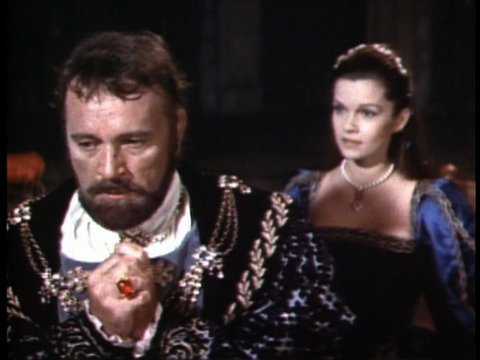
As for the film, Anne of the Thousand Days tells the oft-told story of King Henry VIII and his marriage to Anne Boleyn.  Told in flashback as both Henry and Anne wait for her to be executed on charges of adultery, the film shows us how middle-aged Henry VIII first met and fell in love with 18 year-old Anne Boleyn.  Standing in the way of Henry’s pursuit of Anne was the fact that 1) Anne intensely disliked him, 2) Anne was already engaged, 3) Anne’s sister was already Henry’s mistress, and 4) Henry was already married to Catherine of Aragon (Irene Papas).

Fortunately, Henry happens to be king and being king comes with its perks.

For instance, as king, he can order Anne and her fiancée to break up.  As king, he can casually dismiss his former mistress.  And, as king, Henry has the power that Anne finds to be the ultimate aphrodisiac.  At first, Anne merely loves the fact that Henry is obsessed with her.  But slowly, she comes to love Henry as a man as well…

The only problem is that Henry is still married and Catherine is still popular with the people.  Even after Henry divorces her and marries Anne, the common people refuse to accept Anne as their queen.  When Sir Thomas More (William Squire) refuses to recognize Anne as queen, Anne demands that More be executed.  When Henry initially shows reluctance, Anne announces that she will not sleep with him until More is dead.

Needless to say, Thomas More is quickly executed.

However, Henry’s attention has already moved on to Jane Seymour (Lesley Paterson) and, desperate to get Anne out of his life, he arranges for Cardinal Cromwell (John Colicos) to frame Anne on charges of adultery and incest.  With Anne facing a humiliating trial and the possibility of execution, Henry makes her an offer.  If she agrees to an annulment, he’ll free her.  However, their daughter — Elizabeth — will lose her claim to the throne…

It’s telling that Charles Jarrott did not receive an Oscar nomination for his work as Anne of the Thousand Day‘s director.  There are a lot of technically good things about Anne of the Thousand Days but, despite all of the melodrama and sex and historical detail to be found in Anne, it never comes to life as a movie.  The costumes are to die for, the sets are impressive, and the cast is full of talented British character actors but the whole movie just feels oddly flat.  Try as it may, it can never convince us that either Henry VIII or Anne Boleyn is worth all the trouble.

Anne of the Thousand Days was obviously a big production, which probably explains all the Oscar nominations.  But otherwise, it’s one of the more forgettable best picture nominees.

Film Review: All The Wilderness (dir by Michael Johnson)


All the Wilderness

I recently watched an excellent little film called All The Wilderness.

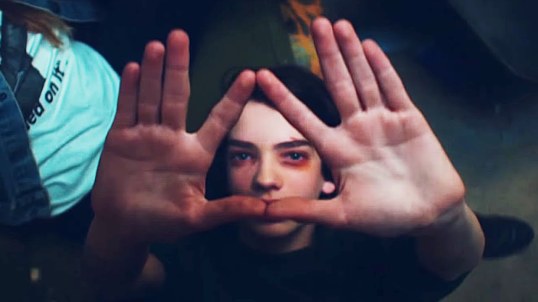
James Charm (Kodi Smit-McPhee) is a shy and withdrawn teenager who is still struggling to deal with the recent death of his father.  He spends his time wandering around the forest surrounding the house where he lives with his mother (Virginia Madsen).  Occasionally, he makes his way into the nearby city and aimlessly wanders through the desolate streets.  In his spare time, he sketches pictures of dead animals and tells people that he can predict when they are going to die.  When he informs the local bully that he’s going to die in just a few more days, the bully responds by punching James in the face.

Sometimes, James visits a therapist (Danny DeVito) who seems to alternate between concern and indifference.  One day, while sitting in the waiting room, James meets Val (Isabelle Fuhrman), who is dealing with her parents’ divorce and spends her time making and selling eccentric doughnuts.  James likes Val but he’s too scared to open up to her.  Some of that may have to do with the mysterious, hooded figures who occasionally materialize out of thin air and pursue him through the streets.

After sneaking out of one unproductive therapy session, James discovers a mysterious man named Harmon (Evan Ross) playing a piano in a courtyard.  Later, after his hamster mysteriously dies, a distraught James sneaks out of his house, makes his way down to the city, and gets on a bus.  Sitting across from him is none other than Harmon.

Harmon invites James to follow him on a trip into the hidden corners of the city.  Soon, James is discovering that the wilderness is not only limited to the countryside surrounding his mother’s house.  There’s also an urban wilderness and, with Harmon as his guide, James starts to discover it.  And yet, even as James starts to find happiness, those hooded figures continue to follow him…

All The Wilderness reminded me a lot of last year’s underappreciated California Scheminganother atmospheric look at alienation that was full of existential dread.  All The Wilderness is probably not a film for everyone.  Not only is it extremely stylized but it’s also a bit too short.  All The Wilderness is one of the few films that could actually benefit from an additional 30 minutes added to its running time.

And yet, flaws and all, All The Wilderness is a great film and one that everyone should take the time to see.  It is perched so precariously between being insightful and being pretentious that it becomes oddly compelling to watch the film’s valiantly struggle to maintain its balance.  Visually, this is an incredible film just to look at, with the constantly moving camera capturing images of ominous yet undeniably beautiful urban decay.  In small roles, both Danny DeVito and Virginia Madsen are well-cast while Evan Ross is appropriately charismatic as Harmon.  Finally, Kodi Smit-McPhee — all grown up from his heartbreaking performances in The Road and Let Me In — gives a wonderful and versatile performance in the lead role.

All The Wilderness is a film that deserves to be seen.